
ChatGPT SEO is the work of getting ChatGPT to mention, cite and recommend your brand when buyers ask it for options. ChatGPT answers from live web search and from what it learned in training, so the levers are crawler access for OpenAI’s bots, pages that answer buyer questions with evidence, and mentions of your brand on sites it already trusts.
The phrase is also used for the opposite job, using ChatGPT as a tool to do SEO research. We covered that in how to use ChatGPT for SERP opportunity discovery. This guide is about being found inside ChatGPT.
Why ChatGPT is worth the effort
ChatGPT passed 900 million weekly users in February 2026 and was reported to be nearing one billion by July. A share of those conversations are buying questions: which tool, which agency, which clinic, which course.
The visits it sends are still few, and the evidence on their quality is mixed. Ahrefs reported that AI search drove 0.5% of its visitors and 12.1% of its signups over a 30-day window in 2025. A separate study covered by Search Engine Land found referrals from language models converting below Google search. The honest position is that results depend on your category, which is why step six below is measurement.
There is a second effect that never shows in analytics. A buyer who asks ChatGPT for a shortlist and sees three names will often search those names on Google next. If you are not on the list, you are not in that later search either.
How ChatGPT decides what to cite
ChatGPT has two sources of knowledge, and they behave differently.
Live search. When a question needs current information, ChatGPT searches the web and shows links to its sources. OpenAI says ChatGPT search draws on third-party search providers and its own crawling. Pages are found by a crawler named OAI-SearchBot.
Training data. The model also carries what it learned before its cutoff date. This is where its sense of “well-known brands in this category” comes from. You cannot edit it. You can influence the next version by being written about widely and consistently today.
OpenAI documents three separate bots, and mixing them up is the most common technical mistake we see.
| Bot | What it does | If you block it |
|---|---|---|
| OAI-SearchBot | Finds and indexes pages for ChatGPT search results | Your pages may not appear as sources in ChatGPT search |
| GPTBot | Collects content that may be used to train future models | Your content is kept out of training. Search inclusion is a separate setting |
| ChatGPT-User | Fetches a page when a user asks ChatGPT to open or read it | ChatGPT cannot read your page when a user shares the link |
Step 1: let the right bots in
Open yourdomain.com/robots.txt. If you see a rule that disallows OAI-SearchBot or all bots, ChatGPT search cannot use your pages. To allow search while keeping your own choice on training, the file needs these lines:
User-agent: OAI-SearchBot
Allow: /

User-agent: ChatGPT-User
Allow: /
Then check the layers robots.txt does not show. Security plugins and CDN bot protection often block AI crawlers by default. In your CDN dashboard look for a setting called AI bots or AI crawlers and make sure search bots are permitted. Finally, confirm that your important content is in the HTML and not loaded only by JavaScript after the page opens, since crawlers may not run scripts.
Step 2: write the buyer prompt list
Before changing any content, find out what ChatGPT says today. Write 20 prompts across five types:
- Category: “best accounting software for a small manufacturer in India”
- Comparison: “Zoho Books vs Tally for a 20-person company”
- Problem: “how do I reduce GST filing errors”
- Local: “good physiotherapy clinic in Noida Sector 62”
- Brand: “is [your brand] any good” and “[your brand] pricing”
Run each one in a fresh chat with search on. Note which brands are named, which sites are linked, and what is said about you. The linked sites are your target list for step four. This is the same method we use in our free AI visibility audit: 20 buyer prompts across four assistants.
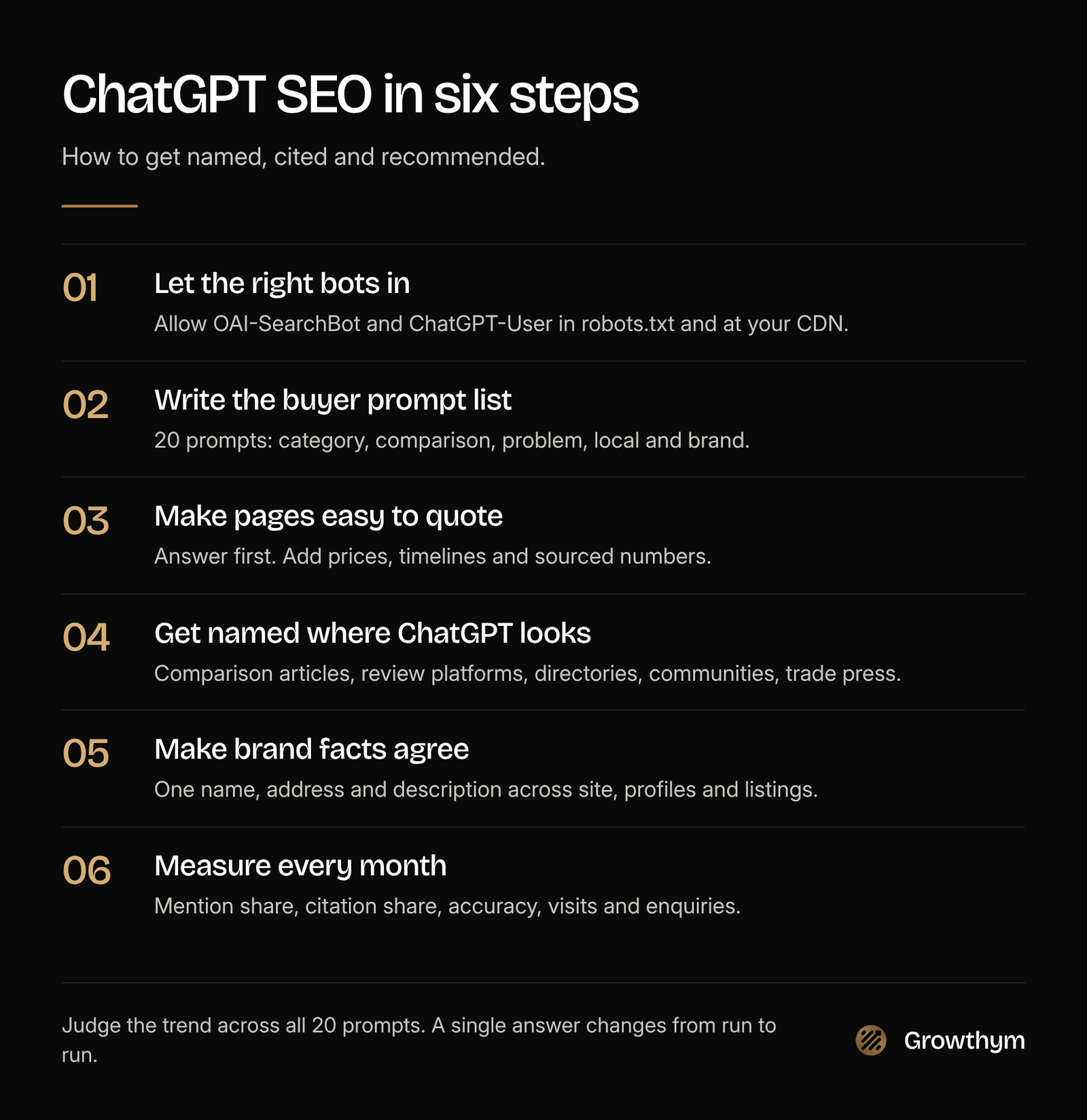
Step 3: make your pages easy to quote
A language model picks passages it can lift cleanly. Research on generative engine optimization found that adding statistics, quotations and cited sources raised a page’s visibility in generated answers by up to 40%. So for each page that matches a prompt on your list:
- Answer the question in the first 40 to 60 words.
- State specifics a model can repeat: price ranges, timelines, sizes, locations served, who it is for.
- Give numbers a source and a date.
- Use a table when you compare options and a numbered list for steps.
- Add a short FAQ built from real sales questions.
Pricing pages, comparison pages and “who is this for” pages matter most, because those are the facts buyers ask for. If ChatGPT cannot find your price range, it will describe a competitor’s.
Step 4: get named where ChatGPT looks
Your own website is one voice. An assistant gives more weight to what many sources agree on. An Ahrefs study of 75,000 brands found that brand mentions across the web had the strongest correlation with visibility in Google’s AI Overviews, ahead of backlinks. That study covers Google and not ChatGPT, but the logic carries over: an assistant can only recommend names it has read about.
Work through the sources from your prompt list in this order:
- Comparison and “best of” articles that already rank for your category. Ask to be considered, and give the writer facts they can use.
- Review platforms for your industry, such as G2 and Capterra for software, Clutch for agencies, Practo for clinics.
- Directories and listings with accurate details, including Google Business Profile.
- Community threads on Reddit and Quora where your category is discussed. Answer as yourself, with your name.
- Trade publications and podcasts. One interview on a respected industry site outweighs fifty directory links.
Step 5: make your brand facts agree everywhere
Models merge what they read. When your address, category or founding year differs between sources, the answer becomes vague or wrong. During our own audit in November 2026 we found the PIN code on our Google Business Profile did not match the one on our website. Small, and exactly the kind of conflict that weakens an entity.
Check these against each other: your About page, footer, Business Profile, LinkedIn company page, directory listings and Organization schema. Use one company name, one description of what you do, one address format. We go deeper on this in our entity SEO guide.
Step 6: measure every month
| What to track | How | Why it matters |
|---|---|---|
| Mention share | Out of 20 prompts, in how many is your brand named | The base measure of visibility |
| Citation share | In how many is your site linked as a source | Shows whether your pages are being used |
| Accuracy | Is what it says about your price, services and location correct | Wrong facts lose deals quietly |
| Referral visits | GA4 traffic where the source is chatgpt.com | Links from ChatGPT carry a utm_source of chatgpt.com |
| Enquiries | Form fills and calls from those visits | The number the business cares about |
Run the full prompt list monthly and compare totals. A single answer changes from one run to the next, so one good or bad reply proves nothing.
Want the baseline done for you? We run 20 buyer prompts across ChatGPT, Gemini, Claude and Perplexity and send your top five fixes in five working days. Free.
Mistakes that waste the effort
- Publishing volume. Fifty AI-written articles add nothing a model has not already read. One page with original numbers does more.
- Stuffing prompts into pages. Repeating “best CRM in India” twenty times did not work on Google and does not work here.
- Judging by one screenshot. Track shares across the full list over months.
- Ignoring Google. ChatGPT’s search layer depends on the open web being able to find and rank you. Classic SEO is still the base, as we explain in GEO vs SEO.
- Blocking everything. A blanket rule against AI bots removes you from the answers your buyers read.
This is the core of our AI search visibility service, run together with SEO so the two feed each other.
Frequently asked questions
Does ChatGPT use Google or Bing for search?
OpenAI says ChatGPT search uses third-party search providers together with its own crawler, OAI-SearchBot. It does not publish a full list. In practice, a site that is crawlable, indexed in the major search engines and open to OAI-SearchBot is eligible to be shown.
Will blocking GPTBot remove my site from ChatGPT?
No. GPTBot collects content for model training. Inclusion in ChatGPT search is controlled separately through OAI-SearchBot. OpenAI documents the two as independent settings, so you can opt out of training and still appear as a source in search answers.
How long does it take to appear in ChatGPT answers?
There is no fixed timeline. Answers that use live search can pick up an improved page within days or weeks of it being crawled. What the model knows from training changes only when a new model is released. Track your prompt list monthly.
How do I see ChatGPT traffic in Google Analytics?
In GA4, open Traffic acquisition and filter session source for chatgpt.com. ChatGPT adds a utm_source of chatgpt.com to the links it shows, so most visits are labelled. Create the same filter for perplexity.ai and gemini.google.com.
Is ChatGPT SEO different from normal SEO?
The base is the same: pages a crawler can read, clear answers and evidence. The differences are that you must allow OpenAI’s crawlers, mentions on other sites carry more weight, and you measure presence in answers across a prompt list instead of a ranking position.
Request the audit