
SEO earns rankings and clicks from search results. AEO shapes a page so a search engine can lift a direct answer from it. GEO earns mentions and citations inside answers written by ChatGPT, Gemini, Perplexity and Google AI Overviews. All three rest on the same base: crawlable pages, clear answers and evidence. What differs is what you measure.
The three terms get sold as three separate services. They are closer to three scoreboards for one body of work. This guide sets out what each one means, what the data says about the shift, and which to fund first.
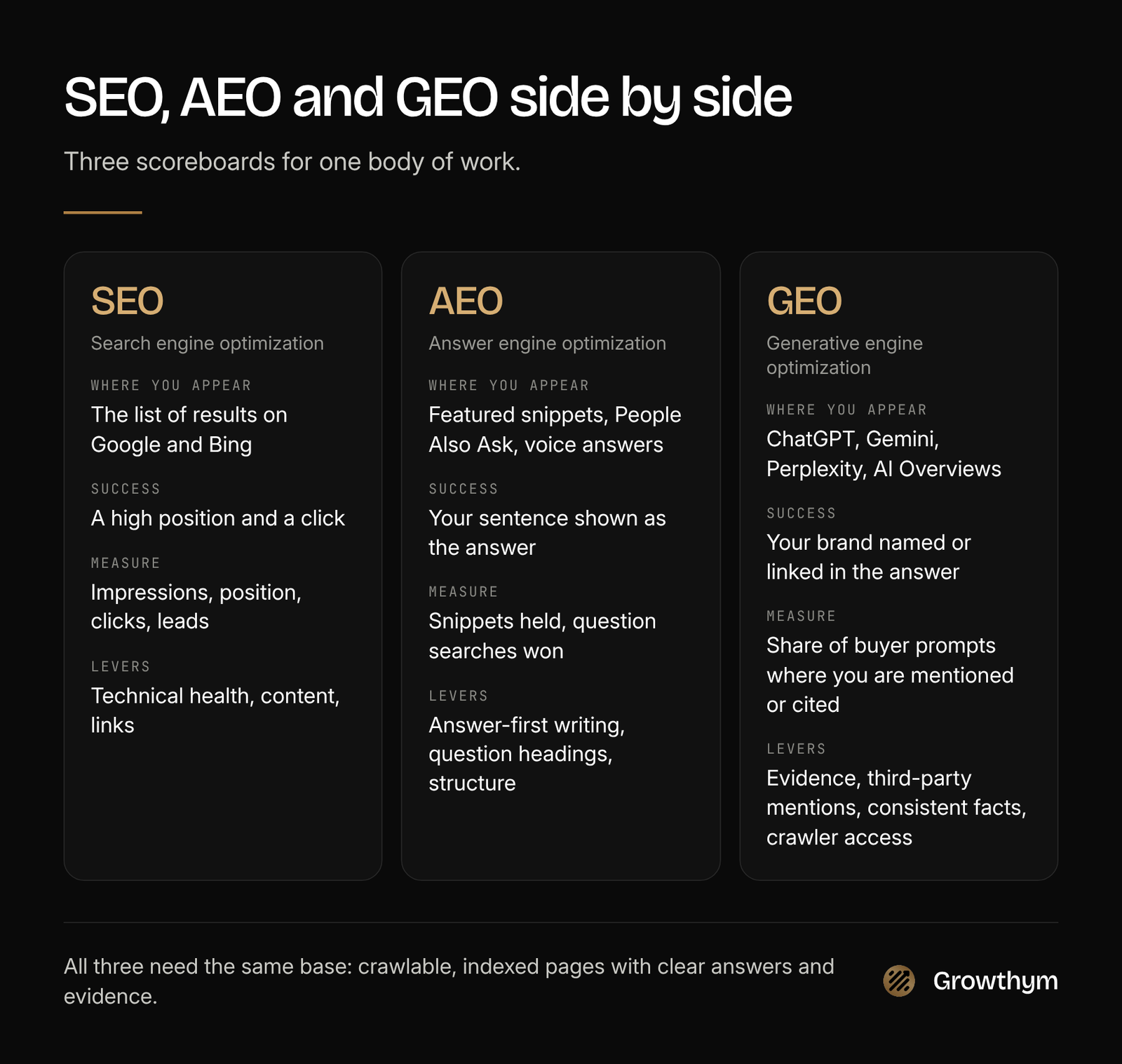
GEO vs SEO vs AEO: the difference in one table
| SEO | AEO | GEO | |
|---|---|---|---|
| Full name | Search engine optimization | Answer engine optimization | Generative engine optimization |
| Where you appear | The list of results on Google and Bing | Featured snippets, People Also Ask, voice answers | Answers from ChatGPT, Gemini, Perplexity, AI Overviews and AI Mode |
| What success looks like | A high position and a click | Your sentence shown as the answer | Your brand named or linked in the answer |
| What you measure | Impressions, position, clicks, leads | Snippets held, question queries won | Share of buyer prompts where you are mentioned, cited or recommended |
| Main levers | Technical health, content, links | Answer-first writing, question headings, structure | Evidence in content, third-party mentions, consistent brand facts, crawler access |
AEO and GEO overlap heavily, and plenty of people use them to mean the same thing. The useful distinction is that AEO grew up around Google lifting one answer from one page, while GEO deals with systems that read many pages and write a new answer.
Why the split matters now
Four numbers explain why this question went from theory to budget line.
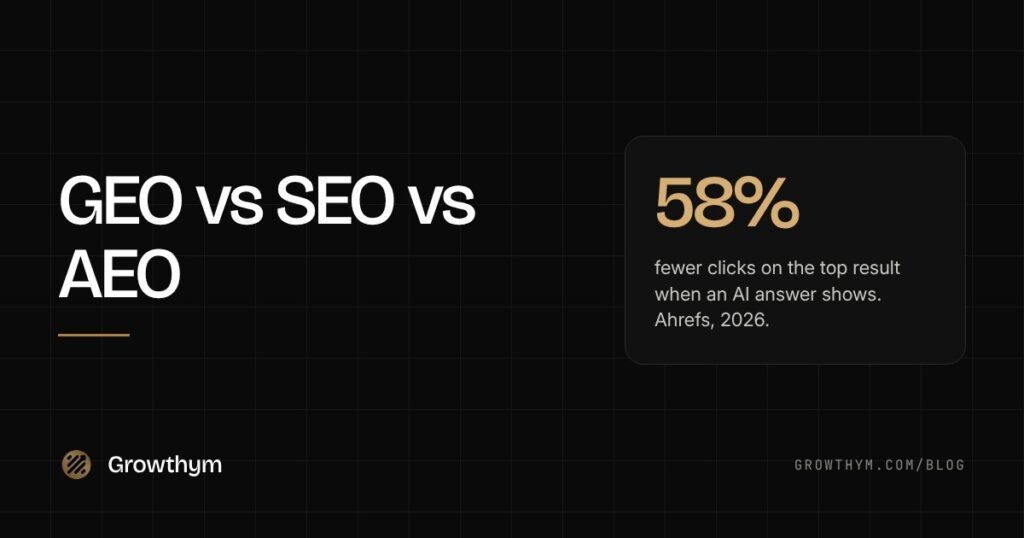
- Clicks on the top result have fallen by more than half where an AI answer shows. Ahrefs compared 300,000 keywords and found that the top-ranking page gets 58% fewer clicks when an AI Overview is present, measured between December 2023 and December 2025. Its earlier study in April 2025 put the drop at 34.5%.
- People stop at the summary. Pew Research tracked real browsing and found users clicked a result in 8% of visits when an AI summary appeared, against 15% when it did not.
- ChatGPT is now a mass habit. It passed 900 million weekly users in February 2026 and was reported to be close to one billion by July.
- Buyers ask AI for recommendations. In BrightLocal’s 2026 survey of 1,002 US consumers, 45% said they use ChatGPT or similar tools for local business recommendations, up from 6% a year earlier.
We see the same thing on our own site. Between August and November 2026 one of our articles held an average position of 8.5 and was shown 4,861 times in Google. It received 10 clicks. A page-one position used to be the finish line. On informational searches it is now the entry ticket.
What stays the same
The base work has not changed, and Google says so directly. Its documentation on AI features states there are no additional requirements to appear in AI Overviews or AI Mode. A page has to be indexed and eligible to show a snippet. No special schema or new file type is needed.
Ranking still helps, though less than it did. Ahrefs found that 38% of pages cited in AI Overviews also rank in the top ten for the same search, down from 76% in its earlier study. The reason is a technique Google calls query fan-out: the system runs several related searches behind your question and draws on pages that rank for those. So the citation often goes to the page that answers a sub-question well, not the page that ranks first for the head term.
If your site has indexing problems, thin pages or no links, fix those first. Nothing in GEO works on a page a crawler cannot read. Our guide on what to do when a website is not showing on Google covers that groundwork.
What changes with GEO
Three things carry more weight when the reader is a language model.
Evidence inside the content. The research paper that named the field, GEO: Generative Engine Optimization, tested content changes across thousands of queries. Adding statistics, quotations and cited sources lifted a page’s visibility in generated answers by up to 40%. Keyword stuffing did nothing.
What other sites say about you. An Ahrefs study of 75,000 brands found that mentions of a brand across the web correlated with AI Overview visibility more strongly than backlinks did. An assistant recommends names it has seen in many trusted places: review sites, industry lists, news coverage, forums.
Access for the right crawlers. ChatGPT search relies on a crawler called OAI-SearchBot and Perplexity uses PerplexityBot. Many sites block these by accident through a security plugin or a CDN setting. Our ChatGPT SEO guide shows how to check.
Where AEO fits
AEO is the writing discipline that serves both of the others. In practice it means:
- A direct answer of 40 to 60 words at the top of the page, before any background.
- Headings phrased the way people ask: “How much does X cost?”, “Is X better than Y?”
- One idea per paragraph, with tables for comparisons and numbered lists for steps.
- A short set of real questions at the end, taken from People Also Ask and from sales calls.
A page written this way can win a featured snippet, be quoted in an AI Overview and be summarised accurately by ChatGPT. That is why we treat AEO as a standard for every page and not a separate project. The step-by-step version is in how to rank in AI Overviews.
Which should you fund first?
| Your situation | Start with | Why |
|---|---|---|
| New site, or many pages not indexed | SEO | Assistants and Overviews draw on indexed pages. No index, no citation. |
| You rank on page one but clicks are falling | AEO on existing pages | Rewriting the top of each page to answer first is the fastest way into the AI answer. |
| Buyers in your category ask AI for shortlists (software, agencies, clinics, courses) | GEO measurement, then mentions | You need to know which brands the assistants name today and why. |
| Local business with few reviews | Local SEO | Reviews and a complete Business Profile feed both Maps and AI recommendations. |
For most businesses the split is not either-or. Keep the SEO programme, apply AEO standards to everything you publish, and add a monthly GEO measurement so you can see whether assistants are naming you.
See what the assistants say about you today. Our free AI visibility audit runs 20 buyer prompts across four assistants and returns your top five fixes in five working days.
A 30-day starting plan
- Week 1: baseline. Write 20 prompts a buyer would type, such as “best payroll software for a 50-person company in India”. Run each in ChatGPT, Gemini, Perplexity and Google AI Mode. Record who is named, who is linked and what sources are quoted.
- Week 2: access and indexing. Check robots.txt and your CDN for blocked AI crawlers. Clear indexing errors in Search Console.
- Week 3: rewrite your ten most important pages. Put the answer first. Add specifics: prices, timelines, numbers with a source and a date.
- Week 4: earn five mentions. Target the sources the assistants quoted in week 1. Get listed, reviewed or interviewed there.
Repeat the baseline every month. Answers vary from run to run, so judge the trend across all 20 prompts and not a single reply.
How to measure GEO without fooling yourself
Rankings do not exist inside a chat answer, so use three simple shares across your prompt list: how often you are mentioned, how often you are linked as a source, and how often you are the recommended option. Track the same shares for two competitors.
Then connect it to revenue. In GA4, filter referral traffic from chatgpt.com, perplexity.ai and gemini.google.com and compare its enquiry rate with organic search. Ahrefs reported that AI search sent 0.5% of its visitors but 12.1% of its signups in mid-2025. Your numbers will differ, and volumes are small today, but that is the comparison that tells you what the work is worth.
This is the work we do under generative engine optimization, alongside classic SEO services, as one organic growth programme.
Frequently asked questions
Is GEO replacing SEO?
No. GEO depends on SEO. AI Overviews and assistants draw on pages that are crawlable and indexed, and Google states that no special optimisation is needed beyond normal SEO practice. GEO adds evidence in content, third-party mentions and measurement of AI answers on top.
Is AEO the same as GEO?
They overlap. AEO began as writing for featured snippets and voice answers, where one page supplies one answer. GEO covers systems that read many sources and write a new answer. The writing standard is the same, so many teams treat them as one practice.
Do I need an llms.txt file?
Google says you do not need new machine-readable files or special markup to appear in AI Overviews or AI Mode. Other AI companies have not published it as a requirement either. Fix crawling, indexing and content first.
How do I track whether AI tools mention my brand?
Write 20 prompts your buyers would type, run them monthly in ChatGPT, Gemini, Perplexity and Google AI Mode, and record how often you are named, linked and recommended. Add GA4 referral reports for chatgpt.com and perplexity.ai to see visits and enquiries.
How long does GEO take to show results?
Pages that are already indexed can appear in live-search answers within weeks of being improved, since those answers use current web results. What a model knows from training changes much more slowly and cannot be scheduled. Measure monthly and judge after a quarter.
Request the audit