
Organic lead generation means earning enquiries from search, AI assistants, content and referrals without paying for each click. It works when three parts are joined up: pages that match what buyers search, proof that makes them trust you, and an easy way to enquire. Most sites have traffic on one set of pages and forms on another.
We learned this on our own site. In the three months to 19 November 2026, growthym.com appeared in Google for 96 different searches with clear buying intent, phrases a person types when they are looking to hire. Those searches produced 639 impressions and zero clicks. The demand existed. Our pages were not the ones answering it. This guide is the system we built to fix that, and it applies to any service business.
What counts as an organic lead
An organic lead is an enquiry that came through a channel you did not pay per visit to use. The main sources are:
- Google search: a buyer searches a service or problem and lands on your page.
- Google Maps and Business Profile: calls and direction requests from local results.
- AI assistants: ChatGPT, Gemini or Perplexity names you and the buyer follows up.
- LinkedIn and other social posts: unpaid content that leads to a message or a visit.
- Referral sites: directories, review platforms, partner pages and articles that mention you.
- Your own list: email subscribers who reply when the timing is right.
Organic is not free. You pay in time, writing, design and often an agency. The difference is that the cost does not rise with every click.
Organic vs paid leads: what the numbers say
Paid search is the benchmark most businesses compare against. WordStream’s 2026 benchmarks, drawn from 13,474 US search campaigns, put the average cost per click at $5.42 and the average cost per lead at $66.69. Indian costs are lower, but the shape is the same: every lead has a price, and the leads stop when the budget stops.
Organic runs the other way. It costs the most in the first months, when you are building and nothing has ranked. Google’s own guidance says SEO typically takes four months to a year to show results. After that, each additional lead costs less than the one before.
| Paid leads | Organic leads | |
|---|---|---|
| Time to first lead | Days | Usually three to six months |
| Cost pattern | Pay for every click, indefinitely | High at the start, falling over time |
| When you stop spending | Leads stop the same day | Pages keep working, then fade slowly |
| Trust | Marked as sponsored | Seen as earned |
| Best for | Launches, offers, testing demand | Lowering cost per lead for the long run |
The two work best together. Our comparison of SEO vs Google Ads shows how to split a budget.
The five-part system
1. A buyer-intent keyword map
List the searches a person makes when they are ready to hire: “[service] company in [city]”, “[service] cost”, “best [service] for [industry]”. Give each one its own page. A blog post cannot do this job. Head buying terms belong on service pages, and the blog exists to support them.
Then check that each term is winnable. Search it and look at who ranks. If page one is small local firms, you can compete this year. If it is marketplaces and national publishers, pick a narrower version.
2. Service pages built to convert
A page that ranks and does not convert is a cost. Each service page needs, in this order:
- A plain statement of what you do and for whom, in the first two lines.
- Proof: a client name, a number, a before and after.
- What working with you involves: steps, timeline, what the client has to provide.
- A price signal. A range, a starting figure or what the quote depends on.
- A short form and a direct contact option, visible without scrolling on a phone.
3. Supporting content that feeds the service pages
Around each service page, publish articles that answer the questions buyers ask earlier: cost, comparison, how to choose, how long, what can go wrong. Each article links to the service page with descriptive words, and the service page links back to the best two or three.
Internal links are where most sites leak. When we crawled 137 URLs on our own site in November 2026, 32 pages had no internal link pointing to them at all. Google’s link guidance is direct about this: every page you care about should be linked from at least one other page on your site.
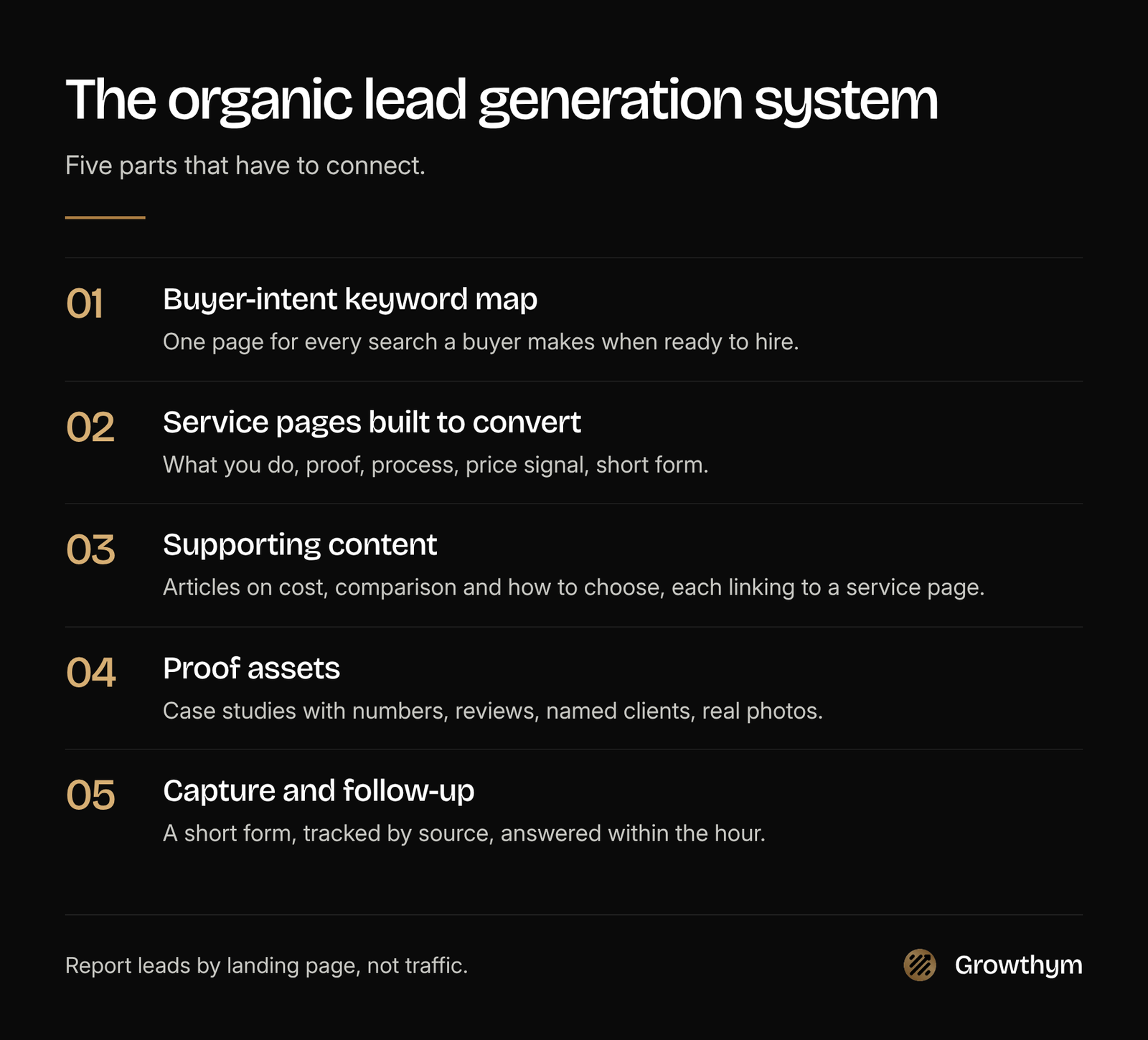
4. Proof assets
Buyers who arrive from search have never heard of you. Give them reasons to believe: case studies with real numbers, reviews on Google and on industry platforms, named clients where you have permission, and photographs of the actual team. One specific case study does more than ten adjectives.
5. Capture and follow-up
Ask only for what you need to respond: name, contact, website or company, and one line about the need. Then respond fast. A Harvard Business Review study of 1.25 million sales leads found that firms contacting a lead within an hour were nearly seven times as likely to qualify it as those that waited longer. An organic lead that gets a reply the next day has usually already spoken to someone else.
Want to know where your site is leaking leads? Tell us your website and your three most valuable services. We will show you which buyer searches you appear for and which pages are missing.
Which channel to build first
| Channel | Best for | What to build first | Typical time to first lead |
|---|---|---|---|
| Local search and Maps | Businesses serving a city or area | Business Profile, reviews, location page | 4 to 8 weeks |
| Google organic search | Services people search by name | Service pages for buying terms, then supporting articles | 3 to 6 months |
| AI assistants | Categories where buyers ask for shortlists | Quotable pages and third-party mentions | 3 to 6 months |
| B2B with a known decision-maker | A founder posting specifics weekly | 1 to 3 months | |
| Referral and review sites | Agencies, software, professional services | Complete profiles and recent reviews | 2 to 4 months |
These timings are planning ranges, not promises. They depend on your starting point and your competition. For local work, follow our local SEO checklist.
AI assistants as a lead source
This channel is small and growing quickly. In BrightLocal’s 2026 survey, 45% of consumers said they use ChatGPT or similar tools for local business recommendations, up from 6% a year earlier. Ahrefs reported that AI search sent 0.5% of its visitors and 12.1% of its signups in one 30-day window. The buyer arrives having already been told you are a good option.
The work overlaps with SEO: clear answers, evidence and mentions on trusted sites. We set out the differences in GEO vs SEO.
How to measure organic lead generation
- Leads by landing page. In GA4, mark form submissions, calls and WhatsApp clicks as key events and report them by the page the visitor entered on.
- Brand and non-brand clicks. In Search Console, separate searches that contain your name from those that do not. On our site, 113 of 160 clicks in the period were brand searches. That told us people who knew us could find us, and strangers could not.
- Lead to meeting rate by source, so you know which channel sends buyers and which sends browsers.
- Cost per lead: total monthly cost of the organic programme divided by organic leads, tracked next to the same figure for ads.
A 90-day plan
| Days | Work | What you should see |
|---|---|---|
| 1 to 30 | Keyword map, tracking set up, fix indexing and internal links, rebuild the top three service pages, complete the Business Profile | Pages indexed, enquiries tracked by source |
| 31 to 60 | Publish two supporting articles per service page, add case studies, start a weekly review request, founder posts on LinkedIn | Impressions for buyer terms rising, first local enquiries |
| 61 to 90 | Earn mentions on five third-party sites, refresh pages sitting on page two, run the first AI prompt check | First non-brand enquiries from search |
Mistakes that keep organic leads at zero
- Blogging without service pages. Traffic lands on articles with no next step.
- Targeting terms you cannot win. A year spent on a national head term when a city-level term was open.
- No proof on the page. Claims without a name or a number.
- Counting traffic and not enquiries. Visits are a means. Report leads.
- Slow replies. The fastest responder usually gets the meeting.
Building this system is what we do as organic growth marketing: SEO, AI search visibility and content run as one programme with leads as the number that is reported.
Frequently asked questions
How long does organic lead generation take?
Local search can bring enquiries in four to eight weeks once a Business Profile is complete. Leads from Google organic search usually start within three to six months, in line with Google’s own guidance that SEO takes four months to a year.
Is organic lead generation free?
No. You do not pay per click, but you pay for the work: writing, design, technical fixes and time. The advantage is that cost per lead falls as pages keep ranking, while paid leads cost the same or more each month.
Which is better, organic or paid lead generation?
Paid is faster and easier to control. Organic is slower and costs less per lead over time. Most businesses need paid leads at the start and a growing share of organic leads after six months.
How many organic leads should a website get?
There is no standard figure. Estimate it from your own numbers: monthly impressions for buyer searches, multiplied by your click rate, multiplied by the share of visitors who enquire. Improving any one of the three raises the result.
Do blog posts generate leads?
Rarely on their own. Articles attract people who are researching. They produce leads when each one links to a relevant service page and offers a next step. Service pages aimed at buying searches produce most direct enquiries.
Request the audit