
To appear in Google AI Overviews, a page must be indexed, eligible to show a snippet and useful for the sub-questions Google runs behind a search. Google says no special markup is needed. In practice the pages that get cited answer early, back the answer with specifics, and come from sites that are named elsewhere on the web.
There is no ranking position inside an AI Overview, so “rank” here means being one of the linked sources. This guide gives nine steps in the order we would do them, the data behind each, and the things that do not work.
What AI Overviews are and where the links come from
An AI Overview is the generated summary Google places above the normal results for some searches. AI Mode is the conversational version of the same system. Both show links to supporting pages.
Google’s documentation on AI features explains the mechanism. The system uses a technique called query fan-out: it runs several related searches across subtopics, then builds one response from what it finds. That is why the cited pages are often not the ones ranking first for the words you typed. They rank for the sub-questions.
The same page sets out the entry rule. To be shown as a supporting link, a page must be indexed and eligible to appear in Search with a snippet. There are no extra technical requirements.
What the data says
| Finding | Source | What it means for you |
|---|---|---|
| The top-ranking page gets 58% fewer clicks when an AI Overview shows | Ahrefs, February 2026, 300,000 keywords | Holding position one no longer protects traffic on informational searches |
| Users clicked a result in 8% of visits with an AI summary, against 15% without. They clicked a link inside the summary in 1% of visits | Pew Research, July 2025 | Being cited is about being seen and trusted more than about the click |
| 38% of pages cited in AI Overviews rank in the top ten for the same search, down from 76% | Ahrefs | Most citations now come from outside the top ten. Sub-question coverage is the way in |
Our own Search Console shows the click effect. One article on growthym.com averaged position 8.5 between August and November 2026 and was shown 4,861 times. It received 10 clicks, a click rate of 0.2%. The impressions are real. The visits never arrive.
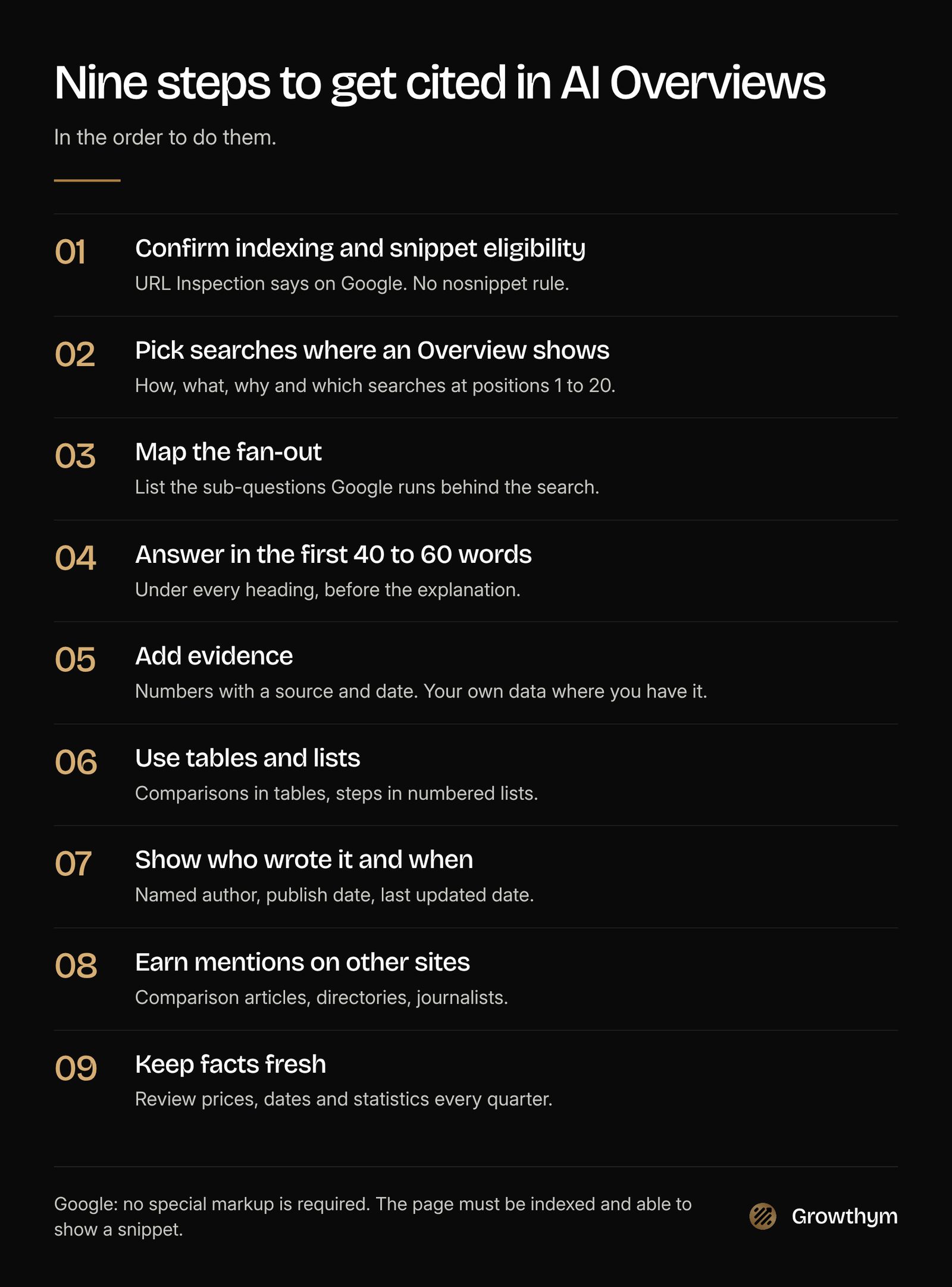
The nine steps
1. Confirm the page is indexed and can show a snippet
Open Search Console, paste the URL into URL Inspection and check that it reads “URL is on Google”. Then view the page source and search for nosnippet and max-snippet. A page that carries a nosnippet rule cannot be used. If Google is not indexing your pages at all, start with our guide for when a website is not showing on Google.
2. Choose searches where an Overview actually appears
Overviews show mostly on informational searches: how, what, why, which, best way to. In Search Console, filter queries containing those words where your position is between 1 and 20. Search each one in a private window and note whether an Overview appears and which sites it links.
3. Map the fan-out
For each target search, list the sub-questions behind it. Use People Also Ask, the related searches at the bottom of the results, and the headings of the pages the Overview already cites. A search like “how to choose a CRM” fans out into cost, team size, integrations, migration and alternatives. Your page needs a short section on each.
4. Answer in the first 40 to 60 words of every section
Put the direct answer immediately under each heading, then explain. A system assembling a summary takes the sentence that answers the question cleanly. If your answer sits in paragraph four after the background, a competitor’s opening line gets used.
5. Add evidence a model can repeat
Research on generative engine optimization found that adding statistics, quotations and cited sources raised visibility in generated answers by up to 40%. Give numbers with a source and a date. Better still, publish a number nobody else has: a count from your own data, a price you surveyed, a test you ran.
6. Use tables and lists where the content is a comparison or a sequence
Structure makes content easy to extract. Comparisons belong in a table with clear column headings. Steps belong in a numbered list. Definitions belong in one sentence that starts with the term.
7. Show who wrote it and when
Google’s guidance on helpful content asks who created the content, how and why. Name a real author with a bio. Show the publish date and the last updated date. Say how you got your numbers.
8. Earn mentions on other sites
An Ahrefs study of 75,000 brands found that mentions of a brand across the web correlated with AI Overview visibility more strongly than any other factor measured, including backlinks. Get listed in the comparison articles and directories already cited for your topic, and give journalists and bloggers original data they can quote.
9. Keep the facts fresh
Set a quarterly review for every page you care about. Update prices, dates and statistics, and change the visible “last updated” date only when the content truly changed.
Not sure which of your pages are being cited? Our free audit checks 20 buyer prompts across four AI assistants and returns your top five fixes in five working days.
What does not work
- Special schema or new files. Google’s page states you do not need new machine-readable files, AI text files or special structured data to appear in its AI features. Structured data is still worth having for rich results. It is not a pass into Overviews.
- Mass-produced AI articles. Google’s spam policies name scaled content abuse, which is publishing many pages mainly to manipulate rankings, as a violation however the pages are produced.
- Chasing the head term only. With most citations coming from outside the top ten, a page that answers one sub-question precisely can be cited without ranking for the main search.
- Blocking Google-Extended and expecting to disappear. That control covers training and grounding in other Google systems. It does not remove you from Overviews.
How to measure it
Search Console does not separate AI Overviews. Google confirms that this traffic is included in the Web search type in the Performance report, so you need proxies.
- Manual panel. Pick 20 searches. Once a month, record whether an Overview appears and whether you are linked. Count your share.
- The impressions and click-rate gap. Rising impressions with a falling click rate on question searches usually means an Overview is answering above you.
- Quality of the clicks you do get. Google says clicks from pages with AI Overviews tend to be higher quality. Test that claim in GA4 by comparing enquiry rates on your informational pages before and after.
- Brand search. If you are named in Overviews, more people search your name. Track branded impressions month on month.
Who does what, and how long it takes
| Step | Owner | Typical effort |
|---|---|---|
| Indexing and snippet checks | SEO or developer | One day |
| Query selection and fan-out mapping | SEO | Two to three days for 20 searches |
| Rewriting pages answer-first with evidence | Writer with a subject expert | Half a day per page |
| Author, dates and sourcing | Editor | One day across the site |
| Mentions on other sites | PR or outreach | Ongoing, monthly |
| Monthly panel and report | SEO | Two hours a month |
Google recrawls at its own pace, and its documentation notes that changes can take from days to months to be reflected. Judge the result after a full quarter.
For how this fits with classic rankings and with assistants like ChatGPT, read GEO vs SEO vs AEO and our ChatGPT SEO guide. If you would like it done for you, this is what our generative engine optimization service covers, as part of organic growth marketing.
Frequently asked questions
Can I opt out of AI Overviews?
Not on its own. Google offers snippet controls such as nosnippet and max-snippet, which limit how your content is shown across Search, including AI features. Using them also removes or shortens your normal snippet. Google-Extended does not control AI Overviews.
Does schema markup help you appear in AI Overviews?
Google says no special structured data is required for AI features. Schema still helps Google understand a page and can earn rich results, so it is worth having. Treat it as good housekeeping and not as a way into Overviews.
Do I need to rank in the top ten to be cited?
No. Ahrefs found that 38% of pages cited in AI Overviews rank in the top ten for the same search. The rest are found through related sub-searches, so a page that answers one sub-question well can be cited.
Why did my clicks fall when my ranking stayed the same?
An AI Overview is probably answering the search above your listing. Ahrefs measured 58% fewer clicks on the top result when an Overview is present. Check the search yourself, then compare impressions and click rate for that query in Search Console.
How often do AI Overviews change?
Often. The sources shown can differ between searches made minutes apart and between users. That is why a single check tells you little. Track a fixed list of searches monthly and look at your share over time.
Request the audit