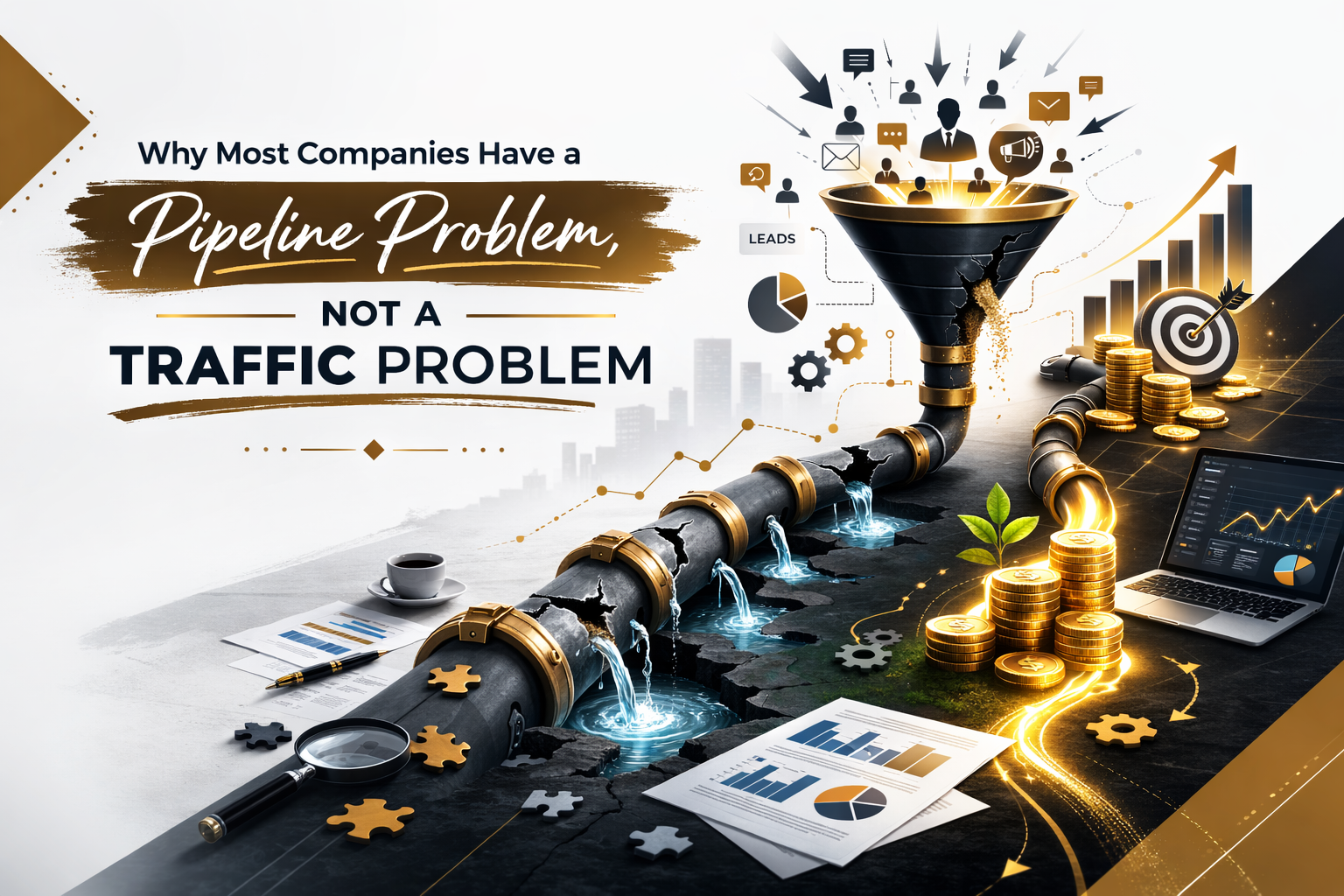
Most marketing agencies, creative agencies, and consultancies are working hard to win clients. Deals are dragging, prospects are ghosting, and proposals seem to disappear. Most founders are frustrated—they are running campaigns, booking calls, and sending proposals. Still, their pipeline feels stuck and unpredictable.
So, what do you think? Is it a traffic problem or a pipeline problem?
Most businesses immediately blame traffic. Then, throw more budget at ads, spin up new SEO pages, and hope this will fix the issue.
But reality is different; you don’t need more people seeing your brand, but more people believing in it. And it is not built by shouting louder or pushing harder. Rather, it is about showing up with clarity, consistency, and proof that you understand the issue better than anyone else.
So, here in this blog, we will uncover why trust, not traffic and leads, is what’s keeping your funnel from converting, and how shifting your marketing effort can actually pull in the right leads.
The Illusion of Traffic Growth
Traffic growth feels like progress. Dashboards look healthier. Reports look positive. But traffic alone does not create pipeline reliability. In many cases, it simply hides structural inefficiencies further down the funnel.
Illusion often begins at:
Vanity metrics
Traffic, impressions, click-through rates, and engagement. These numbers create the appearance of demand. But unless they translate into qualified opportunities and closed revenue, they are surface indicators.
Vanity metrics become dangerous when they:
- Inflate perceived marketing performance
- Mask low opportunity conversion rates
- Distract from weak close rates
- Justify spending without a revenue impact
Content without conversion
Content marketing is often mistaken for a pipeline strategy.
Publishing blogs, whitepapers, webinars, and LinkedIn posts can build visibility. But visibility without a structured conversion path creates passive audiences instead of active buyers.
When content lacks conversion architecture:
- Visitors consume but don’t progress
- Leads enter without qualification
- Sales receives interest, not intent
A predictable pipeline requires content to be mapped to funnel stages, buying signals, and qualification checkpoints.
Content should not just educate but also move accounts forward.
Without that structure, traffic increases while conversion stability declines.
Paid traffic without structure
Paid acquisition can scale traffic quickly. That’s its strength.
But if targeting is broad, qualification is weak, and stage tracking is unclear, paid traffic amplifies inefficiency.
More spending leads to:
- Higher cost per lead
- Lower opportunity rates
- Rising CAC
- Forecast volatility
Paid traffic works when it feeds a disciplined system. It fails when it feeds an undefined funnel.
The difference between traffic growth and predictable pipeline growth is simple—traffic measures visibility. Pipeline measures revenue progression.
And without structure, visibility does not convert into reliability
What a Predictable Pipeline Actually Means
A predictable pipeline is not about perfect forecasting. Rather, it is about knowing where your next opportunities will come from, even before they show up. It is an integrated strategy to find, reach, and convert prospects into customers that aligns sales and marketing.
The goal is to define clear business objectives, integrate sales and marketing details and sales enablement into the next stage of the sales cycle, and enhance B2B marketing for value and referrals.
A predictable pipeline strategy requires three capabilities:
- Ongoing account monitoring
- Signal-based opportunity detection
- Opportunity-to-action translation
And without these, opportunity detection creates noise instead of a pipeline.
When done correctly, predictable pipeline systems improve:
- Conversion rates
- Forecast accuracy
- Sales efficiency
- CAC control
And this is where most companies underestimate the gap between demand generation and actual pipeline engineering.
Where Pipeline Usually Breaks
A pipeline usually doesn’t break overnight. It leaks slowly and quietly. And most teams don’t notice until revenue starts missing targets.
So, here’s where it breaks often:
ICP mismatch
If your Ideal Customer Profile is too broad, outdated, or based on assumptions instead of revenue data, everything downstream suffers.
Marketing attracts interest. Sales struggles to convert it. Deals stall because the buyer was never a strong fit to begin with.
Funnel drop-offs
Most funnels don’t fail at the top. They fail between stages.
Leads don’t become qualified opportunities. Opportunities don’t progress to a proposal. Proposals don’t convert to closed-won.
Every drop-off compounds inefficiency.
When stage conversion rates are inconsistent:
- Forecast accuracy weakens
- Sales capacity planning becomes unreliable
- Revenue targets become reactive
Pipeline growth without stage stability creates volatility. And volatility makes scaling risky.
Predictability comes from knowing your conversion benchmarks at every stage and actively managing them.
Weak qualification
If marketing and sales define “qualified” differently, friction follows.
Marketing celebrates MQL volume. Sales rejects lead quality. Leadership sees pipeline numbers that don’t reflect revenue reality.
Weak qualification frameworks create inflated pipelines that collapse under scrutiny.
Clear qualification criteria should answer:
- Is this account aligned with our ICP?
- Is there demonstrated buying intent?
- Is there budget authority and urgency?
Without a structured qualification, you don’t have a pipeline. You have a contact list.
And that distinction matters for CAC control and close rate stability.
No attribution clarity
If you cannot trace revenue back to its source, optimization becomes opinion-driven.
And lack of attribution clarity results in:
- Wasted spend
- Inflated cost per acquisition
- Inability to scale winning channels
A predictable pipeline requires revenue-level attribution, not just lead-level reporting.
Because pipeline engineering is not about generating movement. It’s about generating measurable, repeatable revenue progression.
Demand Generation vs Pipeline Engineering
Demand generation and pipeline engineering are deeply rooted in today’s marketing. This ultimately creates a valuable opportunity to reach out to prospects in different ways. Below is the revenue-focused difference between demand generation and pipeline engineering.
| Aspect | Demand Generation | Pipeline Engineering |
| Primary Objective | Create awareness and interest in the market | Convert interest into qualified revenue opportunities |
| Core Question | Are the right people discovering and engaging with us? | Are engaged prospects moving predictably toward revenue? |
| Focus Area | Top-of-funnel expansion | Full-funnel structure and conversion |
| Key Activities | Content marketing, paid acquisition, brand campaigns, webinars, nurturing | ICP refinement, qualification frameworks, funnel optimization, stage tracking, attribution |
| Metrics Tracked | Traffic, engagement, MQLs, cost per lead | SQLs, opportunity rate, stage conversion %, CAC, revenue forecast accuracy |
| Revenue Impact | Increases potential pipeline volume | Increases pipeline reliability and close rates |
| Outcome | Pipeline growth potential | Predictable pipeline performance |
Building a Predictable Pipeline System
A strong pipeline is built when acquisition, qualification, and sales progression operate as one system—grounded in revenue data, not activity metrics. And when a pipeline is healthy, growth feels natural. On the other hand, when it’s broken, no amount of marketing spend or sales tactics can compensate.
Hence, if you are seeing signs like inconsistent revenue, stagnant deals, or unpredictable forecasts, consider it an opportunity. You can transform your pipeline from a leaky system into a powerful growth engine by defining clear stages, using automation wisely, and aligning sales and marketing.
Ultimately, your pipeline will either be an asset that compounds your marketing efforts or a liability that silently drains them. But the good news is you can choose which one it becomes.
So, build a predictable pipeline system.
That’s how we at Growthym approach growth marketing as pipeline engineering designed for revenue reliability, not as channel execution. So, if you are interested
FAQs: Predictable Pipeline
What does a “pipeline problem” actually mean?
In simple terms, a pipeline problem means that you are generating traffic or leads. But these actions are not converting into qualified opportunities or revenue. It is a system-level issue where the “pipeline” (the process of turning leads into customers) is inefficient, which is often mistaken for a lack of traffic or lead volume.
Can high traffic still result in poor pipeline growth?
Yes, even high traffic can definitely result in poor pipeline growth. It is because of underlying issues that hinder revenue growth. Primary reasons why high traffic can result in pipeline break are low-quality leads, poor conversion rates, misaligned marketing and sales, etc.
Why is a predictable pipeline harder to achieve than traffic growth?
It is because traffic growth can often be purchased or engineered through digital marketing, and a predictable pipeline is about guiding human behavior and maintaining high-quality data.
How is demand generation different from lead generation?
Demand generation is about creating brand awareness and interest. On the other hand, lead generation is about converting that interest into actionable and qualified prospects. Also, demand generation works at the top of the funnel, targeting a broad audience to build a reputation. And lead generation acts at the bottom to focus on capturing contact information.
What are the early signs that a company has a pipeline problem?
Early signs include stagnant deals, poor lead quality, reduced engagement, and inaccurate forecasting.
How does poor demand generation impact CAC?
Poor demand generation directly increases Customer Acquisition Cost (CAC) by bringing unqualified, low-intent traffic into the sales funnel, resulting in lower conversion rates and wasted sales efforts. When demand generation is ineffective, businesses frequently waste money on broad targeting, resulting in a higher cost to acquire each new customer.
What role does growth marketing play in building a predictable pipeline?
Growth marketing builds a predictable pipeline by shifting from large-scale campaigns to a data-driven, iterative, and full-funnel approach. It focuses on ongoing testing of channels, Customer Acquisition Costs (CAC), and improving retention to build a sustainable and scalable revenue engine instead of relying on only one-off incentives.