Search Engine Optimization (SEO) is a crucial element in the digital marketing ecosystem. It refers to organically optimizing a website’s visibility and rankings in search engine results pages (SERPs). SEO is a long-term strategy that helps businesses generate organic traffic, improve their online presence, and enhance their brand’s credibility.
In this blog, we will discuss the importance of SEO and why every business should implement SEO in their digital marketing strategy.
One of the primary reasons why SEO is essential for businesses is that it helps increase their visibility and rankings in search engine results pages (SERPs). With SEO, businesses can optimize their website content and structure to appear higher in the organic search results of search engines like Google. Higher rankings translate into more visibility and organic traffic to the website, which is crucial for businesses to succeed in the competitive digital landscape.
SEO is not just about optimizing for search engines but also about providing a better user experience. Google has made it clear that they prioritize websites that provide an excellent user experience to their visitors. When businesses implement SEO best practices like optimizing page speed, using responsive design, and improving website navigation, they can create a positive user experience for their visitors. A better user experience leads to lower bounce rates, longer time on site, and higher engagement, which all contribute to higher search engine rankings.
Compared to other marketing strategies like paid advertising, SEO is a cost-effective marketing strategy. While paid advertising can be expensive, SEO is free, and businesses can implement it themselves or hire an SEO agency like Growthym to manage their SEO efforts. Once businesses have optimized their website for SEO, they can generate organic traffic and leads without having to pay for every click or impression.
SEO helps businesses target their ideal audience by optimizing their website for specific keywords and phrases. By optimizing for relevant keywords, businesses can attract visitors who are interested in their products or services. These visitors are more likely to convert into leads and customers since they are actively searching for products or services related to the business. SEO helps businesses generate targeted traffic and leads, which can result in higher conversion rates and revenue.
SEO is a long-term strategy that can provide businesses with long-lasting benefits. Unlike paid advertising, which stops generating traffic and leads as soon as the budget runs out, SEO continues to generate organic traffic and leads even after the initial optimization is done. While SEO may take some time to generate results, businesses can reap the benefits of SEO for years to come.
When launching a new website, it’s important to implement SEO best practices from the start. Here are a few SEO activities to get started with your new website:
Perform keyword research to identify the keywords and phrases your target audience is searching for. Use keyword research tools like Google Keyword Planner or Ahrefs to identify relevant keywords with high search volume and low competition.
Optimize your website’s on-page elements like title tags, meta descriptions, header tags, and content to include your target keywords. Make sure your website’s content is informative, relevant, and engaging for your audience.
Ensure your website’s structure is organized and easy to navigate. Use descriptive URLs, create a sitemap, and optimize your internal linking to make it easier for search engines to crawl and index your website.
Optimize your website for mobile devices to improve user experience and increase search engine rankings. Use responsive design to ensure your website looks and functions well on mobile devices.
If your business has a physical location, optimize your website for local SEO. This includes creating a Google My Business profile, adding your business’s address and phone number to your website, and getting listed in local directories.
Regularly create and publish high-quality, relevant, and engaging content on your website. This can include blog posts, infographics, videos, and other types of content that provide value to your target audience.
By implementing these SEO activities from the start, you can improve your website’s visibility in search engine results pages and attract more targeted traffic to your website.
In conclusion, SEO is a crucial element in any digital marketing strategy. It helps businesses increase their visibility and rankings in search engine results pages, provide a better user experience, generate targeted traffic and leads, and is a cost-effective long-term marketing strategy. Every business should invest in SEO to improve their online presence and attract more leads and customers.
At Growthym, we are a leading growth marketing agency that specializes in SEO. We provide a free SEO audit to businesses to help them identify areas where they can improve their SEO efforts. Contact us today to learn more about how we can help your business succeed online.
In today’s dynamic and competitive marketplace, professional service firms must continuously innovate and adapt to sustain growth and achieve long-term success. Implementing effective growth strategy services is crucial for businesses aiming to expand their market presence, enhance customer satisfaction, and increase revenue. This comprehensive guide explores various growth servicing strategies, growth strategy consulting services, and actionable growth strategies for professional services firms. Whether you are a startup or an established company these insights will equip you with the tools and knowledge to drive substantial business growth.
Growth strategy services encompass a range of consulting and advisory services designed to help businesses identify, plan, and implement strategies that drive growth. These services are tailored to meet the unique needs of each organization, focusing on areas such as market expansion, service diversification, customer acquisition, and operational efficiency. For professional service firms, leveraging specialized growth strategy services can lead to significant improvements in market positioning, client satisfaction, and overall profitability.
Growth strategy services typically include:
Professional service firms—such as consulting, legal, financial, and IT services—operate in highly competitive environments where differentiation is key. Implementing robust growth strategies is essential for these firms to:
Developing a successful growth strategy involves several critical components that work together to drive business expansion and sustainability. Below are the essential elements that should be included in your growth strategy.
A thorough market analysis is fundamental to understanding the landscape in which your business operates. It involves:
Setting clear and measurable business goals provides direction and focus for your growth efforts. Goals should be:
A compelling value proposition communicates the unique benefits your services offer to clients. It should:
Engaging with growth strategy consulting services can provide professional service firms with the expertise and insights needed to develop and implement effective growth strategies. Consultants bring an external perspective, specialized knowledge, and proven methodologies to help businesses navigate complex growth challenges.
Growth strategy consultants play a pivotal role in assisting businesses to:
Selecting the right growth strategy consultancy services provider is crucial for the success of your growth initiatives. Consider the following factors:
Here are some examples of consultant services growth strategy implementations:
Challenge: A mid-sized legal firm wanted to expand its services to new geographic regions but lacked a clear strategy.
Solution: Growth strategy consultants conducted a market analysis to identify high-demand regions and competitive landscapes. They developed a strategic plan that included targeted marketing campaigns, partnership development, and resource allocation for new office setups.
Result: The firm successfully entered three new regions within a year, increasing its client base by 40% and revenue by 35%.
Challenge: An IT consultancy faced stagnation in growth due to limited service offerings.
Solution: Consultants identified opportunities for service diversification based on client feedback and market trends. They guided the firm in launching new services such as cybersecurity consulting and cloud migration services.
Result: The diversified service portfolio attracted new clients and boosted annual revenue by 50%.
Implementing the right growth strategies is essential for professional services firms to thrive in a competitive market. Below are some of the most effective strategies tailored for these firms.
Service growth strategies focus on expanding and enhancing the services offered by a firm to meet the evolving needs of clients. Key approaches include:
B2B growth strategies are tailored to professional services firms that operate in a Business-to-Business (B2B) environment. Effective strategies include:
A strong brand strategy is vital for professional services firms to differentiate themselves and build trust with clients. Components of a robust brand strategy include:
Exceptional customer service is a powerful growth strategy that can lead to increased client satisfaction, loyalty, and referrals. Key elements include:
Different sectors may require tailored growth strategies to address unique challenges and opportunities. Below are some innovative strategies for specific industries.
Financial services firms operate in a highly regulated and competitive environment. Effective growth strategies for this sector include:
Managed services firms provide ongoing support and management of specific business functions. Growth strategies for this sector include:
Amazon Web Services (AWS) has established itself as a leader in cloud computing through effective growth strategies. Key elements of their strategy include:
Utilizing the right tools and frameworks can help businesses identify and capitalize on growth opportunities effectively.
The New Service Strategy Matrix is a framework that helps businesses evaluate and prioritize potential growth opportunities based on various criteria. The matrix typically assesses opportunities based on factors such as market potential, alignment with business strengths, resource requirements, and potential ROI. By using this matrix, professional service firms can make informed decisions about which new services to develop and launch.
Growth as a Service (GaaS) is an emerging model where businesses outsource their growth initiatives to specialized service providers. GaaS strategies include:
Effective growth marketing strategies are essential for service businesses to attract and retain clients, increase brand awareness, and drive revenue growth.
In regions like Ireland, growth hacking strategy services can provide service businesses with innovative and cost-effective marketing solutions. Growth hacking involves:
Key growth marketing strategies for service businesses include:
Successfully implementing and managing growth strategies requires careful planning, execution, and ongoing monitoring. Here are key considerations for effective implementation.
Investing in career growth strategies and coaching services can enhance the skills and performance of your team, contributing to overall business growth. Key elements include:
For businesses that offer field services, developing effective field service strategies is essential for growth. Key strategies include:
Implementing effective growth strategy services is essential for professional service firms aiming to achieve sustained business growth and success. By leveraging specialized growth strategy consulting services, adopting innovative growth strategies, and utilizing the right tools and frameworks, businesses can navigate the complexities of the market and capitalize on growth opportunities. Whether you are looking to expand your service offerings, enter new markets, or enhance your operational efficiency, a well-crafted growth strategy can provide the roadmap to achieve your business objectives.
At Growthym.com, we specialize in providing tailored growth strategy services designed to meet the unique needs of professional service firms. Our team of experienced consultants works closely with you to develop and implement strategies that drive measurable growth and deliver long-term success. Contact us today to discover how we can help your business achieve its growth ambitions.
Growth strategy services are consulting and advisory services aimed at helping businesses identify, plan, and implement strategies to drive growth. These services typically include market research, strategic planning, business development, marketing strategy, and operational optimization.
Growth strategies are crucial for professional service firms to attract and retain clients, expand service offerings, increase market share, enhance brand reputation, and improve profitability. In a competitive market, effective growth strategies help firms differentiate themselves and achieve sustainable growth.
Growth strategy consulting services provide expert insights, external perspectives, and specialized knowledge to help your business identify growth opportunities, overcome challenges, develop strategic plans, and implement effective growth initiatives. Consultants can guide you through the complexities of business growth and ensure that your strategies are aligned with your goals.
Effective growth strategies for service businesses include content marketing, SEO, social media marketing, email marketing, referral programs, service innovation, geographic expansion, upselling and cross-selling, and implementing customer retention programs. These strategies help attract new clients, retain existing ones, and increase revenue.
When choosing a growth strategy consultancy services provider, consider their experience and expertise in your industry, their ability to offer customized solutions, their reputation and client testimonials, their approach and methodology, and their cost-effectiveness. Ensure that the provider aligns with your business goals and can deliver the results you seek.
In the digital marketing arena, combining SEO with content strategies is essential for maximizing organic growth. SEO-driven content strategies ensure that your content not only resonates with your audience but also ranks well on search engines, driving sustainable traffic to your website. This blog delves into effective SEO-driven content strategies that can help your business achieve remarkable organic growth, enhance online visibility, and establish a strong digital presence.
Effective SEO-driven content begins with comprehensive keyword research. Identifying the right keywords ensures that your content aligns with what your audience is searching for.
High-quality content is the cornerstone of SEO-driven content strategies. Providing valuable and informative content engages your audience and encourages them to spend more time on your site.
On-page SEO optimization ensures that your content is easily discoverable by search engines and ranks higher in search results.
A positive user experience complements your SEO efforts, encouraging visitors to stay longer and engage more with your content.
Integrating content marketing with SEO creates a powerful synergy that drives organic growth and enhances your digital presence.
Structured data and schema markup provide additional context to search engines, enhancing your content’s visibility and appearance in search results.
Backlinks from authoritative and relevant websites are a crucial factor in improving your site’s SEO and driving organic growth.
Regular monitoring and analysis of your content’s performance are essential for refining your SEO-driven content strategies and driving continuous improvement.
SEO is a dynamic field, with search engine algorithms and best practices continuously evolving. Staying updated with the latest SEO trends ensures that your content strategies remain effective and aligned with current standards.
Maximizing organic growth with Organic Growth Services through SEO-driven content strategies is a sustainable and effective approach to enhancing your online presence and driving long-term success. By conducting comprehensive keyword research, creating high-quality content, optimizing on-page SEO elements, enhancing user experience, leveraging content marketing and SEO synergy, implementing structured data, building high-quality backlinks, monitoring performance, and staying updated with SEO trends, you can achieve remarkable organic growth and establish a strong digital footprint.
Investing in these SEO-driven content strategies not only boosts your website’s visibility and search engine rankings but also fosters meaningful engagement with your audience, driving conversions and fostering loyalty. Embrace these best practices to unlock the full potential of organic growth marketing, ensuring that your business thrives in the competitive digital landscape.
Are you wondering how to get your blog noticed online? In a world where millions of blog posts
compete for attention, Search Engine Optimization (SEO) is your secret weapon. An
SEO-optimized blog can climb the ranks of Google, bringing more readers to your content
without relying on paid ads. But how do you write a blog that’s both reader-friendly and
search-engine approved?
In this step-by-step guide, we’ll show you how to craft an SEO-optimized blog that drives traffic
and engages your audience. Whether you’re a beginner or a seasoned writer, these practical
tips will help you succeed.
SEO stands for Search Engine Optimization, a process that improves your content’s visibility on
search engines like Google. For bloggers, it’s the key to getting discovered by people searching
for topics you write about.
Why SEO Matters:
– More Traffic: Higher rankings bring more organic visitors.
– Better Reach: Your blog gets in front of the right audience.
– Long-Term Results: Well-optimized content keeps delivering value over time.
Let’s dive into the essentials of writing an SEO-optimized blog.
1. Start with Keyword Research
Keywords are the phrases people type into search engines. Including the right ones in your blog
helps search engines match your content to user queries.
How to Find Keywords:
– Use tools like Google Keyword Planner or Ubersuggest to discover popular terms.
– Focus on long-tail keywords (e.g., “how to write an SEO blog” instead of just “SEO”).
– Check what your competitors rank for and aim for similar or related terms.
Example: For this post, keywords like “SEO-optimized blog,” “how to write SEO content,” and
“SEO tips for bloggers” are targeted.Tip: Place your primary keyword in the title, first paragraph, and naturally throughout the post.
2. Write a Click-Worthy Title and Meta Description
Your title and meta description are your blog’s first impression in search results. Make them
count!
Title Tips:
– Keep it under 60 characters.
– Include your main keyword near the start.
– Make it intriguing (e.g., “Step-by-Step Guide” adds value).
Meta Description Tips:
– Limit to 150-160 characters.
– Summarize the post and include a keyword.
– Add a call to action like “Read now” or “Learn how.”
Example:
– Title: “How to Write an SEO-Optimized Blog: Step-by-Step”
– Meta Description: “Want more blog traffic? Learn how to write an SEO-optimized blog with this
step-by-step guide. Boost your rankings today!”
3. Structure with Header Tags
Header tags (H1, H2, H3) organize your content for readers and search engines. They signal
what’s important and improve readability.
How to Use Them:
– H1: Your blog标题 (used once, like above).
– H2: Main sections (e.g., “Start with Keyword Research”).
– H3: Subpoints (e.g., “How to Find Keywords”).
Tip: Sprinkle keywords in headers naturally, but don’t force them.
4. Create High-Quality Content
Search engines love content that’s informative, engaging, and valuable. Quality keeps readers
on your page longer, which boosts your SEO.
Tips for Great Content:
– Write for humans, not just algorithms.
– Use short paragraphs and a friendly tone.
– Include examples, stats, or tips (like this list!).
– Aim for 1,000+ words for detailed topics, but focus on depth over fluff.
Example: This post answers a common question—“how do I optimize my blog?”—with
actionable advice.
5. Optimize Your Images
Images make your blog visually appealing and can improve SEO if done right.
Image Tips:
– Use descriptive file names (e.g., “seo-blog-tips.jpg”).
– Add alt text with keywords (e.g., “Laptop showing SEO blog tips”).
– Compress images for faster loading (try tools like TinyPNG).
Why It Helps: Optimized images can rank in Google Image Search, bringing extra traffic.
6. Add Links for Context
Links enhance your blog’s credibility and help search engines understand your content.
Linking Strategies:
– Internal Links: Connect to your other blog posts (e.g., a post on “Keyword Research Tools”).
– External Links: Reference trusted sites (e.g., Google’s SEO Starter Guide).
Tip: Use natural anchor text like “learn more about keywords” instead of “click here.”
7. Ensure Mobile Compatibility
With over 50% of web traffic from mobile devices, a mobile-friendly blog is non-negotiable for
SEO.
How to Do It:
– Use a responsive design (most blogging platforms like WordPress offer this).
– Avoid tiny text or cluttered layouts.
– Test with Google’s Mobile-Friendly Test.
Benefit: Google prioritizes mobile-optimized sites in rankings.
8. Boost Page Speed
A slow-loading blog frustrates readers and hurts your SEO. Speed matters!
Speed Tips:
– Compress images and videos.
– Minimize heavy code or plugins.
– Use a fast hosting provider.
Tool: Check your speed with Google PageSpeed Insights and fix any issues.
9. Make Sharing Easy
Social shares amplify your reach, indirectly helping SEO by driving traffic.
How to Encourage Shares:
– Add social media buttons (e.g., Twitter, Pinterest).
– Write shareable headlines (e.g., “Unlock SEO Secrets”).
– Include eye-catching visuals.
Tip: Engage with readers on social platforms to spark shares.
10. Keep Content Fresh
Updated content signals to search engines that your blog is relevant.
How to Update:
– Add new insights or examples.
– Refresh stats or links.
– Republish with a new date.
Pro Tip: Review top posts every 6-12 months.
Conclusion: Get Started with SEO Today
Writing an SEO-optimized blog takes effort, but the payoff—more readers and better
rankings—is worth it. By using keywords, crafting great content, and following technical best
practices, you’ll set your blog up for success.
Ready to grow your audience? Start applying these SEO tips to your next post and watch your
traffic soar!
It’s not long ago when ranking on top of Google SERPs was a matter of keywords, backlinks, and technical tweaks. SEO has evolved drastically since then, and today search engines like Google don’t show results based on exact keyword matching.
Optimizing only for keywords is the past. This is not how modern search engine algorithms work today – they now work with intent, entities, and context – not just keywords. Semantic search has become the core mechanism of Google (with RankBrain, MUM, and BERT updates) and other search engines.
Modern marketers and SEO strategists should therefore focus on Entity SEO, which is not a frequently used term in this domain. It is an entity-based approach to SEO that allows you to optimize your content for semantic searches.
Building entity maps is an essential process in this strategy that organizes key entities and their connections around a topic. This allows search engines like Google to understand content’s relevance, which leads to improved search rankings.
This blog delves deep into the concept of Entity SEO, building entity maps, and how they help grow your search engine ranking. Keep reading to learn more about better SEO strategies that will help your business stay competitive instead of going invisible.
Entity SEO is a search engine optimization strategy that is centered around entities – a well-defined and distinct concept, place, person, organization, or thing – not just keywords. This involves understanding the context behind a search query and optimizing for the meaning behind a search term, not just taking it in the literal sense.
Hence, Entity SEO is a broader concept than traditional keyword-based SEO strategies that emphasize optimizing for specific phrases or words that are typed by users. It focuses on optimizing content for the context in which a particular keyword was used by understanding the intent and connections among entities.
Why does Entity SEO matter? As SEO is evolving and AI becomes an integral part of it, clickthroughs are dropping rapidly. In fact, AI overviews have become the hotspot for most information for users, and they barely visit websites underneath. This is causing a devastating drop in web traffic.
Therefore, marketers must upgrade their strategies to stay visible and get traffic. Now, featured snippets, knowledge graphs, knowledge panels, and AI overviews are the sweet spots for website traffic and brand visibility.
Entity SEO is going to be the bedrock of modern search that will influence how Google ranks a page. By leveraging this strategy, marketers can enhance their brand visibility.
Search engines like Google leverage complex algorithms to understand entities and their relationships. For example, now Google is smart enough to make distinction between a fruit and a technology company when someone searches for “Apple.”
This is all the magic of entity-based SEO that enables search engines to make distinctions with clear, contextual information. Marketers needs to focus on the following to implement entity-based search engine optimization.
The following are the key steps to implement entity SEO.
First of all, identify the core topic of your content. After this, you can start with the main subject, like if the content is about “electric cars”, the core entity of this content is “electric vehicle.” For this, Wikipedia and Wikidata are useful.
Once you have identified the core topic, look for the related entities that connect to the core topic. For example, the related entities for the previous “electric cars” example can be:
There are useful tools like MarketMuse, SEMRush, and Google’s NLP API for this.
Once you have discovered the core and related entities, the next step is to map their relationships. Identify the contextual relationship between them to understand how they relate. Discover the semantic relationships, for example, ‘Tesla’ is a company that manufactures ‘electric vehicles’ and uses ‘Lithium-Ion batteries.’ You can use graph visualization tools or understand the linking via diagrams.
Make updates in your content to ensure it aligns with the entities. For this, clearly mention entities and also clarify their context. Include Schema markup for proper structure.
Leverage topical clustering to build a semantic relationship between your content. By creating a pillar page for the main entity and several pages for related entities, you will create a semantic hierarchy. Besides, interlinking is crucial for semantic SEO to build relationships between distinct content but with similar context.
After creating content around entities, the next you can do is optimize them for search engine visibility. Create fact-based and concise content with high-authority external links.
Continuous monitoring is crucial to identify any gaps and fine tune your content for greater visibility. You can use Google search console to monitor and refine content.
In today’s search landscape semantic SEO rule the game that is based on context and entities. If you are still doing SEO the old-school way relying heavily on keyword, your growth might see a downfall. If you want to get consistent growth and outrank competitors, Entity-based search engine optimization is indispensable.
At Growthym, we have recognized this shift and offer modern AI-driven solutions. Our AI SEO services empower your business to increase your ranking by leveraging AI for optimization and workflow automation.
Our services help you optimize content for topical relevance, entity recognition, and AI overviews – not just keywords. We help you build smart content structures, optimize for knowledge graph, implement schema markup and perform other optimization to ensure enhanced search engine visibility. Schedule a call to discuss your requirements.
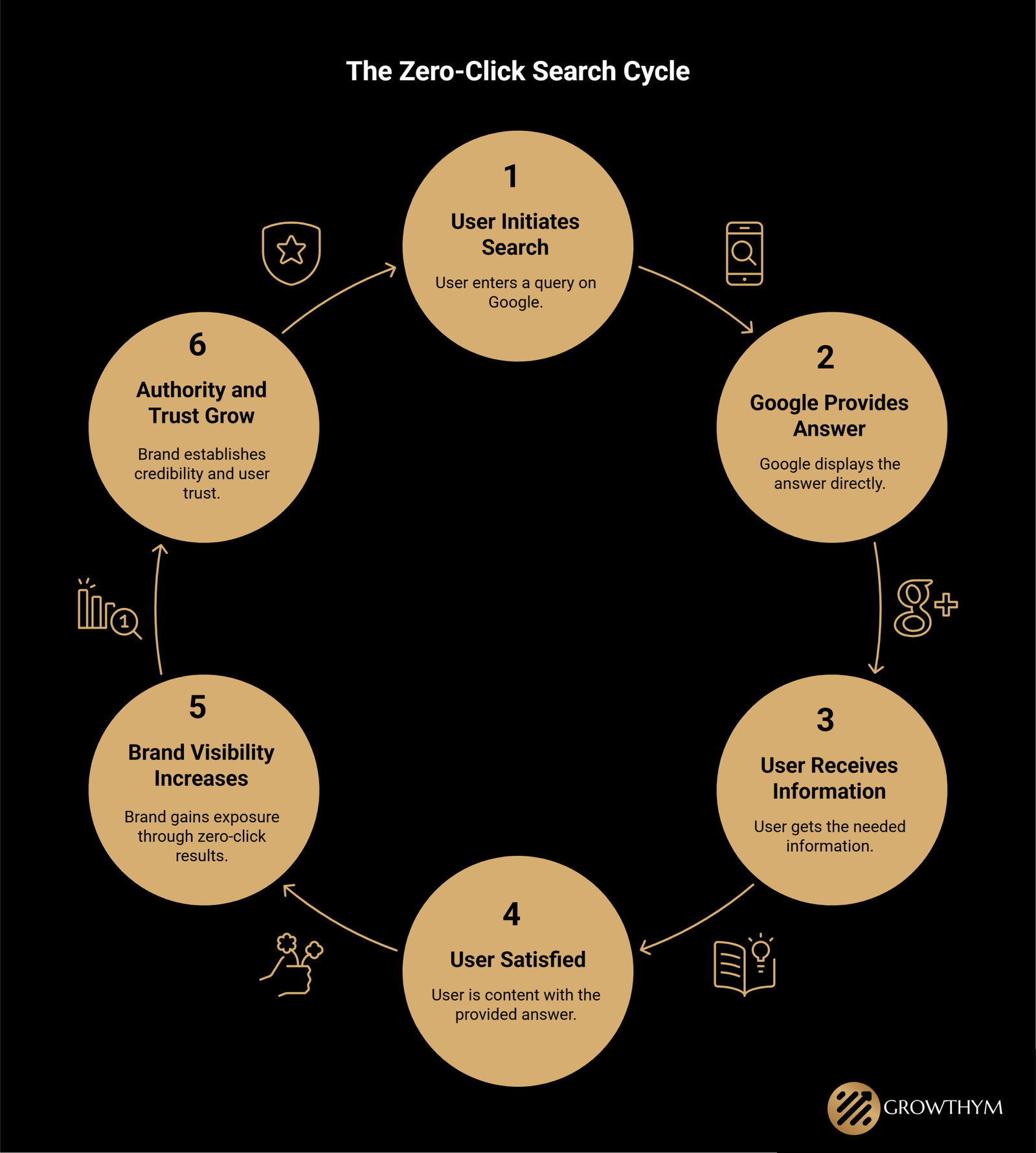
Google search has changed. Today, many users get answers without clicking a single link. This trend is called zero-click search. It is when Google gives direct answers in the search results, leaving fewer clicks for websites.
For marketers, this looks like a problem. But in reality, it is a big opportunity if used smartly. Businesses that adapt to zero-click SEO can still attract attention, grow brand visibility, and gain customers.
In this blog, we’ll explain:
Let’s dive in.
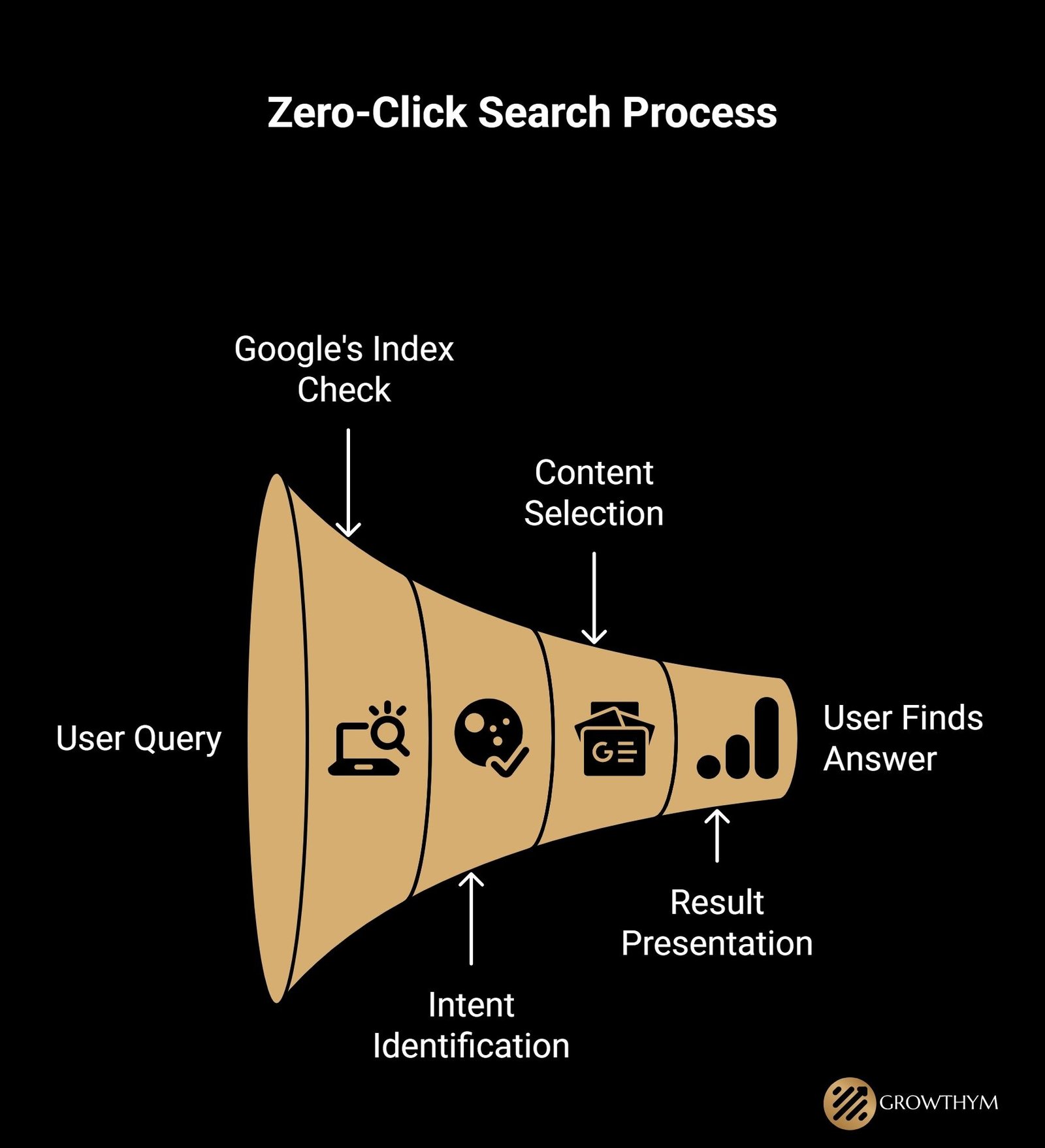
Zero-click search happens when a user finds the answer on the search page itself. They do not click on any website. This usually comes from featured snippets, knowledge panels, maps, calculators, or direct answers.
For example:
In all these cases, the user gets what they need instantly. This means fewer website visits.
But this also means:
So instead of fighting zero-click, you must learn how to win it.
Zero-click searches are now over 50% of all Google searches. This means more than half of searchers don’t leave Google. For businesses, this sounds like lost traffic. But here’s the truth:
In short, zero-click is about being present where people search most. It may reduce clicks but increases trust, reach, and conversions.
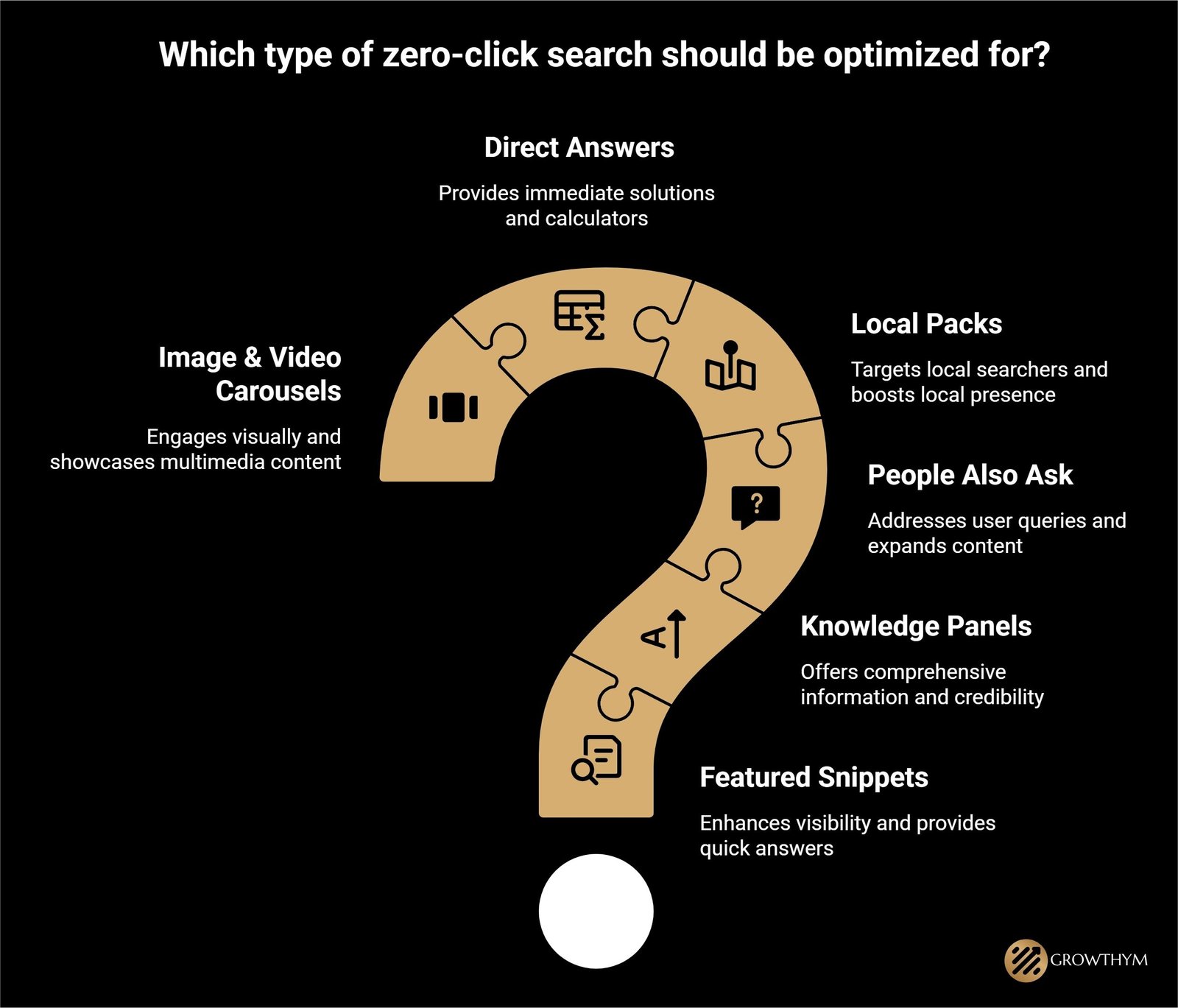
Google uses different formats to answer queries directly. Each type offers a way for brands to gain visibility even without clicks. Knowing these types helps you plan the right SEO strategy.
Here are the most common types:
These are answer boxes shown at the top of results. They often pull content from a website and display it in:
Example: Search “steps to brew coffee” → Google shows a step-by-step list.
These appear on the right side (desktop) or top (mobile). They show quick facts about:
Example: Search “Elon Musk” → You see a knowledge panel with his bio.
This section shows questions related to the main query. Each expands with a short answer and a link.
Also known as the “map pack.” It shows nearby businesses with address, ratings, and directions.
Google gives answers without linking to any site.
Examples:
Google sometimes shows images or YouTube videos directly.
| Zero-Click Type | Best For | Example Search Query |
| Featured Snippets | How-to guides, FAQs, definitions | “How to tie a tie” |
| Knowledge Panels | Brand awareness, authority building | “Nike” |
| People Also Ask (PAA) | Covering related user questions | “Best SEO strategy” |
| Local Packs | Local businesses, stores, services | “Pizza near me” |
| Direct Answers | Quick facts, simple queries | “1 mile in km” |
| Image/Video Carousels | Visual learning, product discovery | “Yoga poses for beginners” |
Winning zero-click searches is not luck. It is about structuring content the way Google prefers. If your content is clear, fast, and authoritative, Google is more likely to feature it.
Here’s a step-by-step approach:
Most zero-click searches are questions. People search in natural language like:
How to optimize:
Example: Instead of writing “SEO strategy steps,” write “What are the steps to create an SEO strategy?”
Google loves well-structured answers. Depending on the query, use:
Pro Tip: Always answer the query directly at the top of the section. Then expand with details below.
Schema markup helps search engines understand your content better. It increases chances of appearing in:
Important Schema Types for Zero-Click:
Example: A local dentist using Local Business Schema can appear in “dentist near me” searches.
“People Also Ask” is a goldmine for long-tail visibility.
Steps to win PAA:
Example:
Google often prefers content with images and videos.
Example: A fitness brand posting a “10-minute home workout” video has a higher chance of being featured in video snippets.
If you run a local business, Local Pack is your biggest zero-click opportunity.
Checklist:
Zero-click opportunities mostly show on mobile searches. If your site is slow, you lose out.
Quick Fixes:
Google favors sites that show expertise. To build authority:
You can see how we built authority in our AI SEO Guide where every detail of AI-driven SEO is explained step by step.
You can’t improve what you don’t measure.
| Optimization Technique | Zero-Click Type It Helps Win |
| FAQ + Q&A Format | Featured Snippets, PAA |
| Numbered/Bullet Lists | Featured Snippets |
| Schema Markup | FAQ, How-to, Local Pack |
| Local SEO (Google Business) | Local Packs |
| YouTube Videos + Timestamps | Video Carousels, Featured Snippets |
| Brand Authority Building | Knowledge Panels |
Zero-click searches sound great for visibility. But many marketers and businesses see them as a double-edged sword. Let’s break down the challenges first, then learn how to solve them.
The Problem:
When users get answers directly from Google, they don’t visit your website. This may lower your pageviews and sessions.
The Solution:
The Problem:
Zero-click visibility is tough to measure. You may appear in snippets, but clicks don’t reflect it.
The Solution:
The Problem:
Only one website gets the snippet. Competition is high, especially in niches like health, finance, and tech.
The Solution:
The Problem:
Google may show your info in a knowledge panel or snippet but not your brand name. This means people get info but don’t know it’s from you.
The Solution:
The Problem:
Google favors its own products like YouTube, Maps, or Google Shopping. This reduces clicks to independent websites.
The Solution:
The Problem:
Sometimes third-party sites copy your snippet-optimized content and outrank you.
The Solution:
| Challenge | Solution Action Plan |
| Drop in Website Traffic | Give short answers + clickable full guide |
| Harder to Track ROI | Measure impressions, CTR, and brand searches |
| More Competition for Featured Spot | Target long-tail + structured content |
| Risk of Brand Dilution | Add brand mentions inside answers |
| Google-Owned Properties Dominate | Use YouTube, Maps, Google Shopping proactively |
| Content Theft by Aggregators | Build authority + update content regularly |
Winning zero-click searches is not about tricks. It’s about matching user intent, providing structured answers, and showing authority. Let’s go step by step with proven strategies you can apply right now.
Before creating content, find where zero-click results already appear.
How to do it:
Example: Searching “AI SEO guide” shows a featured snippet box. If you target that query, you can aim to capture it.
Google pulls answers that are 40–60 words. If your content is too long or unclear, you’ll miss the spot.
Steps:
Example:
Q: What is Zero-Click Search?
A: Zero-click search is when users get answers directly on Google without visiting a website.
Structured content = snippet-friendly content.
Where to use them:
Example:
Search “Steps to build an SEO strategy” → Google shows a numbered list snippet.
FAQs are a direct way to target People Also Ask and featured snippets.
Best Practices:
Zero-click and voice search are connected. Voice assistants like Siri and Google Assistant often read answers from featured snippets.
How to optimize:
Google favors sites that show depth and expertise. Instead of one article, build a content hub around a topic.
Steps:
Example: See how Growthym connects AI SEO Guide with service pages.
We already discussed schema, but here’s how to apply it smartly:
Outdated content rarely gets picked for snippets.
Checklist:
Google sometimes picks visual snippets. If you don’t add visuals, you miss opportunities.
Tips:
Local businesses should focus on Google Maps Pack.
Steps:
Google trusts authoritative websites more for snippets.
How to build authority:
Once you apply strategies, track performance.
Metrics to watch:
| Strategy | Why It Works |
| Direct, concise answers | Matches Google snippet length |
| Lists, tables, steps | Easy for Google to extract |
| FAQ sections | Targets People Also Ask |
| Voice search optimization | Powers voice assistants |
| Content hubs + interlinks | Builds authority and depth |
| Schema markup | Helps search engines understand content |
| Fresh content updates | Keeps answers relevant |
| Images + videos | Increases chances of rich results |
| Local SEO optimization | Wins Google Maps Pack |
| Backlinks + PR | Boosts authority for snippet ranking |
Theory is good. But results matter more. Let’s look at real-world examples of how businesses win with zero-click searches.
A sustainable lifestyle brand wanted more organic visibility without heavy ad spend.
Challenge:
Growthym’s Strategy:
Result:
Full story here: Eco-Friendly Products Case Study
An online store selling fashion items was losing clicks due to Google Shopping ads and image carousels.
Challenge:
Growthym’s Strategy:
Result:
Read here: Ecommerce Retailer Case Study
A finance company struggled to rank because Google often gave direct answers for financial queries.
Challenge:
Growthym’s Strategy:
Result:
Full case here: Financial Services Case Study
HubSpot is a classic example of zero-click SEO success.
What they did:
Result:
WebMD dominates healthcare queries, even in zero-click searches.
What they did:
Result:
| Business Type | Tactic Used | Zero-Click Result |
| Eco-Friendly Brand | FAQ + Schema + Tables | 45% more impressions |
| Ecommerce Retailer | Images + YouTube Videos | 30% higher CTR |
| Finance Firm | Q&A Hubs + Brand Mentions | Appeared in PAA + Panel |
| HubSpot (Global) | Lists + FAQ Schema | Multiple featured snippets |
| WebMD (Global) | Short Definitions + Authority Links | Voice search dominance |
Zero-click search is not just a passing trend. It is the future of search behavior. Google, Bing, and AI-driven platforms are shaping search in ways that keep users on their platforms longer. Let’s explore what the future holds and how marketers should adapt.
Google is rolling out Search Generative Experience (SGE) — where AI generates answers right at the top of results.
What changes with SGE?
Example: If you search “Best AI SEO strategies”, SGE may show a paragraph summary with links to 2–3 sources.
What this means for businesses:
Search is becoming more conversational. Instead of typing “SEO tips,” users will ask:
How to prepare:
Expect to see more AI-powered answer boxes beyond just Google.
Action Point:
Don’t just optimize for Google. Think multi-platform SEO.
Even if clicks decrease, they won’t disappear. Users will still click when:
Example: Someone searching “What is AI SEO?” may not click. But someone searching “AI SEO services near me” is more likely to click and convert.
Takeaway: Don’t chase clicks everywhere. Focus on commercial-intent queries where users take action.
Google’s focus on EEAT will get even stronger in the zero-click era.
How to build EEAT:
Example: Our AI Growth Discovery Sprint service helps brands position themselves as authorities in their industry.
By 2026, experts predict over 8 billion voice assistants will be in use.
Why it matters:
How to optimize:
Google Lens and TikTok searches are on the rise. People want images, videos, and interactive tools instead of plain text.
Future-ready moves:
Example: A calculator for “ROI of SEO campaigns” may not rank for a snippet but will drive strong clicks.
For small businesses, the Google Map Pack and Knowledge Panels are gold.
Trends to watch:
Think about the future of AI + Search.
What this means:
In the zero-click era, success will be measured differently.
Old SEO KPI:
Future SEO KPI:
Visibility will become as important as traffic.
| Trend | What It Means for You | Action to Take |
| Google SGE (AI Search) | AI summaries replace snippets | Optimize for authority & citations |
| Conversational Search | Users ask longer, natural questions | Use FAQ + long-tail conversational content |
| AI-Powered Boxes (Bing, ChatGPT) | More platforms using AI-driven answers | Do multi-platform SEO |
| Clicks Still Matter | Action-intent queries still convert | Focus on commercial keywords |
| EEAT Focus | Authority decides snippet wins | Build trust + expertise |
| Voice Search Growth | Voice assistants read snippets | Use spoken-friendly answers |
| Visual & Interactive Search | Users want images/videos/tools | Add visuals + interactive content |
| Local Zero-Click SEO | Local Pack dominates small businesses | Optimize Google Business Profile |
| AI Assistant Integration | AI bots will cite sources | Use schema + clarity |
| SEO KPI Shift | From traffic to visibility & conversions | Track impressions + leads, not just clicks |
Zero-click searches are no longer an exception — they are the new normal. Instead of fearing them, smart businesses are learning to use them as growth engines.
Yes, clicks may drop. But visibility, authority, and trust can rise if you play the game right. The key is to adapt your SEO strategy to what Google, users, and AI want today.
Here’s a simple roadmap you can start with:
Zero-click SEO is not about chasing traffic. It’s about owning visibility where users search most.
Brands that adapt will gain authority now and stay future-ready as Google shifts to AI-driven search.
The search landscape is changing fast with AI, voice search, and Google SGE. Businesses that start preparing today will not just survive but thrive.
At Growthym, we help brands unlock growth in the zero-click era through data-driven SEO, AI-powered insights, and conversion-focused strategies. If you’re ready to win visibility where it matters most, explore our AI SEO Services today.
A zero-click search happens when Google shows the answer directly on the results page. The user does not need to click a website link to get information.
Zero-click searches are important because they cover over 50% of Google searches. They may reduce clicks but increase brand visibility, authority, and trust.
To optimize for zero-click searches:
Yes, they can lower traffic. But they also increase impressions and brand recall. Many users later search your brand directly or return for detailed information.
Most voice assistants like Google Assistant and Siri pull answers from featured snippets. If you win snippets, you also increase chances of becoming the voice search answer.
Yes. Local businesses can appear in Google Map Packs, knowledge panels, and reviews. By optimizing their Google Business Profile, they can win zero-click searches and attract real customers.
Schema markup helps Google understand content better. With the right schema, your content can appear in:
The future lies in AI-driven search like Google SGE, conversational queries, and voice search. Businesses must adapt by focusing on authority, structured content, and user intent.
Growthym offers AI-powered SEO services including zero-click optimization, content strategy, and conversion-focused growth. Explore our AI SEO Services to get started.