Businesses that grow without a solid growth analytics foundation frequently face inefficiencies, skyrocketing expenses, and strategic confusion in today’s fiercely competitive business environment. Not only is blind scaling ineffectual, but it also leads to anarchy. Teams end up speculating, misallocating valuable funds, and ultimately impeding long-term progress when they lack data to inform their decisions.
In this in-depth analysis, we’ll examine why neglecting analytics is one of the most significant strategic errors a growth-oriented business can make and how a structured analytics approach is essential to scale with confidence and sustainability, particularly when combined with strong attribution systems.
It sounds dangerous to navigate a dark tunnel without headlights, doesn’t it? When growth teams try to scale without growth analytics, that’s precisely what occurs.
Without Analytics:
In other words, scaling blindly does more than just slow you down; it also trips you up. Most firms experiencing significant development should use data to align priorities, allocate money wisely, and influence strategic pivots.
Here is where Growthym’s expertise shines. With a solid analytics foundation, companies can shift from reactive guesswork to proactive decision-making, transforming turbulence into opportunity.
Despite the obvious value of data, many growing businesses still face a major analytics gap. A mismatch between what they should be measuring and what they really are. 89% of high-growth brands regard data-driven decision-making as a critical competitive advantage, but even early-stage organisations frequently fail to apply effective growth analytics frameworks.
This gap manifests in several ways:
What was the result? Teams fail to identify what works and what doesn’t, resulting in costly mistakes and wasted opportunities.
Attribution systems are one of the most commonly misunderstood aspects of an efficient analytics approach. Attribution enables businesses to identify which marketing touchpoints contribute to conversions and revenue and by how much.
In simple words, attribution systems assign credit to different stages of the customer experience, allowing businesses to answer queries such as:
Traditional last-click attribution assigns 100% credit to the final interaction preceding conversion, often masking genuine performance. More complex approaches, such as multi-touch or data-driven attribution, distribute credit across interactions, resulting in a more accurate picture of influence.
Why does this matter? Without attribution tools, businesses are left wondering how to allocate spend, which always costs money.
Customer Acquisition Cost (CAC) refers to the average cost of acquiring a new customer. Without analytics, CAC becomes a mystery number and typically an expanding one.
The CAC is calculated easily as:
Total acquisition expense divided by the number of new clients obtained.
This simple indicator is important since it indicates whether your growth engine is sustainable.
However, in the absence of analytics:
According to industry research, organisations that lack effective attribution capabilities can squander 25-30% of their marketing expenditure since they are unsure which channels create genuine conversions.
When teams are unable to monitor the performance of channels, CAC rises, often without a corresponding revenue increase. This sets up a dangerous feedback loop in which more money is spent to chase declining rewards.
Building a scalable analytics platform isn’t complicated, but it is methodical. The following are the key components of a high-performance growth analytics strategy:
Define the North Star Metrics: Choose KPIs that indicate genuine business growth, not vanity figures. Examples include:
Enable Multi-Touch Attribution: Move beyond simple last-click attribution to models that allocate credit at various phases of the customer experience. This provides a better understanding of which channels actually influence performance.
Integrate Data Sources: Analytics tools are most effective when they combine data from all client touchpoints, including web, mobile, CRM, email, social, and paid, into a single perspective.
Create Real-Time Dashboards: Ensure that important stakeholders have access to current insights, so that performance gaps may be identified and rectified early on.
Automate Tracking and Reporting: Reduce manual time and mistakes by automating data preparation, allowing teams to focus on insights instead.
A successful framework connects analytics to business outcomes, eliminating guessing and enabling demonstrable progress.
An executive dashboard serves as the focal point of your analytics strategy and is more than just attractive graphics. Leaders rely on it to make sound judgements swiftly.
High-impact dashboards should include the following:
Growth doesn’t destroy businesses; scaling without clarity does. Confusion, an increase in CAC, and uneven performance are the outcomes of teams pushing campaigns, channels, and budgets without established growth metrics. What appears to be momentum soon becomes inefficiency. Leaders are forced to rely on assumptions in the lack of trustworthy evidence, and assumptions seldom scale successfully.
Building a deliberate analytics approach backed by precise attribution mechanisms that link each activity to quantifiable results is the answer, not just gathering more data. Growth becomes predictable rather than chaotic when you know exactly where your consumers are coming from, which touchpoints affect decisions, and how expenditure converts to income. Budgets have to work harder, teams move more quickly, and experimentation gets more intelligent.
Q1: Isn’t basic tracking enough for early-stage growth?
Basic tracking merely displays surface data such as clicks and visits. Without effective growth analytics and a structured analytics plan, you won’t be able to tie marketing efforts to revenue, making scaling inefficient or uncertain.
Q2: How do attribution systems improve marketing performance?
Attribution systems identify the touchpoints that influence conversions across the customer journey. This transparency enables companies to reallocate funds to high-performing channels, remove waste, and increase ROI through data-driven decisions rather than assumptions.
Q3: Why does CAC rise when analytics are missing?
Without growth metrics, teams overspend on underperforming channels and rerun useless ads. Poor visibility into customer journeys increases inefficiencies, which raises CAC and lowers profitability as the company grows.
Q4: When should a company invest in a formal analytics strategy?
Companies should invest as soon as they begin spending consistently on acquisitions. Establishing an analytics approach early enables clean data, accurate attribution systems, and more informed judgements before scaling complexity and costs increase.
Q5: What is the primary benefit of utilising growth analytics?
The main advantage is clarity. Growth analytics replaces guessing with measurable insights, allowing for speedier experimentation, more effective budget allocation, and predictable scalability, allowing leaders to make confident, data-driven growth decisions across teams.
Now the role of CMOs has changed. It’s no longer enough to report traffic growth or campaign performance. Today, marketing leaders are expected to show how their efforts turn into real pipeline and closed revenue. As a result, in most board meetings, the question isn’t “How many leads did we generate?” Rather, it’s “How much revenue did marketing impact?”
At the same time, CFOs are watching acquisition costs more closely than ever. Paid channels are getting expensive, and sales cycles are stretching. Capital isn’t as forgiving as it once was. Customer Acquisition Cost (CAC) is under the microscope, and growth that looks good on paper but fails to convert is quickly exposed.
This ultimately creates pressure across the organization. Marketing pushes volume. Sales demand quality. Finance demands efficiency. Even when their significant goal is to make the organization successful, the lack of alignment between these two teams can negatively influence the business’s success. So, how can the sales and marketing teams work together when they are taking actions for different end goals?
Revenue-aligned growth is about making the sales and marketing teams work for the same goal: increased revenue. Revenue alignment ultimately decreases friction for both sales and marketing while resulting in a higher return on investment (ROI) for sales and marketing efforts.
Misalignment between marketing and revenue (often via sales) happens when departments operate in silos, which leads to inconsistent messaging, wasted resources, and missed targets. This gap can cost companies 10% or more of annual revenue and typically stems from conflicting goals, such as marketing focusing on lead volume (MQLs) while sales demands qualified, closed deals.
When marketing, sales, and customer success operate, the impact goes far beyond internal friction. It directly affects revenue predictability, capital efficiency, and growth velocity.
Lost Revenue & Inefficiency: Misaligned teams waste resources on ineffective, uncoordinated campaigns, which leads to lower productivity.
The “MQL” Gap: Marketing often celebrates high volumes of leads that sales dismisses as low-quality, creating a false sense of productivity.
Damaged Customer: Inconsistent and fragmented messaging across different channels frustrates potential buyers.
Cultural Divide: A lack of trust and an “us vs. them” mentality often lead to poor communication and collaboration.
Disjointed Metrics: Marketing is often measured by reach and volume, while sales are measured by closed revenue.
Disconnected Tech Stacks: Separate data silos make it difficult to track the full customer journey.
Structural Silos: Traditional organization designs often promote individual department goals rather than shared, horizontal revenue targets.
Revenue-aligned growth is the strategic synchronization of all revenue-impacting departments, especially Sales, Marketing, and Customer Success, to work towards shared revenue goals rather than operating in silos. This means shifting from a model of “chasing leads” to “driving revenue” to ensure every action, from marketing campaigns to product development, is tied to creating, closing, or exceeding customer value.
At its core, it comes down to three fundamentals:
Shared KPIs: Teams share responsibilities for high-level outcomes like Customer Acquisition Cost (CAC), Lifetime Value (LTV), and Net Revenue Retention (NRR). Ultimately, when KPIs are aligned, incentives align. And when incentives align, collaboration stops being forced and starts being natural.
CAC/LTV visibility: Revenue-aligned companies know exactly:
This visibility changes decision-making. Campaigns aren’t scaled because they look good on paper. They’re scaled because they produce profitable growth. High-volume, low-quality acquisition gets exposed quickly.
Attribution clarity: Clear attribution connects effort to revenue. You know which channels influence the pipeline, which campaigns shorten sales cycles, and which touchpoints drive expansion. With attribution clarity, growth becomes intentional. In simple words, revenue-aligned growth is an operating model where every action, from content strategy to outbound sales to onboarding, ties back to creating, closing, or increasing customer value.
Revenue alignment is an approach of unifying marketing, sales, and customer success teams around shared goals, data, and revenue metrics. This improves Customer Acquisition Cost (CAC) optimization by ensuring that marketing spend is focused on acquiring high-value, high-retention customers rather than just high-volume leads. This way, teams reduce wasted spend on unqualified leads, shorten sales cycles, and reduce the Lifetime value (LTV) relative to the cost of acquisition.
Below are the key ways in which revenue alignment enhances CAC optimization:
Improved Lead Quality & Conversion Rates: When marketing and sales align on definitions of quality, sales teams spend less time on bad leads. This ultimately increases conversion rates by up to 67% and decreases the cost per acquisition.
Decreased Sales Cycle Length: Aligned teams map the customer journey together, which allows for faster, more effective nurturing and shorter, less expensive sales cycles.
Targeted Spend on High-LTC Customers: Revenue alignment helps in focusing marketing efforts on acquiring customers who have high retention rates and, consequently, a higher Customer Lifetime Value (LTV), which improves the overall LTV/CAC ratio.
Better Data-Driven Decision Making: Regular cross-functional reviews of which leads convert (or don’t) allow for better budget allocation toward the most efficient channels.
Increased Cross-Selling/Upselling: Alignment between sales and customer success teams allows for better, lower-cost expansion revenue, which helps amortize initial acquisition costs.
CAC Payback Period: Shortened through collaborative, faster sales processes.
LTV/CAC Ratio: Strengthened to a healthier 3:1 or 4:1 ratio by ensuring high-value, long-term customers.
Ultimately, revenue alignment shifts the focus from “How many leads did we get?” to “How much revenue did we generate relative to our spend?”
If revenue-aligned growth is the goal, weekly measurement has to move beyond surface-level dashboards. CXOs should focus on signals that directly influence predictable pipeline and revenue quality, not just activity volume.
Here’s what deserves attention every week:
Pipeline Created (by source): How much qualified pipeline was generated this week? Break it down by demand generation channel to see what’s actually driving pipeline growth, not just traffic.
Pipeline Coverage Ratio: Do you have 3–5x pipeline coverage against your revenue target? Weak coverage early is a forecasting risk later.
Conversion Rates Across Stages: Track lead-to-opportunity and opportunity-to-close. Small drops here quietly destroy predictable pipeline consistency.
Customer Acquisition Cost (CAC): Monitor blended CAC weekly. Rising acquisition costs without improved win rates signal inefficiency in your growth marketing system.
LTV to CAC Ratio: Growth only works if lifetime value supports acquisition spending. Visibility here protects long-term revenue health.
Sales Cycle Length: Are deals slowing down? Longer cycles affect forecasting accuracy and cash flow predictability.
Retention & Expansion Signals: Early churn indicators and upsell momentum directly impact net revenue growth.
Revenue-aligned leaders don’t wait for quarterly reviews. They track the metrics that compound weekly.
When teams move toward revenue-aligned growth, silos begin to dissolve. Marketing no longer optimizes for vanity metrics. Sales no longer complain about lead quality. Customer success is not treated as a post-sale function. Instead, all revenue-impacting teams work against a shared, predictable pipeline target.
This creates three tangible organizational shifts:
Stronger cross-functional accountability: Shared KPIs reduce internal friction. Everyone owns pipeline growth and revenue outcomes, not just their departmental slice.
Smarter capital allocation: With CAC, LTV, and attribution clarity, leadership can confidently scale demand generation channels that produce profitable revenue, not just activity.
More reliable forecasting: When pipeline quality and conversion rates are measured consistently, forecasting improves. Revenue becomes more predictable. Risk becomes visible earlier.
Over time, this alignment compounds. Customer acquisition improves. Retention strengthens. Expansion revenue increases. Growth becomes deliberate rather than reactive.
Companies that embed revenue alignment build systems, not campaigns. See our Revenue-Aligned Growth Framework.
What does revenue-aligned growth really mean?
It’s an operating shift. Marketing, Sales, and Customer Success commit to the same revenue number and the same predictable pipeline target. Success is measured by revenue impact, not internal activity.
Isn’t this just another name for demand generation?
Not quite. Demand generation fills the top of the funnel. Revenue-aligned growth follows the money through the entire funnel—pipeline quality, conversion rates, CAC, and lifetime value. It doesn’t stop at leads.
Why do CXOs push for a predictable pipeline?
Because revenue gaps rarely appear overnight. They start as weak pipeline coverage or falling stage conversions. Weekly visibility into pipeline growth reduces surprises at quarter’s end.
Which metrics show whether revenue alignment is working?
Shared KPIs, pipeline coverage ratio, CAC trends, LTV:CAC balance, win rates, and clean attribution. If these move in the right direction, revenue alignment is doing its job.
How does revenue alignment affect customer acquisition cost?
When attribution is clear, budget shifts to channels that create a qualified pipeline. Waste gets cut. CAC stabilizes. Growth becomes more efficient instead of more expensive.
Does revenue-aligned growth help beyond acquisition?
Yes. Retention and expansion become part of the revenue strategy. That strengthens lifetime value and makes pipeline growth more predictable over time.
Too many GTM teams still debate demand generation vs lead generation as separate tactics. The real issue isn’t choosing one. Rather, it’s building systems designed around how modern buyers actually behave and how revenue teams must align to win.
Traditional lead gen focuses on short-term contact capture. It treats channels as silos, marketing and sales as separate lanes, and MQLs as success. That playbook worked when buyer journeys were linear. It doesn’t anymore.
In 2026, buyers self-navigate awareness, consideration, and purchase on their own timelines, which exposes the gaps in one-off campaigns and fragmented lead generation strategies. Top performers now unify demand creation with quality pipeline delivery in structured demand generation systems and pipeline systems, so brand activity actually converts into predictable revenue.
Forms, gated PDFs, static pages. For years, these were all the backbone of digital lead generation. But in 2026, this system is breaking. Brands are spending more, converting less, and watching cost per lead increase. This is because audience behavior has changed.
Data shows the old playbook of gated content and outreach is no longer aligned with how people actually buy. Like, about 81% of buyers choose their preferred vendor even before talking to the sales team. And about 75% of B2B buyers want a rep-free, self-service experience.
Attention is scattered, and choice is endless. Therefore, passive lead capture no longer works. Modern lead generation has changed, and it rewards teams that understand this shift. That’s why the next era of growth is not just capturing demand; it’s creating predictable demand generation systems.
Buyers are smart: Now people don’t want spam. Rather, they want innovative solutions. They search at their own pace and on their own terms. They want relevant information that helps them understand whether you are the right fit or not. The old-school lead generation strategies no longer support this journey.
Noise & Clutter: Generic demand generation systems often create a huge volume of marketing noise. Prospects are bombarded with thousands of emails, offers, and aggressive follow-ups. And as a result, they tune it out. Hence, even the most voluminous approaches that used to work are delivering fewer results.
Privacy & Compliance: With regulations like GDPR and CCPA, data privacy rules have changed. These restrict how businesses can use the confidential and personal data. Therefore, buying contact lists and sending emails to people who didn’t opt in can lead to huge penalties while damaging your brand’s reputation.
Misalignment between Sales and Marketing: Traditional lead generation used to create lots of confusion between marketing and sales. Marketing teams deliver a large volume of poorly qualified leads, and the sales team gets frustrated chasing people who are not even interested. This ultimately decreases alignment while increasing costs.
A demand generation system is a data-driven, full-funnel marketing framework built to enhance brand awareness, educate potential customers, and create a predictable sales pipeline. It includes content marketing, social media, and paid ads to drive interest, using lead magnets and nurturing to convert prospects into qualified leads.
Demand Creation (Top-of-Funnel – TOFU): It focuses on creating awareness through blog posts, social media, SEO, podcasts, and thought leadership.
Demand Capture (Middle/Bottom-of-Funnel – MOFU/BOFU): Converts interest into pipeline using webinars and gated content (ebooks), case studies, and personalized targeted ads.
Lead Nurturing & Scoring: Uses marketing automation to guide prospects through the buyer’s journey, utilizing CRM data for personalized communication and to prioritize high-value leads.
Alignment: Connects marketing and sales teams, ensuring consistent messaging and shared goals.
Most companies don’t struggle with traffic. They struggle with consistency. One month, the leads spike. The next month, silence. That volatility makes forecasting difficult and puts pressure on sales.
Well-built pipeline systems solve this. Instead of running isolated campaigns, demand generation systems create steady demand across the funnel. They connect awareness, intent, qualification, and revenue into one measurable flow.
This shifts the focus away from raw lead volume and toward qualified pipeline value. A modern lead generation strategy should improve pipeline velocity, deal quality, and revenue predictability, not just MQL counts. Stability comes from systems, not spikes.
MQLs (Marketing Qualified Leads) measure top-of-funnel interest like content downloads; on the other hand, revenue impact focuses on bottom-line outcomes like closed-won deals, pipeline velocity, and customer lifetime value (CLV).
MQLs represent potential leads who have shown interest initially, e.g., downloading a whitepaper, visiting a website, etc., but need further information. These are considered “surface-level engagement.” When we talk about revenue impact, it focuses on tangible financial contributions of marketing activities, such as revenue generated, sales-qualified opportunity creation rate, and ROI.
Key differences are:
Here is a summary table:
| Feature | MQLs | Revenue Impact |
| Focus | Top-of-funnel, interest | Bottom-line, outcome |
| Indicator | Superficial action (e.g., clicks) | True buying intent (e.g., demo request) |
| Goal | Generate a high volume of leads | Drive closed-won deals |
| Key Metric | Number of leads | Revenue/ROI |
The traditional MQL model is now considered outdated by many businesses. It is because it often fails to forecast the actual sales revenue. Now, high-performing teams are moving towards:
Most growth teams still operate in bursts. Launch a campaign. Push ads. Collect leads. Repeat. It feels productive, but it rarely builds predictable revenue.
Shifting to system-based growth means building infrastructure, not just running promotions. Strong demand generation systems and integrated pipeline systems connect strategy, execution, and revenue outcomes.
What changes in a system-based model:
Over time, systems compound. Campaigns fade. A predictable pipeline comes from structure, not spikes.
Most teams don’t need more campaigns. They need structure. That’s where Growthym’s demand generation systems come in. We design connected pipeline systems that turn scattered marketing activity into steady revenue movement.
Instead of chasing MQL spikes, we build a lead generation strategy tied to real buying intent. Every stage, from awareness to consideration to qualification, feeds the same pipeline. Nothing operates in isolation.
What This Looks Like in Practice
How is demand generation different from lead generation?
Demand generation in B2B marketing builds awareness and buying intent before someone fills out a form. Lead generation focuses on capturing contact details. Strong demand generation systems create trust and educate the market, while a basic lead generation strategy often stops at collecting emails. One drives pipeline quality. The other drives volume.
What are the key components of demand generation systems?
Effective demand generation systems include demand creation, demand capture, lead nurturing, and sales alignment. They connect content, paid distribution, CRM data, and qualification rules into structured pipeline systems. The goal is not activity. It is a measurable pipeline contribution and revenue impact.
What does “demand generation” really mean?
Demand generation means influencing buying decisions before prospects formally enter your funnel. It builds visibility, credibility, and preference across the buying group. In practical terms, it creates a future pipeline, not just immediate leads.
How do demand generation systems improve pipeline predictability?
They replace campaign spikes with always-on demand creation and capture. By tracking SQLs, pipeline value, and deal velocity, they give leadership clearer forecasting. Stable input creates stable output.
Why are MQLs no longer enough for modern B2B growth?
MQLs tell you someone clicked, downloaded, or browsed. But they don’t tell you if that company is actually ready to buy. That gap is where most pipeline leakage happens. Sales ends up chasing names, not intent, and trust erodes internally. Strong pipeline systems shift the conversation to SQLs, deal progression, and revenue impact.
When should a company transition from campaign-based marketing to pipeline systems?
If customer acquisition cost keeps rising, lead quality is inconsistent, or revenue forecasts feel unreliable, it’s time. A structured demand generation system aligns marketing activity with a predictable pipeline and long-term growth.
Most businesses do not struggle because they lack campaigns. They struggle because growth breaks the moment campaigns stop.
Spending goes up. Activity increases. Traffic looks healthy. But the pipeline feels uneven. Results depend too much on the next launch or experiment. Learning resets every quarter. Growth starts to feel fragile.
This usually happens when growth marketing is treated as execution, not structure.
Running SEO, ads, content, and experiments can create short-term gains. But without a system, those gains do not compound. What companies need is a way to connect demand creation, conversion paths, data, and sales into one flow.
That is what modern growth marketing strategy is meant to do.
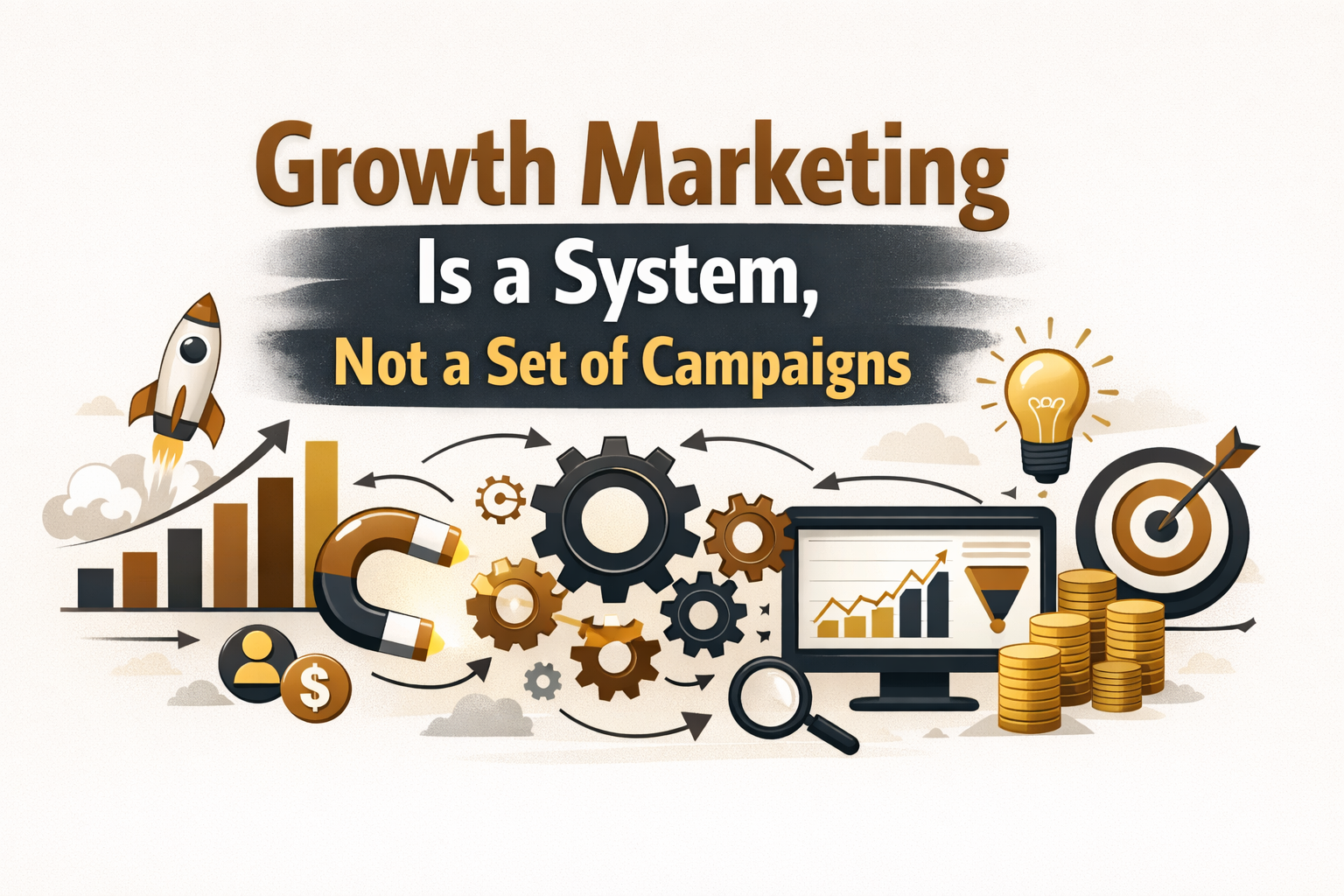
This article explains why growth marketing is a system, not a set of campaigns, and how teams move from activity-driven growth to structure-led results.
Traditional marketing focuses on visibility. While today’s Growth marketing services focus on outcomes. Let’s take a look at this brief difference:
| Area | Traditional Marketing | Growth Marketing |
| Core Focus | Awareness and visibility | Predictable growth and revenue impact |
| Primary goal | Reach more people | Create demand and convert it into a pipeline |
| View of channels | Channels operate independently | Channels work as part of a growth system |
| Measurement | Impressions, reach, clicks | Conversion, CAC, pipeline, revenue |
| Approach to execution | Fixed plans and static calendars | Adaptive systems that improve over time |
| Customer Journey | Often top- or mid-funnel focused | Full lifecycle from awareness to advocacy |
A growth marketing system is not a set of tools or campaigns. It is how demand, conversion, data, and sales work together to create consistent outcomes. Each part has a clear role. Each part supports a predictable pipeline, not just activity.
Below are the four components that matter most.
Traffic by itself does not create growth. It only creates movement. When traffic has no intent, it fails to convert and weakens pipeline quality.
Demand creation focuses on the right audience, the right message, and the right timing. It speaks to real problems and reaches buyers who are ready to act. This is where a strong growth marketing strategy becomes crucial.
When demand is created properly, leads enter with context. Sales conversations start warmer. The pipeline becomes more stable. This is how growth systems improve pipeline quality, not just volume.
Most teams focus conversion on landing pages. That is only one part of the journey. In a growth system, conversion is designed at every stage, from first touch to sales conversation.
Each interaction moves the buyer forward. Nothing feels disconnected. This reduces friction and removes guesswork for both buyers and teams.
Instead of relying on funnel hacks, the system creates continuity. Buyers know what to do next. Teams know what to improve next. This consistency supports long-term pipeline growth.
Reporting shows what happened. Decision data shows what to fix. Many teams collect data but do not act on it. Dashboards grow, but clarity does not.
But in a growth marketing system, data has a clear purpose. It helps teams choose priorities, spot drop-offs, and test improvements. Metrics guide action, not explanations.
This is how data reduces waste and improves focus. It is also why system-led growth marketing services rely on decision data, not vanity metrics.
Alignment should not depend on meetings or shared documents. In a growth system, alignment is built into the process.
Marketing creates demand that sales can close. Sales feedback improves future demand. There is no handoff gap and no confusion about lead quality.
When sales and marketing operate inside the same system, friction drops. Trust improves. The pipeline becomes easier to predict. That is the real advantage of system-led growth marketing services.
Frameworks are not the problem. Context is.
Most growth frameworks are meant to create clarity. When they fail, it is rarely because the framework is flawed. They fail because they are used in isolation.
Many teams treat frameworks like task lists. AARRR (Acquisition, Activation, Retention, Revenue, Referral) is a common example. It becomes a set of boxes to fill instead of a way to understand how growth actually flows through the business.
This leads to local optimization. One stage improves while the rest stay weak. Learning does not carry forward. Wins stay isolated. Losses repeat.
A growth system changes that outcome. When demand, conversion, data, and sales operate inside one loop, frameworks gain context. They guide focus. They help teams decide what to improve next.
That is how results compound instead of resetting.
Below are a few reasons:
Ultimately, campaigns chase outcomes, while systems produce them.
Many teams track numbers without controlling the journey behind them. That is where confusion starts.
CAC looks simple, but without journey control, it hides the real issue. Traffic quality, message clarity, and handoff gaps all affect cost. When these break, CAC rises even if execution looks busy.
Improving one step does not fix the whole pipeline. A better landing page cannot repair weak demand or poor follow-up. Pipeline improves only when the full flow works together.
In a growth system, metrics guide action. They show where friction exists and what to fix next. CAC, LTV, and churn then appear as effects, not targets.
This is how systems turn reports into decisions.
A strong tactic can create attention. It cannot fix the full journey. When demand is unclear or follow-up is weak, results drop. Leads arrive, but the pipeline does not move.
This is why effort increases while outcomes stay flat. The tactic works. The system does not.
Growth does not happen in isolation. Each step depends on the one before it. When tactics are launched without sequence, teams optimize the wrong part of the journey.
Integration matters more than tools. Messaging, conversion paths, and sales motion must connect. Without this, even the best tools create noise instead of growth.
Adding channels often feels like progress. In reality, it can hide system gaps. More channels increase complexity and dilute focus when the structure is weak.
Strong growth systems do not rely on constant expansion. They rely on clarity. When the system is sound, fewer tactics produce better results.
Below are some of the things to avoid in structure and focus:
High traffic looks good on reports. It does not guarantee a pipeline. Without intent, traffic weakens conversion and inflates CAC.
One-off campaigns create spikes. They do not build momentum. When each campaign resets learning, growth stays unstable.
Clicks and impressions show movement, not impact. Pipeline, conversion, and revenue show whether a growth marketing strategy is working.
Improving a landing page alone does not fix pipeline gaps. Growth systems fail when teams treat problems as isolated.
More channels often increase noise. When the structure is weak, expansion makes growth harder, not faster.
These examples work because they were built as systems. Not campaigns. The examples used a growth marketing strategy to achieve massive scale.
Dropbox – Referral as a Feedback Loop
Dropbox did not treat referrals as a one-time tactic. The product itself encouraged sharing. Every new user increased the chance of another. This created a feedback loop where usage drove distribution. Demand compounded because the system rewarded the right behavior at the right moment.
HubSpot—Inbound as Distribution Infrastructure
HubSpot’s inbound approach was not about content volume. It was about building long-term distribution. Content attracted demand early. Tools captured intent. Sales followed context. Each layer reinforced the next. Over time, demand compounded because learning and reach carried forward.
Airbnb – Leveraging Existing Distribution
Airbnb did not create demand from scratch. It tapped into an existing network. The Craigslist integration extended reach without adding friction. Listings gained visibility where demand already existed. This distribution leverage allowed growth without proportional spending.
There is a clear moment when growth starts to feel fragile. Results depend too much on the next campaign. One quarter looks strong. The next feels uncertain. Confidence drops, even when effort stays high.
This usually happens when spending increases, but outcomes do not. Budgets grow. Tools are added. Teams work harder. Yet the pipeline does not move in the same direction. CAC rises. Forecasts become harder to trust.
At this stage, the problem is no longer execution. Campaigns are running. Channels are active. The issue is that growth has no structure holding it together.
This is when companies begin to rethink their growth marketing strategy. Not to run more campaigns, but to understand why results do not compound. They need clarity on demand flow, conversion paths, and sales alignment.
That is also when teams start looking for growth marketing services differently. Not as execution support or extra hands. But as system builders who can design how growth works end-to-end.
Once growth is treated as a system, results stabilize. Spending becomes easier to control. Pipeline becomes easier to predict.
These questions reveal how growth really works inside your business.
Growth becomes fragile when it depends on constant campaigns. It becomes reliable when it is built as a system. That is the core shift this blog highlights.
A strong growth marketing strategy connects demand creation, conversion, data, and sales into one flow. When this structure exists, learning compounds, CAC stabilizes, and the pipeline becomes easier to predict. This is how growth systems support long-term results, not short-term spikes.
If growth in your business feels uneven, the issue is rarely effort or channels. It is usually structure. Fixing that structure is what turns activity into outcomes.
If you are ready to move beyond campaign-led growth and build a system that compounds, explore how Growthym’s growth marketing services help companies design growth that lasts.
What does growth marketing actually do?
Growth marketing services design how demand turns into revenue. It connects audience intent, messaging, conversion paths, and sales into one system. The goal is not traffic alone, but a predictable pipeline and steady growth.
What are the best growth marketing strategies for 2026?
A strong growth marketing strategy should focus on systems. Teams that align demand generation, conversion, data, and sales are going to see better results than those chasing new platforms. Structure will matter more than tactics in 2026.
How does poor system design inflate CAC?
When the buyer journey is unclear, spending increases without improving results. Leads drop off, sales cycles stretch, and teams compensate with more budget. This is how weak growth systems push CAC higher over time.
Why do growth wins stop compounding over time?
Growth wins stop compounding when learning resets after each campaign. Without a system, improvements stay isolated and are not reused. This makes growth dependent on constant effort instead of structure.
Why do most growth frameworks fail in execution?
Frameworks fail when they are treated as task lists. Without an effective growth marketing strategy and system behind them, teams optimize parts instead of flow. Execution breaks because context is missing.
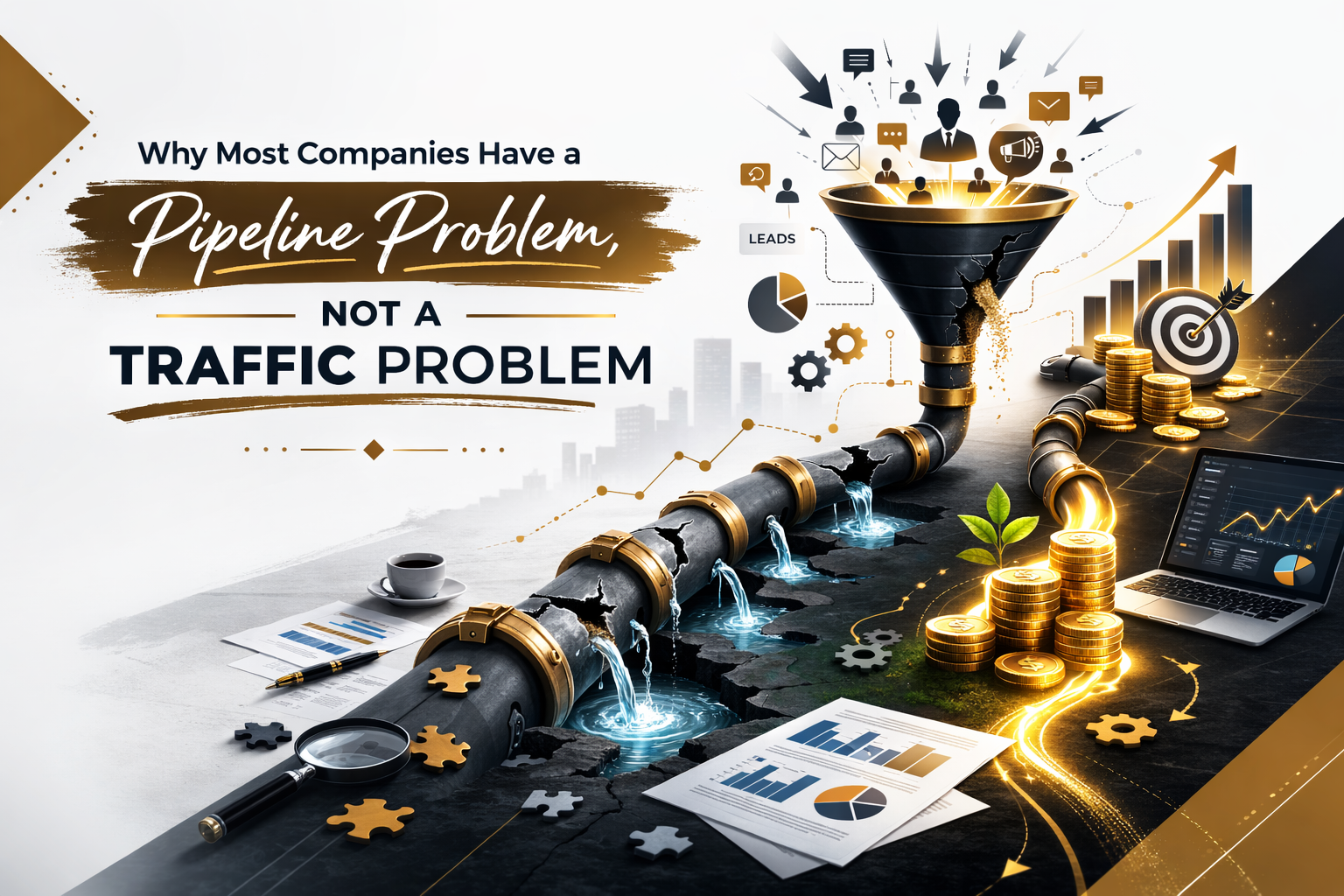
Most marketing agencies, creative agencies, and consultancies are working hard to win clients. Deals are dragging, prospects are ghosting, and proposals seem to disappear. Most founders are frustrated—they are running campaigns, booking calls, and sending proposals. Still, their pipeline feels stuck and unpredictable.
So, what do you think? Is it a traffic problem or a pipeline problem?
Most businesses immediately blame traffic. Then, throw more budget at ads, spin up new SEO pages, and hope this will fix the issue.
But reality is different; you don’t need more people seeing your brand, but more people believing in it. And it is not built by shouting louder or pushing harder. Rather, it is about showing up with clarity, consistency, and proof that you understand the issue better than anyone else.
So, here in this blog, we will uncover why trust, not traffic and leads, is what’s keeping your funnel from converting, and how shifting your marketing effort can actually pull in the right leads.
Traffic growth feels like progress. Dashboards look healthier. Reports look positive. But traffic alone does not create pipeline reliability. In many cases, it simply hides structural inefficiencies further down the funnel.
Illusion often begins at:
Traffic, impressions, click-through rates, and engagement. These numbers create the appearance of demand. But unless they translate into qualified opportunities and closed revenue, they are surface indicators.
Vanity metrics become dangerous when they:
Content marketing is often mistaken for a pipeline strategy.
Publishing blogs, whitepapers, webinars, and LinkedIn posts can build visibility. But visibility without a structured conversion path creates passive audiences instead of active buyers.
When content lacks conversion architecture:
A predictable pipeline requires content to be mapped to funnel stages, buying signals, and qualification checkpoints.
Content should not just educate but also move accounts forward.
Without that structure, traffic increases while conversion stability declines.
Paid acquisition can scale traffic quickly. That’s its strength.
But if targeting is broad, qualification is weak, and stage tracking is unclear, paid traffic amplifies inefficiency.
More spending leads to:
Paid traffic works when it feeds a disciplined system. It fails when it feeds an undefined funnel.
The difference between traffic growth and predictable pipeline growth is simple—traffic measures visibility. Pipeline measures revenue progression.
And without structure, visibility does not convert into reliability
A predictable pipeline is not about perfect forecasting. Rather, it is about knowing where your next opportunities will come from, even before they show up. It is an integrated strategy to find, reach, and convert prospects into customers that aligns sales and marketing.
The goal is to define clear business objectives, integrate sales and marketing details and sales enablement into the next stage of the sales cycle, and enhance B2B marketing for value and referrals.
A predictable pipeline strategy requires three capabilities:
And without these, opportunity detection creates noise instead of a pipeline.
When done correctly, predictable pipeline systems improve:
And this is where most companies underestimate the gap between demand generation and actual pipeline engineering.
A pipeline usually doesn’t break overnight. It leaks slowly and quietly. And most teams don’t notice until revenue starts missing targets.
So, here’s where it breaks often:
If your Ideal Customer Profile is too broad, outdated, or based on assumptions instead of revenue data, everything downstream suffers.
Marketing attracts interest. Sales struggles to convert it. Deals stall because the buyer was never a strong fit to begin with.
Most funnels don’t fail at the top. They fail between stages.
Leads don’t become qualified opportunities. Opportunities don’t progress to a proposal. Proposals don’t convert to closed-won.
Every drop-off compounds inefficiency.
When stage conversion rates are inconsistent:
Pipeline growth without stage stability creates volatility. And volatility makes scaling risky.
Predictability comes from knowing your conversion benchmarks at every stage and actively managing them.
If marketing and sales define “qualified” differently, friction follows.
Marketing celebrates MQL volume. Sales rejects lead quality. Leadership sees pipeline numbers that don’t reflect revenue reality.
Weak qualification frameworks create inflated pipelines that collapse under scrutiny.
Clear qualification criteria should answer:
Without a structured qualification, you don’t have a pipeline. You have a contact list.
And that distinction matters for CAC control and close rate stability.
If you cannot trace revenue back to its source, optimization becomes opinion-driven.
And lack of attribution clarity results in:
A predictable pipeline requires revenue-level attribution, not just lead-level reporting.
Because pipeline engineering is not about generating movement. It’s about generating measurable, repeatable revenue progression.
Demand generation and pipeline engineering are deeply rooted in today’s marketing. This ultimately creates a valuable opportunity to reach out to prospects in different ways. Below is the revenue-focused difference between demand generation and pipeline engineering.
| Aspect | Demand Generation | Pipeline Engineering |
| Primary Objective | Create awareness and interest in the market | Convert interest into qualified revenue opportunities |
| Core Question | Are the right people discovering and engaging with us? | Are engaged prospects moving predictably toward revenue? |
| Focus Area | Top-of-funnel expansion | Full-funnel structure and conversion |
| Key Activities | Content marketing, paid acquisition, brand campaigns, webinars, nurturing | ICP refinement, qualification frameworks, funnel optimization, stage tracking, attribution |
| Metrics Tracked | Traffic, engagement, MQLs, cost per lead | SQLs, opportunity rate, stage conversion %, CAC, revenue forecast accuracy |
| Revenue Impact | Increases potential pipeline volume | Increases pipeline reliability and close rates |
| Outcome | Pipeline growth potential | Predictable pipeline performance |
A strong pipeline is built when acquisition, qualification, and sales progression operate as one system—grounded in revenue data, not activity metrics. And when a pipeline is healthy, growth feels natural. On the other hand, when it’s broken, no amount of marketing spend or sales tactics can compensate.
Hence, if you are seeing signs like inconsistent revenue, stagnant deals, or unpredictable forecasts, consider it an opportunity. You can transform your pipeline from a leaky system into a powerful growth engine by defining clear stages, using automation wisely, and aligning sales and marketing.
Ultimately, your pipeline will either be an asset that compounds your marketing efforts or a liability that silently drains them. But the good news is you can choose which one it becomes.
So, build a predictable pipeline system.
That’s how we at Growthym approach growth marketing as pipeline engineering designed for revenue reliability, not as channel execution. So, if you are interested
In simple terms, a pipeline problem means that you are generating traffic or leads. But these actions are not converting into qualified opportunities or revenue. It is a system-level issue where the “pipeline” (the process of turning leads into customers) is inefficient, which is often mistaken for a lack of traffic or lead volume.
Can high traffic still result in poor pipeline growth?
Yes, even high traffic can definitely result in poor pipeline growth. It is because of underlying issues that hinder revenue growth. Primary reasons why high traffic can result in pipeline break are low-quality leads, poor conversion rates, misaligned marketing and sales, etc.
Why is a predictable pipeline harder to achieve than traffic growth?
It is because traffic growth can often be purchased or engineered through digital marketing, and a predictable pipeline is about guiding human behavior and maintaining high-quality data.
How is demand generation different from lead generation?
Demand generation is about creating brand awareness and interest. On the other hand, lead generation is about converting that interest into actionable and qualified prospects. Also, demand generation works at the top of the funnel, targeting a broad audience to build a reputation. And lead generation acts at the bottom to focus on capturing contact information.
What are the early signs that a company has a pipeline problem?
Early signs include stagnant deals, poor lead quality, reduced engagement, and inaccurate forecasting.
How does poor demand generation impact CAC?
Poor demand generation directly increases Customer Acquisition Cost (CAC) by bringing unqualified, low-intent traffic into the sales funnel, resulting in lower conversion rates and wasted sales efforts. When demand generation is ineffective, businesses frequently waste money on broad targeting, resulting in a higher cost to acquire each new customer.
What role does growth marketing play in building a predictable pipeline?
Growth marketing builds a predictable pipeline by shifting from large-scale campaigns to a data-driven, iterative, and full-funnel approach. It focuses on ongoing testing of channels, Customer Acquisition Costs (CAC), and improving retention to build a sustainable and scalable revenue engine instead of relying on only one-off incentives.
In today’s fast-paced digital world, staying ahead of the competition requires more than just traditional marketing strategies. Businesses need innovative, data-driven approaches that not only attract new customers but also retain existing ones. This is where Growthym’s AI-powered growth marketing services come into play.
Artificial Intelligence (AI) has revolutionized various industries, and marketing is no exception. AI-powered growth marketing leverages advanced algorithms and machine learning to provide deeper insights into customer behavior, optimize marketing campaigns, and deliver personalized experiences. Here are some key reasons to choose AI-powered growth marketing:
At Growthym, we offer a comprehensive suite of AI-powered growth marketing services designed to transform your business. Here’s a closer look at our offerings:
Case Study: Elevating Brand Presence for a Tech Startup A tech startup aimed to increase its market presence. Through our AI-powered SEO audit and strategic content development, we boosted their organic traffic by 50% and lead generation by 35% in six months.
Case Study: Boosting Engagement for an E-commerce Platform An e-commerce platform struggled with low engagement. Our AI-driven email marketing campaigns and social media strategies increased email open rates by 40% and social media followers by 25%.
Case Study: Increasing Conversions for a Financial Services Firm A financial services firm sought to improve their conversion rates. By utilizing our AI-powered predictive insights and targeted marketing strategies, we achieved a 30% increase in conversion rates within three months.
AI-Driven Strategies: Our AI-powered solutions provide deeper insights and faster optimizations, leading to higher engagement and conversion rates.
Customized Solutions: We tailor our services to meet your specific business needs and goals, ensuring effective and targeted marketing strategies.
Proven Results: Our success stories highlight our ability to deliver significant improvements in brand awareness, customer engagement, and lead generation.
In the rapidly evolving digital landscape, businesses must adopt innovative marketing strategies to stay competitive and drive growth. Growthym’s AI-powered growth marketing services offer a comprehensive approach that leverages advanced AI technologies to optimize digital interactions and enhance customer experiences. By integrating AI into your marketing efforts, you gain access to deeper insights, more efficient optimizations, and personalized customer engagements that drive superior results.
Our services, including comprehensive AI-powered SEO audits, strategic content development and distribution, AI-driven email marketing campaigns, social media community building, predictive customer insights, and advanced analytics solutions, are designed to meet the unique needs of your business. The success stories of our clients, from tech startups to e-commerce platforms and financial services firms, demonstrate the transformative impact of our AI-powered strategies.
Choosing Growthym means partnering with a growth marketing agency that prioritizes data-driven insights, scalable solutions, and proven results. Our customized approaches ensure that your marketing strategies are tailored to your specific goals, helping you achieve significant improvements in brand awareness, customer engagement, organic traffic, and lead generation.
Are you ready to transform your business with AI-powered growth marketing? Contact Growthym today to learn how our innovative solutions can help you achieve your growth goals. Embrace the future of marketing with Growthym and unlock your business’s full potential.
Are you ready to transform your business with AI-powered growth marketing? Contact Growthym today to learn how our innovative solutions can help you achieve your growth goals.
In today’s competitive marketplace, B2B customer acquisition is more critical than ever for small and medium-sized businesses (SMBs) striving to scale their operations and increase revenue. With limited resources and budgets, SMBs need to implement effective customer acquisition strategies that are both efficient and scalable. This comprehensive guide explores proven B2B customer acquisition strategies, tactics, and tools tailored specifically for SMBs. Whether you’re a startup or an established company looking to expand your client base, this guide will provide actionable insights to enhance your acquisition marketing efforts.
B2B customer acquisition refers to the strategies and processes businesses use to attract, engage, and convert other businesses into customers. Unlike B2C (Business-to-Consumer) models, B2B transactions often involve longer sales cycles, higher-value contracts, and more complex decision-making processes. Understanding the nuances of B2B customer acquisition is essential for SMBs aiming to establish strong, lasting relationships with their clients.
For SMBs, especially those with revenues under ₹50 crore, customer acquisition is the lifeblood of growth. Acquiring new clients not only increases revenue but also enhances brand visibility and market presence. Effective customer acquisition strategies enable SMBs to:
Creating an effective B2B acquisition strategy involves several critical steps. This section outlines the foundational elements required to develop a strategy that aligns with your business goals and resonates with your target audience.
Understanding who your ideal clients are is the first step in crafting an effective acquisition strategy. Consider the following factors:
Establishing specific, measurable, achievable, relevant, and time-bound (SMART) goals ensures that your acquisition efforts are focused and effective. Examples of acquisition goals include:
A compelling value proposition clearly communicates the unique benefits your business offers to clients. It should address the specific needs and pain points of your target audience. Elements of a strong value proposition include:
Implementing a structured customer acquisition process helps SMBs systematically attract and convert new clients. Here are the essential steps:
Lead generation is the process of attracting potential clients interested in your products or services. Effective lead generation tactics include:
Once you’ve generated leads, it’s essential to nurture them through the sales funnel. Lead nurturing involves:
Optimizing your website and sales processes to convert leads into customers is crucial. Conversion optimization strategies include:
Acquiring new customers is important, but retaining existing ones is equally vital. Retention strategies include:
Implementing the right customer acquisition tactics can significantly enhance your ability to attract and convert B2B clients. Here are some proven tactics to consider:
Content marketing involves creating and distributing valuable, relevant content to attract and engage your target audience. Effective content marketing tactics include:
SEO is essential for increasing your online visibility and driving organic traffic to your website. Key SEO strategies include:
Email marketing remains one of the most effective channels for B2B customer acquisition. Successful email marketing tactics include:
Leveraging social media marketing can help you connect with potential clients and build brand awareness. Effective strategies include:
Paid advertising can accelerate your customer acquisition efforts by driving targeted traffic to your website. Key paid advertising strategies include:
Leveraging the right customer acquisition tools can streamline your marketing efforts and enhance efficiency. Here are some essential tools for SMBs:
A robust CRM system helps you manage and analyze interactions with current and potential clients. Popular CRM tools include:
Marketing automation platforms enable you to automate repetitive marketing tasks, allowing you to focus on strategy and creativity. Top marketing automation tools include:
Understanding the effectiveness of your customer acquisition campaigns requires robust analytics and reporting. Essential tools include:
Learning from successful customer acquisition strategies can provide valuable insights for your own efforts. Here are two case studies illustrating effective strategies:
Company: TechSolutions, a SaaS startup offering project management tools.
Strategy:
Results:
Company: CreativeVideos, a video production company catering to B2B clients.
Strategy:
Results:
To maximize the effectiveness of your customer acquisition strategy, it’s essential to continuously optimize your processes. Here are key optimization techniques:
A/B testing involves comparing two versions of a webpage, email, or ad to determine which performs better. By testing different elements such as headlines, images, and CTAs, you can identify the most effective variations and improve your conversion rates.
Personalizing your marketing efforts can significantly enhance engagement and conversion rates. Techniques include:
Regularly monitoring the performance of your customer acquisition campaigns is crucial for identifying areas of improvement. Key metrics to track include:
Effective B2B customer acquisition is a multifaceted process that requires a strategic approach tailored to the unique needs of SMBs. By implementing proven customer acquisition strategies, leveraging the right tools, and continuously optimizing your processes, your business can attract and retain valuable B2B clients, driving sustained growth and success.
Remember, customer acquisition is not a one-time effort but an ongoing strategy that evolves with your business and market dynamics. Stay informed about the latest trends, continually refine your tactics, and prioritize building strong relationships with your clients to ensure long-term success.
B2B customer acquisition targets other businesses and typically involves longer sales cycles, higher-value transactions, and more complex decision-making processes. In contrast, B2C customer acquisition targets individual consumers, often with shorter sales cycles and lower transaction values.
Effective channels include content marketing, SEO, email marketing, social media marketing (especially LinkedIn for B2B), and paid advertising. The best channels depend on your target audience and industry.
Key metrics include Cost Per Acquisition (CPA), Customer Lifetime Value (CLTV), conversion rates, and Return on Investment (ROI). Using analytics tools like Google Analytics and CRM systems can help track these metrics.
Cost-effective tactics include content marketing (blogging, eBooks), SEO, social media engagement, email marketing, and leveraging free or affordable marketing automation tools.
Personalization significantly enhances engagement and conversion rates by making your marketing efforts more relevant and tailored to the specific needs and preferences of your leads and clients.
Today, every business faces cut-throat competition. It poses a huge challenge to growth and sustainability for businesses. In this crowded marketplace, you can only survive with effective marketing that drives sustainable growth and success. In this journey, a reliable growth marketing agency in India can help you make your dream come true. They offer you their expertise and strategies that help your business thrive. Today, India is a hotspot of diverse marketing agencies. These agencies are cost-effective and offer innovative and data-driven marketing solutions. With tailored services that meet the needs of diverse businesses, these agencies ensure long-term success. There are many good reasons why you should opt for a growth marketing agency in India. Let’s see those reasons below.
A good reason why you should go for a growth marketing agency in India is the affordable services they offer. Indeed, you can get high-quality services from agencies in India that too at cost-effective rates. In fact, their rates are lower compared to their Western counterparts. For sure, this cost benefit is a boon for businesses like startups and SMEs. They can get premium marketing services without putting a heavy strain on their budgets. So, it’s a good deal for:
With a vast and diverse talent pool of skilled marketing professionals in India. You have good options to choose professionals for growth marketing services such as SEO, social media management, content marketing, PPC advertising, etc. By partnering with an Indian agency, you can tap into this diverse and large talent pool to benefit from comprehensive and multifaceted marketing campaigns. So, it brings you a bunch of benefits like:
The growth marketing agencies in India always focus on the latest technologies and data analytics that enable them to provide top-notch services that ensure success. They build actionable strategies that drive tangible results. Besides, they focus on continuous experimentation, testing, and optimization enabling them to build strategies that align with your business goals. Key components of their services include:
A growth marketing agency in India can also adapt to your evolving needs. So, there are no worries about scalability as Indian agencies are able to handle projects of varying sizes and complexities. It ensures that your marketing efforts align with your goals as your business grows. It boils down to:
You can get a wide range of services from Indian growth marketing agencies that cover different aspects of digital marketing. Additionally, they offer competitive services that are at par with Western agencies. Whether you are looking for strategic planning, content creation, performance analysis, or anything else, you can get end-to-end solutions with these agencies. They streamline all your marketing efforts.
You can find plenty of growth marketing agencies in India with a proven track record of delivering successful campaigns. They are proficient and experienced in catering to clients in various industries. Their expertise and experience enable them to build marketing strategies that lead to the best outcomes for clients.
ROI and performance metrics are the prime focus of growth marketing agencies. It means these agencies ensure that your marketing investments give you tangible results. They consider key performance indicators (KPIs) to evaluate the outcomes and continuously optimize strategies. It allows you to maximize your marketing effectiveness.
Today, growth marketing is crucial for businesses to stay competitive and ensure consistent growth. You need the best services to meet your goals. The role of a growth marketing agency in India is pivotal in this initiative. You can choose them for many benefits including cost-effective solutions, a diversified talent pool, result-driven strategies, and more. They will help you with the necessary expertise and experience. Choose a reliable agency in India to get remarkable outcomes.
Creating a good content brief takes time. Research, keyword planning, and structure can take hours. This delay slows your content production.
AI now changes that. You can create content briefs in minutes with the right tools. These AI-powered briefs are fast, consistent, and data-driven. They use live search data and competitor insights to guide your writers.
In this guide, you’ll learn how to build a complete AI-powered content brief in just 15 minutes. We’ll use practical steps, proven methods, and real examples.
If you want to understand AI’s role in SEO, read our AI SEO Guide.
An AI-powered content brief is a document that AI creates with data analysis. It includes target keywords, audience details, and a suggested content structure.
Unlike traditional briefs, AI-generated briefs pull data from SERPs, competitor pages, and keyword tools. This makes them more accurate and faster to create.
Key parts of an AI-powered content brief:
Using AI also reduces human error and keeps your briefs consistent. If you need full-service support, check our AI SEO Services.
AI can transform how you prepare content briefs. It turns long manual work into a quick, data-backed process.
Manual research can take hours. You need to check keywords, review competitors, and outline the content. AI does this in minutes. It scans SERPs, finds relevant keywords, and suggests an outline instantly.
When different writers prepare briefs, structures can vary. This affects quality. AI keeps a standard format for every brief. This helps writers follow a clear structure and saves editing time.
AI briefs include SERP analysis, keyword clustering, and competitor research. They highlight ranking opportunities and content gaps. This ensures your content targets real search demand, not guesses.
If you run a content team, speed and quality matter. AI helps you produce more briefs without losing accuracy. This makes it possible to scale content production without hiring more staff.
A mid-sized eCommerce company used manual briefs. Each brief took 3 hours to prepare. After adopting AI briefs through AI Growth Discovery Sprint, they cut the time to 15 minutes.
Writers received briefs with keyword priorities, search intent notes, and suggested headlines. As a result:
AI-powered content briefs don’t replace SEO strategy—they make it faster and more accurate. They ensure your writers work with clear, research-backed guidance.
For teams looking to track performance, the AI Growth Analytics Hub can help measure the impact of these briefs on traffic and conversions.
A strong content brief ensures writers know exactly what to create. AI-generated briefs make this process faster and more consistent. But the quality depends on the elements you include.
Define your reader persona clearly. Include their interests, search intent, and pain points. For example, a B2B software buyer looks for detailed feature comparisons, not just benefits. AI tools can extract these details from SERP patterns and competitor analysis.
Choose one primary keyword and a set of supporting keywords. These should come from data, not guesswork. Use AI to filter by search volume, difficulty, and intent. This helps you target both main and long-tail opportunities.
Provide a clear heading structure (H1, H2, H3). AI can suggest this based on top-ranking pages. It ensures all key topics are covered and prevents gaps in coverage.
Match your content length to top competitors. If the top pages have 2,000 words, aim for a similar range. Format for easy scanning with bullet points, short paragraphs, and visuals.
Keep your brand voice consistent. If your tone is friendly but technical, note that in the brief. AI can help maintain this style across multiple writers.
Highlight featured snippet opportunities, “People Also Ask” topics, and missing subtopics. AI analysis of SERPs can point out gaps that your content can fill.
Include internal links to relevant pages, like SEO Services, and credible external sources. This improves authority and user trust.
When all these elements are in place, AI-generated briefs become a powerful tool. They guide writers with precision while ensuring your content has a competitive edge in rankings.
AI makes it possible to create a high-quality content brief in minutes instead of hours. Below is a fast, structured process you can follow.
Start by selecting a topic that supports your business goals and SEO strategy.
For example, a company offering AI SEO solutions might choose “AI SEO Guide for Beginners” to attract businesses new to AI-driven marketing.
Use AI along with SEO tools like Semrush, Ahrefs, or Google Search Console. Integrate this data into ChatGPT for SERP opportunity analysis.
AI reduces manual work here by combining keyword, SERP, and competitor data in one view.
AI can process top-ranking pages to find:
For example, if competitors don’t include case studies, you can add links like the Eco-Friendly Products Case Study to stand out.
With the data ready, use ChatGPT to create a clear content structure.
Example prompt for ChatGPT:
“Create an SEO-optimized content outline for the keyword ‘AI SEO Tools,’ including headings, subheadings, and bullet points. Match competitor word count and include featured snippet opportunities.”
AI gives speed, but human review ensures quality.
Once done, you have a content brief that’s data-backed, SEO-optimized, and ready for writers — all in under 15 minutes.
If you follow this process, your content production becomes faster, more consistent, and strategically aligned with your growth goals.
AI makes creating content briefs faster and more consistent, but relying on it blindly can lead to mistakes. The most effective approach is to treat AI as your research and structuring assistant, while you provide the judgment, creativity, and industry expertise. Below are key best practices to make sure your AI-powered briefs drive results and maintain high content quality.
Never send AI-generated briefs directly to writers without checking the data. AI tools can speed up keyword research, SERP analysis, and competitor comparison, but they can also present outdated or irrelevant information. This happens because AI predictions are only as good as the data they receive. If the source data is incomplete or inaccurate, the entire brief can lose credibility. Before sharing with writers:
By validating this information, you protect your brand from publishing misleading content and increase the chances of ranking well on search engines.
AI can’t fully understand your brand’s voice, customer preferences, or internal success stories unless you train it with that data. Without these inputs, the content may sound generic and fail to connect with your audience. Adding brand-specific insights ensures the final article reflects your identity and stands apart from competitors. You can do this by:
This not only improves engagement but also makes your content memorable and trustworthy.
While AI excels at processing large datasets and spotting SEO patterns, it can’t replace the emotional intelligence, storytelling ability, and real-world experience of a human writer. By blending AI’s speed with human creativity, you get the best of both worlds — factual accuracy and engaging delivery. Consider this workflow:
This mix ensures your content feels personal, credible, and aligned with your audience’s expectations.
SEO is not static — algorithms, SERP layouts, and keyword trends change frequently. An AI-powered brief created six months ago might now be outdated. To keep your content performing well:
Staying proactive with updates ensures your AI-powered content briefs remain competitive and continue to deliver results over time.
AI can make content brief creation faster and more consistent, but only if it’s used the right way. Many teams lose potential ranking power and audience engagement because they skip critical checks or misuse the technology. Here are the most common mistakes to watch out for — and how to avoid them.
One of the biggest mistakes is taking AI’s keyword, SERP, or competitor suggestions at face value. While AI can process massive amounts of data quickly, it can still misinterpret search intent or pull outdated information. Always verify statistics, ranking data, and competitor details with trusted SEO tools before finalizing the brief.
It’s tempting to add every keyword AI suggests, but stuffing a brief with excessive keywords can lead to unnatural writing and poor user experience. Focus on one primary keyword and two to four secondary keywords that are highly relevant to the topic. This keeps the content clear, SEO-friendly, and easy for writers to follow.
Even the most data-rich AI brief will fail if it doesn’t connect with the right audience. AI might suggest a tone that doesn’t match your brand or overlook audience-specific needs. Include clear tone guidelines and audience personas in every brief so the final content resonates.
AI tools often provide competitor-based outlines but may miss unique opportunities to stand out. Review SERP features like “People Also Ask” boxes, videos, and featured snippets. Identify content gaps competitors haven’t covered and add them to your brief for a competitive advantage.
AI tools make it easier to collect keyword data, analyze SERPs, and create structured briefs in minutes. Below are some of the most effective options and what they offer.
ChatGPT is a flexible AI writing assistant that can create detailed content outlines, suggest headings, and generate keyword ideas when combined with SERP data. It’s best used with a clear prompt structure for accurate results.
Jasper specializes in marketing content creation. It offers templates for blog outlines, product descriptions, and ad copy. It integrates with SurferSEO to align briefs with SEO data.
SurferSEO focuses on on-page optimization. It provides keyword clusters, competitor outlines, and content score tracking, helping ensure briefs match top-ranking content structure.
Clearscope analyzes top-ranking pages and suggests relevant keywords, readability improvements, and content structure updates for better SEO performance.
Frase automates SERP analysis and competitor research, delivering AI-generated outlines and questions to cover. It’s useful for building briefs around search intent.
Content Harmony creates SEO-driven briefs with keyword targeting, competitor comparisons, and recommended visuals for stronger engagement.
AI has changed the way marketing teams create content briefs. What once took hours of manual research, keyword collection, and competitor analysis can now be done in minutes. With tools like ChatGPT, SurferSEO, and Frase, you can quickly pull SERP data, analyze competition, and create outlines that match both search intent and brand goals.
The real advantage lies in combining AI’s speed with human creativity. AI delivers data-backed recommendations, but it’s your insights, industry knowledge, and brand voice that turn a good brief into an exceptional one. By adopting AI-powered workflows, you can scale content production, maintain quality, and stay ahead in competitive search results.
Now is the best time to test these tools in your process. Start with one article, measure results, and refine your prompts and structure. The sooner you integrate AI into your content strategy, the faster you’ll see measurable improvements in SEO performance and team efficiency.
AI-generated briefs are highly accurate when based on reliable data sources like SERP APIs, keyword research tools, and competitor analysis. However, accuracy depends on prompt quality and the freshness of the data. Always review and fact-check before sharing with writers.
Yes. AI works best when combined with SEO tools like Ahrefs, Semrush, or SurferSEO. These tools provide up-to-date keyword data, search volume trends, and SERP insights that AI alone cannot always generate in real time.
AI-powered briefs are versatile and work across most industries, from eCommerce to B2B software. However, niche sectors with strict regulations—like healthcare or finance—require additional human oversight for compliance and accuracy.
To maintain originality, add brand-specific insights, unique perspectives, and proprietary data. Use AI as a foundation, but customize sections to reflect your tone, style, and expertise. This helps avoid generic content and ensures your briefs stand out in competitive search results.
AI writing tools—be it ChatGPT, Perplexity, Writesonic—are now a routine part of modern marketing. Data reported on Statista shows that over 80% of marketers worldwide use AI in some capacity. That rapid adoption changed copywriting more than most areas of marketing: teams can generate content fast, but speed alone does not create a recognisable brand.
Out of the box, AI tends to produce competent but generic text. Left unchecked, this makes your messaging blend into a crowded feed rather than stand out. That’s where brand voice AI comes in: instead of treating AI as a content factory, you train it to reflect your distinct tone, vocabulary, and priorities so output reads like it came from your team.
At the heart of that training is prompt design — the disciplined craft of writing instructions, examples, and constraints that guide the model’s output. Good prompt design + a feedback loop = consistent, scalable writing that still feels human.
In this guide you’ll get practical, consultancy-style steps to:
Your brand voice is the personality your business communicates through words. It’s how your brand “sounds” — the tone, choice of words, and rhythm you use when speaking to your audience.
Think of it as the written version of your brand’s attitude. Whether you sound friendly and approachable or professional and insightful, that tone is what helps people identify you without even seeing your logo.
This is where brand voice AI comes into play. With AI tools like ChatGPT, businesses can maintain the same tone and writing quality across every channel — at scale. But AI needs to be trained to understand your way of communicating.
Once aligned with your brand voice, it becomes a reliable writing assistant that delivers content true to your brand’s personality — consistent, authentic, and human.
To know more about how to create AI-powered content brief in 15 minutes.
Grasping behind the scenes of AI models, you can better set the brand tone.
Models like ChatGPT do not “think” or “feel.” They work by studying patterns in language:
When you give a prompt, the model predicts what comes next based on those learned patterns. The more context you give it, the better the prediction becomes.
That’s where prompt design comes in.
Prompt design simply means giving clear, structured instructions to guide how the AI writes. It’s about telling the model not just what to write, but how to sound while doing it. For example, you could say:
“Write a product description in Growthym’s tone — clear, confident, and helpful.”
Each time you do this, the AI gets a clearer sense of your writing style. Think of every prompt as a small training exercise — one that helps the model learn your tone, choice of words, and rhythm.
Over time, with consistent prompts and feedback, the AI starts recognizing your style patterns. It picks up your preferred sentence flow, level of formality, and how you balance information with emotion. That’s how it starts sounding less like a generic chatbot and more like an extension of your brand’s voice.
Before you train AI to write like your brand, you need clarity — about who you are, how you sound, and what you stand for. Without that, even the best AI will produce words that do not feel like yours.
These factors form the foundation your AI will learn from.
A brand voice begins with self-awareness. Ask simple but defining questions:
List three to five words that capture your brand’s tone.
Examples: direct, approachable, expert, honest, grounded.
Then write a few lines in that voice — real sentences that sound like your brand, not like a slogan.
AI learns best from clear direction. The more precisely you describe your personality, the more accurately it can mirror it. Vague traits like “professional” or “creative” mean little to a machine. Be specific. Describe the way you talk, not just what you say.
Suggesting to read: How to Rank in Google, SGE, GRO & AI-Powered Search
A voice is shaped by details most people overlook. Define those details early.
Write these down. They’re not rules to limit your brand — they’re patterns that keep your message consistent. AI will pick up your rhythm through these patterns: how you open sentences, when you pause, and how you end. The goal is not perfection. The goal is consistency.
A brand voice is a bridge between your message and your audience. To build that bridge, you need to know who’s listening.
Ask yourself:
AI does not know your audience — you do. It needs you to define the tone that earns trust and keeps attention. The right voice does not talk at your audience. It speaks to them, in their language.
Your voice stays the same; your tone adjusts with the medium.
Teach the AI how your tone shifts without changing your core. The words should always sound like you, even when the rhythm changes.
Every platform carries its own rhythm. Let your brand voice adapt, not drift.
Your tone bends with the platform, but your intent should not. Whether the reader scrolls, clicks, or listens — your brand should feel familiar.
AI writing improves the same way human writing does — through feedback.
Review what it creates. Mark what feels true to your brand and what does not.
If it misses the tone, change the input. Tell it why.
When it gets it right, note the prompt that worked.
Over time, these corrections form a rhythm the AI begins to recognize. The machine learns your pauses, your phrasing, your restraint. It begins to sound less like a tool and more like a voice — your voice.
Creating a brand voice AI takes clarity, patience, and structure.
Here’s how to do it — step by step.
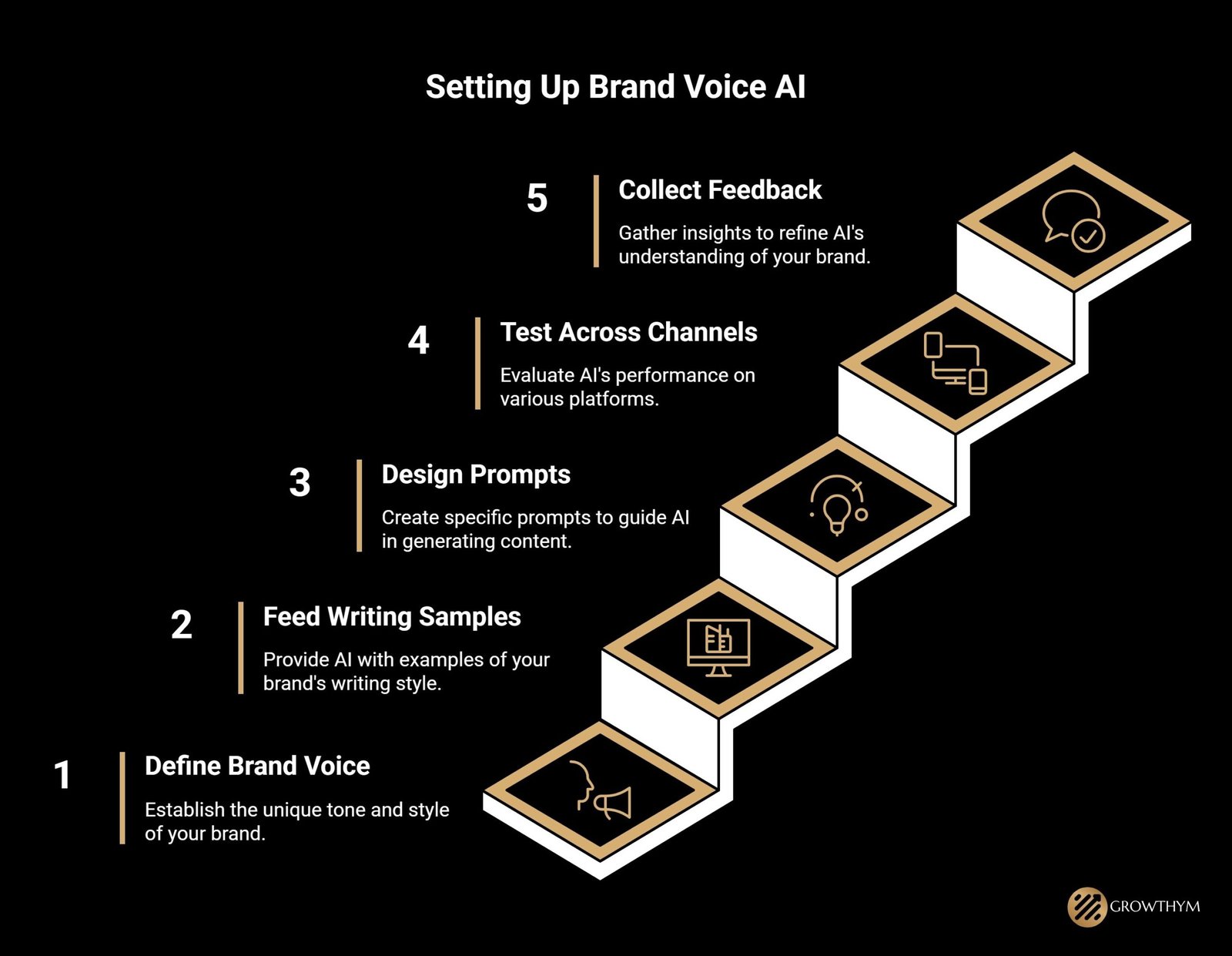
Start with a document. One that captures your tone, your do’s and don’ts, and your real words. Do not describe how you want to sound — show how you actually sound. Add snippets from your blogs, captions, and replies. Note the rhythm in your writing — short lines, pauses, warmth, or restraint.
AI does not learn from adjectives like authentic or bold. It learns from examples. So build your brand voice guide around real sentences, not vague traits.
Give the AI your true work — blogs, LinkedIn posts, captions, newsletters. Let it study how you talk.
Then, ask it:
“Analyze my writing style and summarize my tone.”
This prompt helps you see how the AI interprets your voice. Compare that summary with what you intended. If it sounds off, feed more samples. AI learns best when you give it range — serious, light, detailed, brief.
Every AI output begins with a prompt. And every good prompt has structure:
Context + Task + Tone + Example.
Example:
“You’re writing as Growthym — a consulting agency with an approachable but expert tone. Write a LinkedIn post explaining why enterprises need AI governance.”
This clarity sets boundaries. It tells the AI who it is, what to write, and how to sound. The more structured your prompts, the more natural the output will feel.
A brand voice must adapt without losing itself. Try your AI on different platforms and see how it holds up.
Observe how the tone shifts with each channel. The words should bend, not break. Your brand should still feel the same — only its rhythm should change.
Your first few AI outputs won’t be perfect. That’s part of the process. Read them. Mark what feels true and what does not. When it misses the tone, refine the prompt. When it gets it right, save that format.
Create a simple feedback loop — your observations in, AI adjustments out. With every cycle, it learns you better. Soon, it will write lines that sound less AI-made and more brand-born.
Ethical AI writing is not just about compliance. It’s about conscience. When your brand voice stays honest — powered by AI but guided by people — it earns something no algorithm can replicate: trust.
Be open about using AI in your content process. It builds trust. Your audience does not mind AI help. They mind when the human touch disappears. Make it clear that AI supports your team — it does not speak for your brand.
When brands lean too much on AI, their tone starts to blur. Every line begins to sound polished, safe, and predictable. That’s when people stop listening. Keep the soul in your message. Review and rewrite where needed.
AI learns from data — and data carries bias. The tone that works for one culture, gender, or region might offend another. Be careful with words that carry social weight. Train your AI to stay sensitive to how people think, feel, and respond.
Even the best AI can miss nuance — irony, emotion, timing. A human eye can catch what algorithms can’t. So, before you publish, review. Check if it feels like your brand.
You do not need complex systems to train AI to sound like you — just clear, well-structured prompts. Here are a few you can start using today:
Use this when you want AI to understand your tone before it starts writing.
“Analyze the tone, sentence structure, and language style in the text below.
Identify key characteristics such as formality, emotional tone, and sentence rhythm.
Text: [Paste your writing sample]”
This helps you see how AI interprets your style — and if it aligns with your brand’s real personality.
Once the AI understands your tone, ask it to mimic that voice.
“Write a [type of content — blog, caption, or email] in the same tone and style as the sample provided below.
Maintain the same level of warmth, professionalism, and sentence rhythm.
Sample: [Paste your writing sample]
Topic: [Your content topic]”
Use this to ensure your new content feels natural and consistent with past work.
When you have a draft that does not sound like your brand, this prompt refines it.
“Rewrite the following text in the voice of [your brand name].
Keep the message intact but align the tone, phrasing, and rhythm with the brand’s usual style — clear, conversational, and expert.
Text: [Paste your draft]”
This works best for polishing AI-generated content before it goes live.
Train the AI to adjust tone depending on the platform while keeping your voice recognizable.
“Using the brand voice of [your brand name], rewrite this post for different platforms:
This builds tone flexibility across all communication channels.
Use this to refine the AI’s understanding over time.
“Compare the following two outputs. Identify which one better matches the brand voice described below, and explain why.
Brand voice description: [Insert your tone guidelines]
Output 1: [Paste text]
Output 2: [Paste text]”
This keeps the AI learning and adjusting to your feedback — making it sound more like your brand with every iteration.
AI can write. But it needs direction to write like you. That direction comes from your brand voice and the prompts you design. When both align, AI does not just create content — it carries your tone, your intent, your truth.
A strong brand voice AI keeps your messaging consistent, your presence recognizable, and your communication real — no matter how much you scale. That’s how brands grow with AI — by keeping the human voice at the center.
At Growthym, we help brands use AI the right way. We build systems that make AI sound human — through smart prompt design, brand voice training, and AI-led SEO that drives visibility.
If you’re ready to make AI write in your voice — not just for you — let’s build it together.