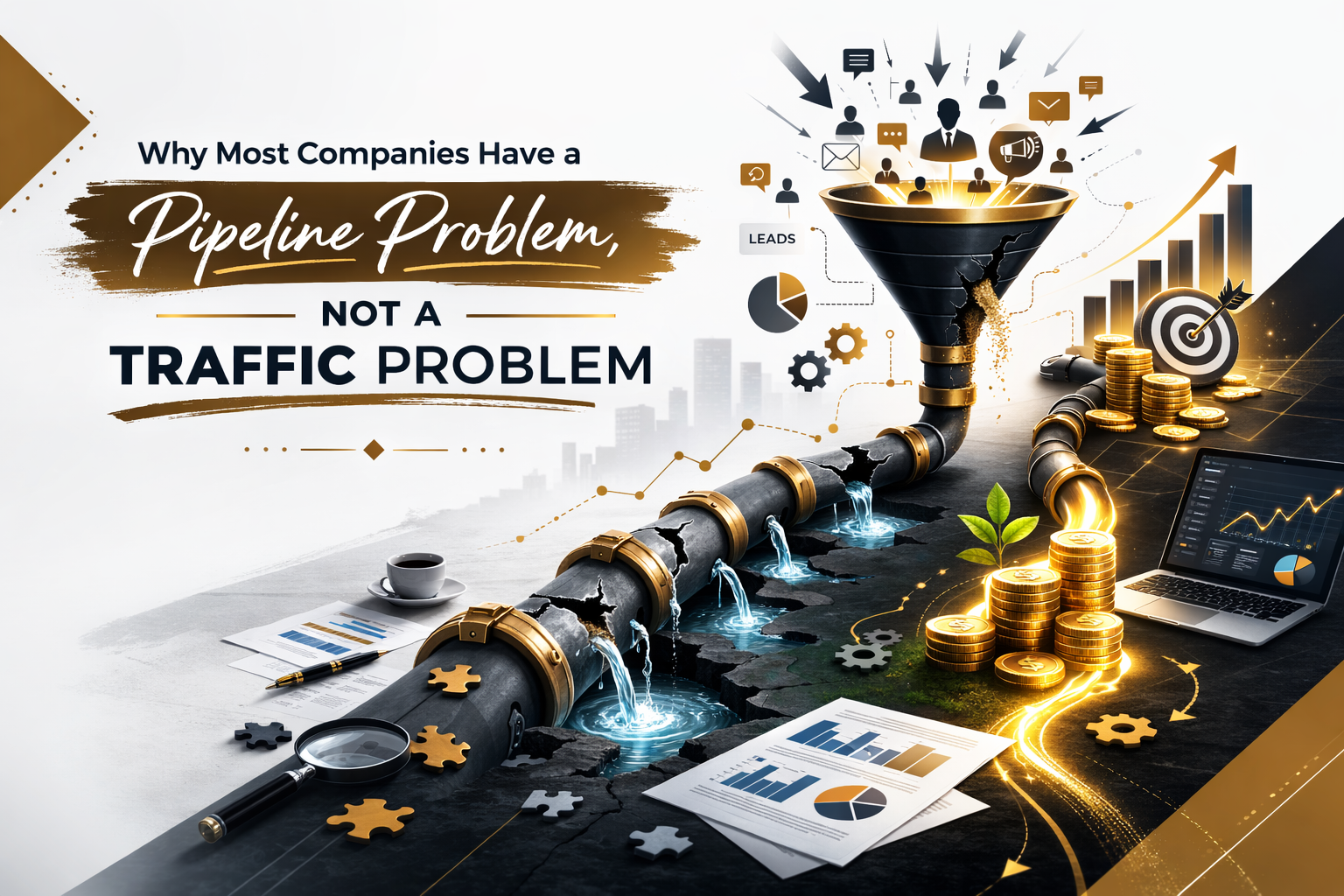
Most businesses fail to maximize their revenue despite high marketing expenditures. It is because they don’t make sufficient use of conversion rate optimization. Why? Without a strong conversion rate optimization mindset, even high-volume traffic turns into wasted budget, stagnant growth, and rising customer acquisition costs. And many teams treat CRO as a set of one-off tweaks. Rather than a structured CRO strategy that strengthens every stage of the customer journey.
CRO focuses on improving how efficiently your existing traffic turns into leads and opportunities. It helps you get more value from existing traffic. And when done right, CRO boosts revenue, aligns sales and marketing, and creates compounding over time.
So, here in this blog, we will walk you through everything about conversion rate optimization, formulas, processes, and more.
Conversion rate optimization (CRO) is a process of improving your website or digital experience. It aims to increase the percentage of visitors who take a desired action (purchasing, signing up for a free trial, or booking a demo) and turn them into leads and subscribers. With increased customer acquisition costs, rising competition, and AI changing user expectations, CRO is now vital for enhancing ROI while improving user journeys.
CRO starts by understanding how your visitors actually behave, like where they come from, which pages are visited, and where they abandon.
In simple words, conversion rate optimization is a growth multiplier for businesses. It does not just improve conversions. Rather, it drives smarter decision-making, enhances user experience, and boosts revenue without increasing ad spend.
CRO is vital as it turns more visitors into leads and customers, which ultimately grows your business. Conversion rate optimization makes your digital experience more persuasive, more intuitive, and more efficient.
By testing and enhancing user experience, CRO lowers customer acquisition costs (CAC), increases average order value, and offers valuable insights into visitors’ behavioral data.
Funnel optimization is a comprehensive and strategic approach to improve the overall user journey from awareness to purchases by fixing high-drop-off stages. On the other hand, page tweaks are tactical, granular, and iterative changes like button colors, headings, etc., that focus on specific, isolated pages to boost performance.
Here is a brief breakdown of the key differences:
| Area | Funnel optimization | Page tweaks |
| Scope | It addresses the entire flow, including user intent and psychological journey. | Page tweaks focus on a single element on one page. |
| Goal | Funnel optimization aims for significant and high-level conversion increases. | These are designed for marginal and incremental gains. |
| Data Usage | It relies on finding bottlenecks in the flow. | They often rely on A/B testing, such as testing a red button vs. a blue one. |
| Impact | It often has a higher potential for impact as it fixes steps. | Page tweaks are useful for maximizing the efficiency of an already functioning page. |
Conversion Funnel Optimization: Use when you have high traffic but poor overall conversion rates (i.e., a high bounce rate or high funnel abandonment).
Page Tweaks: Use when you have a functioning funnel but want to improve the conversion rate of specific landing pages (i.e., marginal improvements).
Conversion rate optimization acts as a revenue multiplier by improving the efficiency of existing traffic and allowing businesses to generate more revenue without increasing ad spend. A strong CRO strategy creates compound and sustainable growth.
The conversion rate formula is simple, calculated by dividing the total number of conversions by the total number of visitors and then multiplying it by 100.
Conversion Rate (%) = (Total Conversions ÷ Total Visitors) × 100
It is the simple formula of the CRO strategy, whether you are optimizing eCommerce purchases, form fills, demo signups, or app installs.
Ultimately, by increasing the conversion efficiency of your existing traffic, CRO boosts the effectiveness of your entire marketing mix.
Even seasoned teams struggle with conversion rate optimization because it’s easy to mistake short-lived wins for long-term growth. Many CRO strategies plateau quickly, not because CRO doesn’t work, but because they skip the fundamentals of a strong CRO strategy: deep research, robust data, clear hypotheses, and a strategic framework that looks beyond one-off wins.
Treating CRO as a Quick Fix: A CRO strategy fails when it stops learning after early successes and replaces curiosity with the assumption that what worked once will work always. Successful conversion rate optimization is a continuous, iterative process grounded in understanding why people act or don’t act and fixing those deeper barriers.
Not Doing Research: Jumping straight into experiments without understanding visitor intent or where drop-offs occur sets the whole program up to fail. Without research, tests are guesses, and guesses rarely produce repeatable revenue impact. A good CRO strategy starts with observing behavior, mapping funnels, and identifying true friction points.
Poor Data Foundation: Incomplete tracking, misconfigured goals, and messy metrics can distort how a page or experience is actually performing. When the underlying data is unreliable, testing becomes gambling, not strategic optimization.
Low-Traffic Testing: Many teams try to run experiments on pages that don’t have enough visitors to produce statistically meaningful results. Tests that end too soon or without sufficient conversions are of no use. This often leads to wrong conclusions and wasted time.
Focusing on Vanity Metrics: Prioritizing clicks over, for example, actual conversions or revenue.
Lack of Strategic Framework: A strong CRO strategy is a roadmap that connects user insights, hypotheses, prioritization, and business outcomes. Without that framework, teams end up with random tests that rarely build on one another or unlock larger gains.
Prematurely Ending Tests: Tests need to run long enough to reach statistical significance; otherwise, you risk making decisions based on false signals.
Rushing Without Hypotheses: Tests without strong, data-backed hypotheses are scattershot. A solid hypothesis doesn’t just suggest what to test; it explains why a change should move the needle. Without that, you’re tweaking in the dark instead of optimizing with direction.
Today, conversion rate optimization is not just a tactical upgrade. Rather, it is a strategic imperative. It works best when you are attracting the right people who are already interested in your offer.
For example, if your goal is to boost product sales, you will want to drive traffic from buyers who are actively looking and comparing. And that’s where tactics like targeted ads, SEO, and content marketing work better.
Furthermore, as AI overviews and LLMs become major sources of traffic, optimizing for these channels is necessary. Also, a continuous conversion rate optimization program starts with research. You need to understand how users move through your funnel, where momentum drops, and what objections block decisions. Regardless of whether you are managing lead generation funnels or running an eCommerce brand, the difference between flat metrics and exponential growth often comes down to how well you optimize for optimization.
Ultimately, with increased hyper-personalization and real-time testing, CRO has evolved into a dynamic and data-led strategy that influences revenue, user experience, and long-term profitability.
Contact our experts and improve your conversion funnel now.
What is conversion rate optimization?
Conversion rate optimization is a process of making your website or digital channels better to turn visitors into leads. It focuses on reducing friction, improving clarity, and encouraging visitors to take desired actions.
What are the key stages of conversion?
Key stages of conversion include awareness, interest, desire, and action. During the interest, they explore your offering and evaluate relevance. Desire builds when trust, value, and differentiation become clear. Finally, action occurs when the user completes a goal such as booking a demo, signing up, or making a purchase.
What are common CRO mistakes?
A few conversion rate optimization mistakes include testing without research, relying on poor data, ending experiments too early, and focusing on vanity metrics instead of revenue impact. Many teams also treat CRO as a one-time project rather than an ongoing CRO strategy tied to funnel optimization and business goals.
How long does a CRO strategy take to show results?
Simple CRO strategy changes, such as CTA or form optimization, can show results within 2-4 weeks. Medium-impact strategy takes about 4-8 weeks, and structural changes often take 8-12 weeks. Also, results depend on traffic volume, test complexity, and statistical significance.
What are some common CRO tactics?
Common CRO practices include A/B testing, multivariate testing, UX simplifications, copy optimization, visual hierarchy improvements, customization, trust optimization, and performance improvements. Advanced strategies also utilize AI-driven personalization to adapt experiences based on user behavior and intent.
What is the main use of CRO?
The main goal of the CRO strategy is to boost revenue, leads, and engagement. It helps businesses get more value from their existing traffic and enhance customer experience at every touchpoint.
Most marketing agencies, creative agencies, and consultancies are working hard to win clients. Deals are dragging, prospects are ghosting, and proposals seem to disappear. Most founders are frustrated—they are running campaigns, booking calls, and sending proposals. Still, their pipeline feels stuck and unpredictable.
So, what do you think? Is it a traffic problem or a pipeline problem?
Most businesses immediately blame traffic. Then, throw more budget at ads, spin up new SEO pages, and hope this will fix the issue.
But reality is different; you don’t need more people seeing your brand, but more people believing in it. And it is not built by shouting louder or pushing harder. Rather, it is about showing up with clarity, consistency, and proof that you understand the issue better than anyone else.
So, here in this blog, we will uncover why trust, not traffic and leads, is what’s keeping your funnel from converting, and how shifting your marketing effort can actually pull in the right leads.
Traffic growth feels like progress. Dashboards look healthier. Reports look positive. But traffic alone does not create pipeline reliability. In many cases, it simply hides structural inefficiencies further down the funnel.
Illusion often begins at:
Traffic, impressions, click-through rates, and engagement. These numbers create the appearance of demand. But unless they translate into qualified opportunities and closed revenue, they are surface indicators.
Vanity metrics become dangerous when they:
Content marketing is often mistaken for a pipeline strategy.
Publishing blogs, whitepapers, webinars, and LinkedIn posts can build visibility. But visibility without a structured conversion path creates passive audiences instead of active buyers.
When content lacks conversion architecture:
A predictable pipeline requires content to be mapped to funnel stages, buying signals, and qualification checkpoints.
Content should not just educate but also move accounts forward.
Without that structure, traffic increases while conversion stability declines.
Paid acquisition can scale traffic quickly. That’s its strength.
But if targeting is broad, qualification is weak, and stage tracking is unclear, paid traffic amplifies inefficiency.
More spending leads to:
Paid traffic works when it feeds a disciplined system. It fails when it feeds an undefined funnel.
The difference between traffic growth and predictable pipeline growth is simple—traffic measures visibility. Pipeline measures revenue progression.
And without structure, visibility does not convert into reliability
A predictable pipeline is not about perfect forecasting. Rather, it is about knowing where your next opportunities will come from, even before they show up. It is an integrated strategy to find, reach, and convert prospects into customers that aligns sales and marketing.
The goal is to define clear business objectives, integrate sales and marketing details and sales enablement into the next stage of the sales cycle, and enhance B2B marketing for value and referrals.
A predictable pipeline strategy requires three capabilities:
And without these, opportunity detection creates noise instead of a pipeline.
When done correctly, predictable pipeline systems improve:
And this is where most companies underestimate the gap between demand generation and actual pipeline engineering.
A pipeline usually doesn’t break overnight. It leaks slowly and quietly. And most teams don’t notice until revenue starts missing targets.
So, here’s where it breaks often:
If your Ideal Customer Profile is too broad, outdated, or based on assumptions instead of revenue data, everything downstream suffers.
Marketing attracts interest. Sales struggles to convert it. Deals stall because the buyer was never a strong fit to begin with.
Most funnels don’t fail at the top. They fail between stages.
Leads don’t become qualified opportunities. Opportunities don’t progress to a proposal. Proposals don’t convert to closed-won.
Every drop-off compounds inefficiency.
When stage conversion rates are inconsistent:
Pipeline growth without stage stability creates volatility. And volatility makes scaling risky.
Predictability comes from knowing your conversion benchmarks at every stage and actively managing them.
If marketing and sales define “qualified” differently, friction follows.
Marketing celebrates MQL volume. Sales rejects lead quality. Leadership sees pipeline numbers that don’t reflect revenue reality.
Weak qualification frameworks create inflated pipelines that collapse under scrutiny.
Clear qualification criteria should answer:
Without a structured qualification, you don’t have a pipeline. You have a contact list.
And that distinction matters for CAC control and close rate stability.
If you cannot trace revenue back to its source, optimization becomes opinion-driven.
And lack of attribution clarity results in:
A predictable pipeline requires revenue-level attribution, not just lead-level reporting.
Because pipeline engineering is not about generating movement. It’s about generating measurable, repeatable revenue progression.
Demand generation and pipeline engineering are deeply rooted in today’s marketing. This ultimately creates a valuable opportunity to reach out to prospects in different ways. Below is the revenue-focused difference between demand generation and pipeline engineering.
| Aspect | Demand Generation | Pipeline Engineering |
| Primary Objective | Create awareness and interest in the market | Convert interest into qualified revenue opportunities |
| Core Question | Are the right people discovering and engaging with us? | Are engaged prospects moving predictably toward revenue? |
| Focus Area | Top-of-funnel expansion | Full-funnel structure and conversion |
| Key Activities | Content marketing, paid acquisition, brand campaigns, webinars, nurturing | ICP refinement, qualification frameworks, funnel optimization, stage tracking, attribution |
| Metrics Tracked | Traffic, engagement, MQLs, cost per lead | SQLs, opportunity rate, stage conversion %, CAC, revenue forecast accuracy |
| Revenue Impact | Increases potential pipeline volume | Increases pipeline reliability and close rates |
| Outcome | Pipeline growth potential | Predictable pipeline performance |
A strong pipeline is built when acquisition, qualification, and sales progression operate as one system—grounded in revenue data, not activity metrics. And when a pipeline is healthy, growth feels natural. On the other hand, when it’s broken, no amount of marketing spend or sales tactics can compensate.
Hence, if you are seeing signs like inconsistent revenue, stagnant deals, or unpredictable forecasts, consider it an opportunity. You can transform your pipeline from a leaky system into a powerful growth engine by defining clear stages, using automation wisely, and aligning sales and marketing.
Ultimately, your pipeline will either be an asset that compounds your marketing efforts or a liability that silently drains them. But the good news is you can choose which one it becomes.
So, build a predictable pipeline system.
That’s how we at Growthym approach growth marketing as pipeline engineering designed for revenue reliability, not as channel execution. So, if you are interested
In simple terms, a pipeline problem means that you are generating traffic or leads. But these actions are not converting into qualified opportunities or revenue. It is a system-level issue where the “pipeline” (the process of turning leads into customers) is inefficient, which is often mistaken for a lack of traffic or lead volume.
Can high traffic still result in poor pipeline growth?
Yes, even high traffic can definitely result in poor pipeline growth. It is because of underlying issues that hinder revenue growth. Primary reasons why high traffic can result in pipeline break are low-quality leads, poor conversion rates, misaligned marketing and sales, etc.
Why is a predictable pipeline harder to achieve than traffic growth?
It is because traffic growth can often be purchased or engineered through digital marketing, and a predictable pipeline is about guiding human behavior and maintaining high-quality data.
How is demand generation different from lead generation?
Demand generation is about creating brand awareness and interest. On the other hand, lead generation is about converting that interest into actionable and qualified prospects. Also, demand generation works at the top of the funnel, targeting a broad audience to build a reputation. And lead generation acts at the bottom to focus on capturing contact information.
What are the early signs that a company has a pipeline problem?
Early signs include stagnant deals, poor lead quality, reduced engagement, and inaccurate forecasting.
How does poor demand generation impact CAC?
Poor demand generation directly increases Customer Acquisition Cost (CAC) by bringing unqualified, low-intent traffic into the sales funnel, resulting in lower conversion rates and wasted sales efforts. When demand generation is ineffective, businesses frequently waste money on broad targeting, resulting in a higher cost to acquire each new customer.
What role does growth marketing play in building a predictable pipeline?
Growth marketing builds a predictable pipeline by shifting from large-scale campaigns to a data-driven, iterative, and full-funnel approach. It focuses on ongoing testing of channels, Customer Acquisition Costs (CAC), and improving retention to build a sustainable and scalable revenue engine instead of relying on only one-off incentives.