Marketing is constantly evolving, and businesses must adapt to stay relevant and competitive. One of the most significant advancements in recent years is the integration of Artificial Intelligence (AI) into marketing strategies. Growthym’s AI-powered growth marketing services are at the forefront of this transformation, offering innovative solutions that drive business growth.
AI has the potential to revolutionize marketing by providing unprecedented insights, optimizing campaigns, and delivering personalized experiences. Here’s how AI is reshaping the marketing landscape:
At Growthym, we leverage AI to offer a full range of growth marketing services that help businesses achieve their goals. Here’s an overview of our key services:
Case Study: Elevating Brand Presence for a Tech Startup A tech startup aimed to increase its market presence. Through our AI-powered SEO audit and strategic content development, we boosted their organic traffic by 50% and lead generation by 35% in six months.
Case Study: Boosting Engagement for an E-commerce Platform An e-commerce platform struggled with low engagement. Our AI-driven email marketing campaigns and social media strategies increased email open rates by 40% and social media followers by 25%.
Case Study: Increasing Conversions for a Financial Services Firm A financial services firm sought to improve their conversion rates. By utilizing our AI-powered predictive insights and targeted marketing strategies, we achieved a 30% increase in conversion rates within three months.
At Growthym, we believe that the future of marketing lies in AI-powered strategies. Our innovative solutions are designed to help businesses navigate the complexities of modern marketing and achieve sustainable growth.
AI-Driven Strategies: Our AI-powered solutions provide deeper insights and faster optimizations, leading to higher engagement and conversion rates.
Customized Solutions: We tailor our services to meet your specific business needs and goals, ensuring effective and targeted marketing strategies.
Proven Results: Our success stories highlight our ability to deliver significant improvements in brand awareness, customer engagement, and lead generation.
As the marketing landscape continues to evolve, embracing AI-powered growth strategies is essential for businesses seeking to stay ahead of the competition. Growthym’s comprehensive AI-driven services are designed to provide the insights, optimizations, and personalized experiences necessary for driving sustainable business growth. By leveraging AI, businesses can gain a deeper understanding of customer behavior, optimize campaigns in real-time, and deliver highly personalized marketing experiences.
Our offerings, including AI-powered SEO audits, strategic content development and distribution, AI-driven email marketing campaigns, social media community building, predictive customer insights, and advanced analytics solutions, are tailored to meet the diverse needs of modern businesses. The success stories of our clients, from tech startups to e-commerce platforms and financial services firms, highlight the significant improvements in brand presence, customer engagement, and conversion rates that can be achieved through AI-powered strategies.
At Growthym, we are committed to helping businesses navigate the complexities of modern marketing and achieve their growth objectives. Our AI-driven strategies, customized solutions, and proven results make us the ideal partner for businesses looking to enhance their marketing efforts and drive growth.
Are you ready to embrace the future of marketing with AI-powered growth strategies? Contact Growthym today to discover how our comprehensive services can help you achieve your business goals. With Growthym, you can unlock the full potential of your marketing efforts and secure a competitive edge in the digital marketplace.
The digital landscape is undergoing its most significant transformation since the advent of search engines. The rise of generative artificial intelligence (AI) has fundamentally altered how users seek and receive information. The traditional goal of ranking keywords to drive traffic to a website is being superseded by a new strategic imperative: influencing the answers generated by AI models. This report provides a comprehensive analysis of this new discipline, known as Generative Engine Optimization (GEO), offering a detailed framework for understanding, implementing, and measuring visibility in the age of AI.
Generative Engine Optimization (GEO) is the practice of strategically optimizing an entity—such as a brand, website, or piece of content—to be featured, cited, or accurately represented in responses generated by AI applications like ChatGPT, Google’s AI Overviews, Perplexity, and Claude. This emerging field is also referred to by other names, including LLM Optimization (LLMO), Generative Search Optimization (GSO), or AI Search Optimization (AISO), but this report will use the term GEO for consistency.
The core objective of GEO marks a fundamental departure from traditional search optimization. The primary goal is no longer to use a search engine to bring a user to a website via a ranked link. Instead, the focus is on ensuring a brand’s message, data, and expertise are seamlessly and accurately integrated into the AI’s direct answer. Success in GEO is achieved when the AI model deems your content a trustworthy and citable source, even if the user never clicks through to your domain. This represents a paradigm shift from a destination-focused model, where the website is the end goal, to an influence-focused model, where shaping the information landscape is the primary objective.
To navigate this new environment, it is crucial to understand the distinct yet complementary roles of traditional Search Engine Optimization (SEO) and GEO.
quantified by metrics like keyword rankings, click-through rates (CTR), and the volume of organic sessions driven to the site. The strategic aim is to create the “best page” on a given topic—a comprehensive resource that satisfies a search engine’s criteria for relevance and authority.
It is a critical strategic error to assume these two disciplines are mutually exclusive. A robust SEO foundation provides the crawlability, indexability, and baseline authority that GEO strategies build upon. However, relying solely on traditional SEO is insufficient, as a high ranking in a SERP does not guarantee inclusion in an AI-generated answer. A modern, resilient digital strategy must integrate both SEO and GEO to ensure visibility across all forms of search.
The established economic model of search, predicated on monetizing website traffic, is being fundamentally inverted. Historically, the value of SEO was in its ability to drive a high volume of clicks to a website, where monetization occurred through advertising, lead generation, or direct sales. The primary output of a generative engine, however, is a direct answer that often makes a click unnecessary. This shift threatens to significantly reduce organic traffic, with some analyses predicting declines as high as 60% for certain publishers. While this appears to be a direct threat, it also creates a new form of value. Being mentioned or cited in an AI answer builds significant brand authority and can lead to subsequent, high-intent user actions, such as direct branded searches or navigating straight to the brand’s website. Therefore, the economic calculus is evolving from monetizing low-intent clicks to cultivating high-intent brand influence. This necessitates a re-evaluation of how marketing ROI is calculated and how budgets are allocated, moving beyond a simple Traffic x Conversion Rate formula to a more complex model that accounts for the long-term value of brand authority.
Influencing AI outputs requires a deep understanding of the process by which an answer is generated. Unlike the relatively straightforward crawl-and-rank mechanism of traditional search, AI-powered search is a multi-stage cognitive process.
This multi-stage process fundamentally alters the user journey. The traditional, transparent path of Search -> Click -> Land -> Convert is being replaced by a more opaque journey: Search -> Get Answer from AI -> (Maybe) Search for Brand -> (Maybe) Go Direct to Site -> Convert. The middle of this new journey is a “black box,” as direct attribution is often lost when AI engines fail to cite sources or pass referral data. This loss of visibility into the user’s consideration phase means marketers can no longer rely on tracking a linear path. The strategic response is to build such overwhelming brand authority and trust that when a user emerges from the AI’s “black box,” your brand is their definitive, top-of-mind choice. This also elevates the importance of qualitative data collection, such as adding a “How did you hear about us?” field to forms, to manually bridge the attribution gap.
| Aspect | Traditional SEO | Generative Engine Optimization
(GEO) |
| Primary Goal | Drive organic traffic to a
destination website. |
Influence AI to cite or mention
your brand within a generated answer. |
| Core Target | Keywords and backlinks. | User intent, context, and
entities. |
| Primary Output | A ranked list of links (SERP). | A synthesized, conversational
answer. |
| Key Metrics | Keyword rankings, CTR,
organic sessions. |
Brand mentions, citation
frequency, share of voice, sentiment. |
| Content Strategy | Create the “best page” on a
topic (comprehensive guides). |
Provide the “best answer” to a
question (clear, direct, citable facts). |
| Economic Model | Monetization via on-site traffic
and clicks. |
Monetization via brand
influence leading to downstream direct or branded traffic. |
To effectively optimize for generative engines, one must first understand the technical underpinnings of how they select, prioritize, and synthesize information. This section demystifies the “black box” of AI search, detailing the core concepts and ranking signals that determine visibility.
The processes that power AI search are fundamentally different from the keyword-matching systems of the past. They rely on sophisticated models that understand language and context.
pattern-recognition systems trained on data. RAG is the process that allows these models to access and incorporate external, up-to-date information from a knowledge base (like the live internet) at the time of a query. This grounds the AI’s response in verifiable data, reducing the likelihood of generating false information, or “hallucinations”. From a practical standpoint, GEO is the art and science of optimizing your content to be the most authoritative and easily retrievable source for a RAG system.
Learning-to-Rank (LTR) is a class of machine learning techniques used to construct the ranking models at the heart of information retrieval systems. In the context of GEO, after an initial pool of relevant passages is retrieved via RAG, a sophisticated LTR model re-ranks these candidates to determine which are the most valuable and trustworthy for synthesizing the final answer. This re-ranking step is where the AI’s “editorial judgment” is applied. There are three primary approaches to LTR, categorized by how they process the training data :
Modern search engines like Google employ a hybrid system. They do not rely on a single model but combine signals from traditional information retrieval systems (like PageRank and user click data) with advanced machine learning signals from models like BERT and Rank Embed to produce the final, synthesized result.
The concept of a static list of “ranking factors” is obsolete. Instead, visibility is determined by a dynamic set of signals that are fed into the LTR models. These signals can be grouped into four key categories.
The shift to passage-level semantics means that optimization must become more granular. While traditional SEO focused on making a single page the “best page,” GEO requires every component of that page to be a potential “best answer.” A long, comprehensive article may only have one or two key paragraphs that are ever surfaced by an AI for a specific query. This necessitates a modular content strategy, where every section, paragraph, and list is crafted as a self-contained, clearly-headed block of information, ready for individual extraction.
|
Furthermore, achieving relevance in this new paradigm is a two-stage process. The first gate is semantic matching, where AI uses embeddings to find a pool of content that is conceptually related to the query. The second gate is structural extractability. From that initial pool, the AI prioritizes content that is easy to parse, such as direct answers and well-structured lists. Content that is buried in dense prose or is poorly formatted will be skipped, even if it is semantically relevant. Success in GEO requires mastering both stages: creating topically deep content to pass the first gate, and then structuring it with extreme clarity to pass the second.
| Signal Category | Specific Signal | Why It Matters for GEO | Key Optimization Tactic |
| expertise. | |||
| Technical & Structural | Schema Markup | Provides explicit, unambiguous context to the AI about the nature and structure of your content. | Implement FAQPage, HowTo, and Article schema using
JSON-LD. |
| Site Speed | AI crawlers operate on tight timeouts (1-5 seconds) and will drop
slow-loading pages. |
Optimize for a
sub-1-second Time to First Byte (TTFB) and overall fast page load. |
|
| Passage Structure | Clear headings, lists, and tables act as “extraction cues” for AI to parse information. | Use a logical heading hierarchy (H1-H6) and format key information in bulleted or numbered lists. | |
| AI Crawler Access | AI crawlers like GPTBot and Google-Extended must be permitted to
access your site. |
Ensure your robots.txt file explicitly allows relevant AI
user-agents. |
This section translates the theoretical and technical foundations of GEO into a practical, phased implementation framework. It provides a step-by-step guide for research, content optimization, technical implementation, and authority building.
Before any optimization begins, a thorough research phase is required to understand the specific AI landscape for your niche.
high-volume keywords, the goal is to identify the long-tail, natural language questions that users pose to AI assistants. AI tools like ChatGPT or Perplexity can be used as brainstorming aids to generate potential user prompts. These prompts should then be mapped to user intent—informational, navigational, transactional, or commercial—as the optimal content format varies by intent. For example, informational queries demand content rich with statistics and citations, while transactional queries require clear calls-to-action.
With a research-backed strategy in place, the next phase is to create and optimize content designed for AI consumption and citation.
This approach requires a fundamental shift in mindset from creating content for a human audience to creating content as a structured data source for a machine. The role of the content creator evolves into that of a “data curator”—structuring human knowledge in a way that is optimized for algorithmic consumption. This new hybrid role demands skills in writing, information architecture, and data structuring principles.
A technically sound foundation is non-negotiable for GEO. If an AI crawler cannot access or understand your content, even the most authoritative information will remain invisible.
Authority in the AI era is not solely defined by backlinks. It is an ambient and distributed signal, aggregated from mentions and context across the entire web.
user-generated content (UGC), such as customer reviews and social media posts, helps create a diverse and authentic footprint of brand mentions.
The ultimate objective of this off-page work is to increase the “co-occurrence” of your brand name with your target topics across the web. When an AI model repeatedly encounters your brand in the context of a specific area of expertise, it learns to associate your entity with that topic, making it a more likely source for future queries. This requires breaking down the traditional silos between SEO, PR, and social media teams, as every public-facing interaction now contributes to the brand’s machine-perceivable authority.
| Category | Task | Priority | Rationale & Key
Sources |
| Crawlability | Configure robots.txt to allow GPTBot,
Google-Extended, etc. |
High | AI crawlers must be explicitly permitted to access your content to be included in their models. |
| Submit an up-to-date sitemap.xml. | High | Helps crawlers efficiently discover all indexable pages on
your site. |
|
| Monitor developments for llms.txt. | Medium | An emerging standard that may offer more granular control over LLM interactions in the future. | |
| Performance | Optimize for page speed (target <1 sec TTFB). | High | AI systems have tight timeouts; slow pages are dropped from the
retrieval process. |
| Implement a Content Delivery Network (CDN). | High | Speeds up content delivery globally, ensuring fast responses for crawlers and users everywhere. | |
| Structured Data | Implement Article, Author, FAQPage, and HowTo schema. | High | Provides explicit, machine-readable context, which is critical
for the RAG process. |
| Validate all schema markup to ensure it is error-free. | High | Incorrectly implemented schema can be ignored or cause parsing issues for crawlers. | |
| On-Page Structure | Use a clean HTML structure with proper heading hierarchy (H1-H6). | High | Headings act as crucial “extraction cues” for AI models to parse and understand content
sections. |
| Use semantic HTML elements like <article>,
<section>, <nav>. |
Medium | Provides additional structural context to crawlers about the purpose of different
content blocks. |
|
| Accessibility | Ensure the site is mobile-friendly and secure (HTTPS). | High | These are foundational trust and quality signals for all crawlers, |
| Category | Task | Priority | Rationale & Key
Sources |
| including AI. | |||
| Incorporate ARIA labels on interactive elements. | Medium | While primarily for human accessibility, these labels can also help future “agentic” AIs understand how to
interact with your site. |
The obsolescence of traditional keyword ranking as a primary metric necessitates a new framework for measurement and analytics. Tracking success in GEO requires a shift towards monitoring brand presence within AI-generated text and correlating that visibility with business outcomes.
The focus of measurement moves from a single position on a results page to a more nuanced analysis of how a brand is represented within the AI’s narrative output.
Connecting GEO efforts to tangible business results requires a multi-pronged approach that captures both direct and indirect impacts.
The nature of GEO measurement requires a strategic shift in the analyst’s role. Traditional SEO reporting was often a linear process of showing that a specific ranking drove a specific amount of traffic and conversions. GEO measurement is more akin to business intelligence. It involves synthesizing disparate and often incomplete data points—SOV from a GEO tool, referral traffic from GA4, impression data from Google Search Console, and qualitative attribution from a CRM—into a coherent narrative that demonstrates business impact. Success is proven through correlation, triangulation, and data-driven storytelling, not a simple dashboard.
To meet the demand for these new metrics, a new market of specialized GEO monitoring tools is rapidly emerging, filling the void left by traditional rank trackers.
The proliferation of generative engines necessitates a portfolio management approach to optimization. In the past, “search optimization” largely meant optimizing for Google. Today, the landscape is fragmented across numerous AI platforms, each with its own user base, data sources (live web vs. static training data), and response “personality”. A strategy that succeeds on Perplexity, which heavily cites its sources, may not be optimal for a more conversational model like Claude. Therefore, brands must manage a portfolio of AI engines, identifying which platforms their audience uses most, understanding the unique optimization requirements of each, and allocating resources accordingly. Measurement must also be platform-specific to effectively track performance across this diverse portfolio.
| Tool Name | Primary Focus | Key Features | AI Engines
Covered |
Starting Price |
| Goodie AI | Enterprise GEO (Monitoring & Optimization) | Visibility monitoring, optimization hub, content writer, analytics &
attribution. |
ChatGPT, Gemini, Perplexity, DeepSeek, Claude, and more. | Custom |
| AthenaHQ | Enterprise GEO (Monitoring & Optimization) | 360-degree brand view, AI-generated recommendations, query performance
tracking. |
ChatGPT, Perplexity, Claude, Gemini, and more. | $900/month |
| SE Ranking AI Visibility Tracker | SMB/Pro Monitoring | Tracks linked & unlinked mentions, competitor visibility, prompt
testing. |
ChatGPT, Google AI Overviews, Gemini, and more. | Part of SE Ranking plans |
| Surfer AI Tracker | Content Marketer Monitoring | Tracks brand/keyword mentions, prompt-level insights, source
transparency. |
ChatGPT, SearchGPT (more planned). | $95/month (add-on) |
| Ahrefs Brand Radar | SEO Integration | Share of AI mentions vs. competitors, competitor gap analysis, domain
citation tracking. |
Google AI Overviews only. | Paid add-on for Ahrefs subscribers |
| Otterly.AI | SMB Monitoring | AI prompt generator, link citation analysis, country-specific
monitoring. |
Limited to 3 platforms. | $29/month |
As generative AI continues its rapid integration into the fabric of digital life, it is essential to look forward, anticipating the challenges, ethical considerations, and strategic shifts that will define the next era of information discovery.
While GEO presents a significant opportunity, it is accompanied by a unique set of challenges and limitations that practitioners must navigate.
The power of AI to shape understanding comes with profound ethical responsibilities. The systems are not infallible and can perpetuate societal harms if not managed carefully.
The evolution of AI in search is not stopping at question-answering. The next frontier is the rise of “agentic AI”—proactive AI assistants that can understand complex goals and execute
multi-step tasks on a user’s behalf. This includes researching options, comparing products, booking travel, and even making purchases, often with minimal human intervention. Google’s “AI Mode” and “Deep Search” features, which act as powerful, automated research assistants, are early manifestations of this trend.
This coming shift demands a third evolution in optimization strategy. The goal of SEO was to become a destination. The goal of GEO is to become an information source. The goal of the next paradigm, which could be termed Agentic Engine Optimization (AEO), will be to become an integrated partner.
An AI agent tasked with booking a flight for a user will not “read” a blog post about the best travel destinations. It will need to connect directly to a booking system via an Application Programming Interface (API). An agent comparing the technical specifications of two products will be most efficient if it can ingest a structured data feed, not parse a marketing landing page. The ultimate future of optimization, therefore, is not about content in the traditional sense, but about making a business’s core data and functionality programmatically accessible to autonomous AI agents. The strategic imperative for forward-thinking organizations is to begin architecting for this future now. This involves developing robust APIs, creating clean and comprehensive product data feeds, and structuring all business information for machine consumption. The winners of the next decade of digital transformation will be those who move beyond simply providing information and become indispensable, functional nodes in the AI’s action-oriented supply chain.
Long gone are the days when SEO used to be a game of keywords, metadata, backlinks, and technical tweaks; it has evolved over the years. The advent of AI has brought yet another seismic shift in this domain.
Users are now getting answers to their queries without navigating a web page, thanks to AI overviews that you see on top of the Google search page. And, this is what is bothering the most marketers today. They are now skeptical about SEO.
Is SEO dead? Not really, but it is rapidly changing, and traditional SEO alone is not enough to stay visible. So, marketers who have spent a long time building their visibility and ranking have to reconsider their strategy to stay competitive.
This is where AI SEO comes into the picture; it turns the table by leveraging AI-driven strategies, tools, and processes to ensure brand visibility. Now, optimizing for search engines isn’t enough; your content should also be machine-readable.
In this post, we are going to delve deep into AI SEO, its importance, impact, and the ways marketers and businesses can leverage it to ensure consistent growth. Let’s start without further ado!
AI SEO combines artificial intelligence technology with traditional SEO tactics. It involves leveraging LLMs (Large Language Models), NLP (Natural Language Processing), and machine learning into search engine optimization strategies. It is not just a new buzzword but also denotes a transformational change in how marketers approach search engine optimization.
This technology-driven method improves and streamlines the core of conventional SEO – content generation, keyword research, on/off-page optimization, technical SEO audit, analytics, etc. It merges technology with human skill to develop more efficient strategies to provide traffic and ensure growth.
Today, organic search volume is decreasing and for informational queries, the decline is quite rapid. The reason is clear: more users are using AI tools to get instant and relevant answers to their queries.
So, as a marketer, what can you do?
You must think beyond ranking your content. You should optimize the content in order to make it authoritative and credible, machine-readable, and optimized for more than one environment. In short, you must optimize your content for not only search engines but also for AI.
It calls for a strategy that is centered on maximizing content that is both machine-discoverable and human-discoverable. In this age of AI, you don’t live on pure SEO anymore; you need a hybrid approach that incorporates AI along with traditional SEO practices.
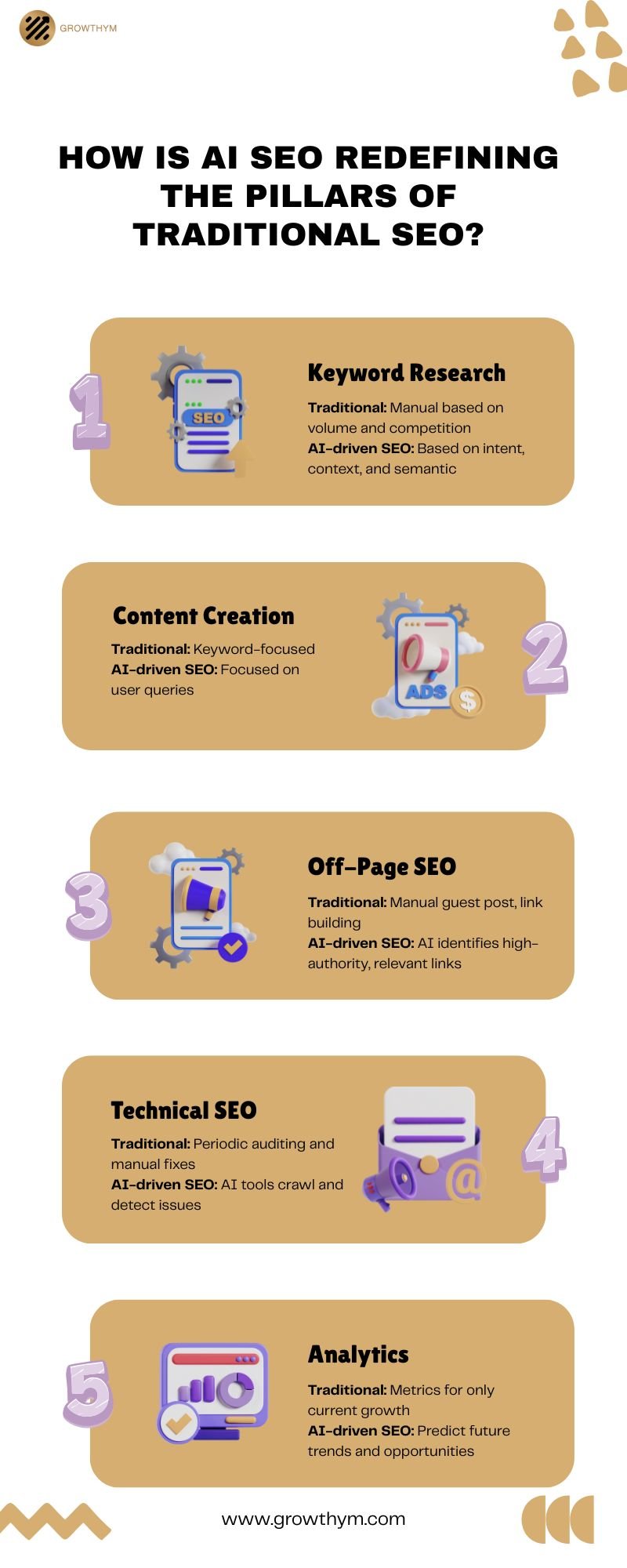
AI in SEO is bringing a fundamental shift in how it works and is implemented. For example, extensive manual human work has been a part of SEO traditionally, like searching for the right keywords based on volume and keyword difficulty.
Artificial Intelligence in SEO can streamline this process through automation and reduce the time taken in this process. As a result, it speeds up campaigns and helps in faster outcomes. The following points further describe how the integration of AI in SEO is changing the landscape for marketers.
Creating quality content is the bedrock of good SEO. The traditional SEO heavily relies on keywords, especially those that exactly match the user intent. However, AI like Google’s RankBrain goes in depth and they allow search engines to understand the nuance and context of every query.
So, keywords won’t just work. Instead of stuffing keywords, the answers should provide true value. Additionally, AI can understand the relationships between concepts and entities with semantic search. Thus, a broad and deep understanding of the topic is crucial instead of keywords.
AI SEO brings automation and efficiency to overall workflows. For example, instead of manual, time-consuming keyword research, AI tools can generate long-tail keywords on the fly, analyze competitors’ keyword strategies, find emerging trends, and more.
Besides, AI can generate content ideas, brainstorm, and give outlines for content. Plus, it also simplifies the complex process of generating structured data, i.e., schema markups, providing enhanced visibility for search engines.
AI in SEO can also be leveraged to identify technical issues like broken links, page speed issues, mobile-based usability problems, and more. It can even identify the opportunity for internal linking.
The AI overview has taken most of the attention that used to go to a particular page that ranked on top in Google SERPs. Now, featured snippets (zero-click results) and AI overviews are where most users stop to get all the information, and clicks are going down.
AI overviews and featured snippets provide direct answers to user queries. Marketers must focus on optimizing content not just for organic ranking but also for these zero-clicks and AI-generated summaries to get cited or for brand visibility.
Personalized results are the key benefit of AI-driven results. AI can analyze user behavior, preferences, location, and other aspects to deliver personalized answers to their queries. As a result, it is possible that different users may get different SERP results.
AI SEO services can be very useful for local SEO as it can help target geo-targeted keywords. It can help businesses gain visibility in localized searches and enable them to manage local business listings. So, a business can be visible in an AI search result for local searches after optimization, for example.
The integration of AI in the traditional SEO workflow offers a revolutionary change. It not only provides automation but also improves the outcomes of the various processes in it. Let’s see how LLM SEO revolutionizes traditional search engine optimization.
AI is no longer a future; it’s a reality today, and the way SEO works is changing – faster than you think. You cannot undermine the role of AI in SEO; if you do so, you are going to get left behind your competitors. Those who adapt to this changing landscape will navigate the challenges in getting visibility in this AI era.
As AI is redefining how users search, platforms generate answers, and brands get discovered, sticking to your old-school approach is not sensible. It’s time you led the change with AI SEO from Growthym. As a fast-growing AI growth marketing agency, we leverage the power of artificial intelligence to help your business grow and get discovered by the right audience.
We offer end-to-end AI-based marketing services, including AI SEO. Contact us to discuss how we can help you get your business in front of the audience you always intended.
Imagine you are a content manager feeling frustrated and overwhelmed by the workload. Now you remember that you also have to work on a content brief. You start working on it and spend 2 hours on keyword research, competitor analysis, and audience insights for a single blog.
This is a lot of hard work, isn’t it? Surely, your frustration level goes high. But what if I told you that this can be completed in just 15 minutes? Today, AI is touted as our companion in different fields, and content creation is not an exception.
You can hit the ground running in minutes with AI content briefs that took hours in the past. It works like magic and helps you save valuable time that you can devote to more important strategic tasks for your marketing campaigns.
When it comes to creating content briefs, you have to spend hours scouring multiple tools for keywords, digging into audience personas, and piecing together user behavior. It’s exhaustive and leaves you drained before you even start writing. What’s the payoff? Often, you end up having briefs that miss the mark.
There is also the template trap that you find yourself in. Generic content briefs churn out cookie-cutter outlines that ignore specific opportunities. They lack the context of user intent—the key driving force for search engines now. They also miss the real-time market trends or hot topics that make your content outdated.
Consider AI content briefs that leverage artificial intelligence to provide SEO-friendly and fresh outlines. Using AI for content planning and strategy can slash research time, pulling competitor insights, keyword gaps, and trending topics in minutes.
As AI becomes a must-have tool, integrating it into your content strategy has become indispensable. There are many AI content brief generators out there today that you can use to create optimized and quality outlines.
But this isn’t just what AI can do; it’s not about creating generic briefs. Content strategy with AI enables you to build in-depth and strategic briefs that deliver tailored, data-driven roadmaps. AI tools analyze user intent with precision that makes sure your brief nails what your audience wants.
With AI content briefs, you happily say goodbye to outdated templates or a painstaking process. AI enables you to build content briefs fast by working smarter, not harder. Here is how it is actually changing the landscape.
Are you ready to cut the time in creating content briefs to just 15 minutes from hours? This is how you can leverage artificial intelligence in creating killer briefs.
Step 1: AI-Powered Research Phase (5 minutes)
Get instant competitor analysis without hopping through multiple tools with AI. Just drop your topic into an AI tool and boom – you have complete information in a few seconds. AI tools can analyze competitors at a lightning-fast speed, identifying their weak spots.
Apart from this, they can also analyze SERPs to discover the opportunity for featured snippets, provide “People Also Ask,” and uncover content gaps. Within minutes, you have the information that would take hours in manual research.
Step 2: Structure and Optimization (5 minutes)
After the research, AI will create a content structure with concise headings and subtopics relevant to your content topic. It also provides high-value keywords while also mapping them to user intent to allow you to craft content that matches what users are actually searching. Besides, it helps provide audience insights, including the pain points and desired tone.
Step 3: Strategic Refinement (5 minutes)
After this, review the AI-generated brief to add your human touch. It will ensure that the final content draft aligns with your brand’s voice and goals. Make changes to align it with your strategic objectives – building authority, driving conversion, or anything else. Define your success metrics, which can be a click-through rate or dwell time.
AI content briefs offer you a data-driven, intent-focused plan allowing you to dominate search in record time. Say goodbye to hours of manual grinding. This 15-minute content planning will give you peace of mind and supercharge your content strategy.
Want to take your content game to the next level? Let’s dive into advanced tactics for AI content briefs that upscale your strategy.
Multi-Format Brief Generation starts with crafting briefs for blogs, social posts, and video scripts in one go. AI tailors each for platform-specific wins—think snappy Instagram captions or in-depth blog outlines. It even builds in repurposing strategies, so your blog post becomes a TikTok series or a LinkedIn carousel without extra work.
Next, Performance Prediction and Success Metrics is where AI shines. It forecasts how your content will perform, spotting high-potential topics before you hit publish. AI content briefs come with built-in tracking recommendations, like monitoring click-through rates or engagement metrics, and suggest KPIs tailored to your goals. Plus, they highlight competitive advantages—maybe your angle on “vegan snacks” hits a gap competitors missed.
Instead of guesswork, focus on data-driven strategies that will set you apart. These tactics are quite useful for creating content briefs that will drive results across platforms and save time. You can outsmart your competitors and make every piece of content count?
Now put an end to your hectic and time-consuming content research with the 15-minute content planning hack! Say hello to AI content briefs. You can come up with a data-driven strategy in minutes with structured outlines refined for impact.
Avoid the fuss of basic content brief vs outline, AI content planning nails user intent and competitor gaps. RAG pipelines power these tools, pulling real-time insights for precision. The result?
Your content team’s productivity skyrockets, churning out high-quality briefs that boost output without burnout. You’re not just saving time—you’re crafting content strategy with AI that resonates and ranks.
Plus, you can optimize existing content with AI to keep it fresh and competitive. Skip manual outline building and the hours-long grind. This AI content strategy shortcut is your ticket to smarter, faster wins.
Ready to transform your workflow? Start creating AI content briefs fast—fire up your first AI-powered brief today and watch your content game soar. The future of content planning is here, and it’s time to jump in!
We at Growthym help you unlock the potential of AI for marketing and content with our AI-driven growth marketing services. Our modern and strategic services help you grow your business steadily with AI-powered marketing services. Contact us to discuss more and get sparkling results for your business.
Search is evolving faster than at any point in the last two decades. Google’s traditional “10 blue links” are giving way to AI-powered summaries, interactive answer panels, and predictive search results. At the same time, Large Language Models (LLMs) like ChatGPT, Claude, Gemini, and Perplexity are influencing how users find, consume, and trust information. In this new environment, AI SEO has emerged as a critical discipline — one that blends the principles of traditional search optimization with advanced techniques tailored for AI-driven ranking systems.
AI SEO isn’t just about ranking in Google anymore. It’s about ensuring your brand is visible across multiple discovery surfaces:
Three concepts define this next era of search:
These aren’t buzzwords — they are ranking systems and content selection mechanisms already shaping traffic distribution. For example:
For businesses, this shift changes the game. The question is no longer “How do we rank on Google?” but “How do we make sure AI models trust and recommend our content?”
At Growthym, we’ve been pioneering AI SEO strategies that address this exact challenge. Our approach integrates:
In this guide, we’ll break down the entire AI SEO playbook, covering how GRO, AEO, and SGE work, how to optimize for them, and how to measure success. By the end, you’ll have a blueprint to ensure your content doesn’t just rank — it dominates in both Google Search and AI-driven platforms.
AI SEO is the practice of optimizing digital content and websites for search engines and AI-powered answer engines. Unlike traditional SEO, which focuses mainly on Google’s ranking factors for SERPs, AI SEO targets multi-platform discoverability — ensuring your brand is visible in Google’s Search Generative Experience (SGE), ChatGPT responses, voice assistants, and other AI-driven ecosystems.
AI SEO blends:
Search engines no longer just “index and retrieve” — they interpret, summarize, and generate answers.
Where traditional SEO aimed at ranking on page 1, AI SEO’s goal is to become a trusted source in the AI’s knowledge base.
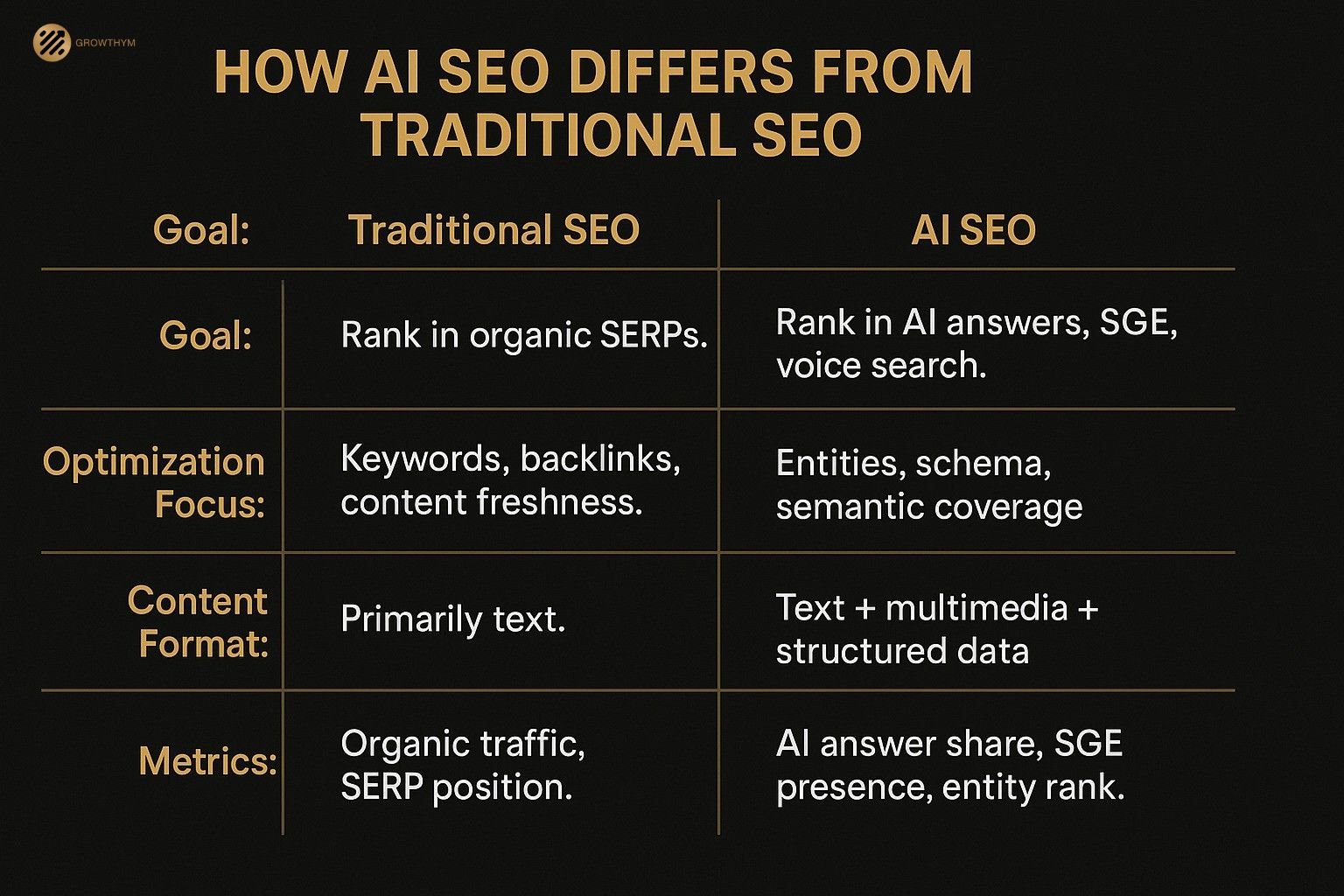
| Aspect | Traditional SEO | AI SEO |
| Goal | Rank in organic SERPs | Appear in AI-generated answers, SGE panels, voice responses |
| Optimization Focus | Keywords, backlinks, content freshness | Entities, structured data, semantic coverage, topical authority |
| Content Format | Primarily text-based | Multi-format: text, tables, lists, multimedia |
| Search Algorithms | Keyword-based ranking + on-page/off-page signals | AI-driven semantic understanding + generative ranking |
| User Interaction | Click-through to website | Direct answer delivery without clicks |
| Measurement | Organic traffic, SERP position | AI panel presence, answer share, LLM mentions |
To perform well in both Google AI search and LLM-driven answers, your site must excel in these areas:
In AI-generated answers, brand visibility is often zero-click — meaning users may never visit your site. That’s why brand recall and authority become more valuable than a single click.
AI models don’t just scan the latest post; they consider:
This is why GRO (Generative Ranking Optimization), AEO (Answer Engine Optimization), and SGE optimization all require entity-driven, interconnected content ecosystems rather than isolated blog posts.
Understanding how different AI models process and rank content is key to AI SEO:
Each of these platforms rewards clear, factual, semantically-rich content with machine-readable structure.
In AI SEO, performance tracking moves beyond Google rank tracking.
New metrics include:
In short, AI SEO is not a replacement for traditional SEO, but an evolution that expands your optimization target from Google’s SERPs to the entire AI-driven discovery ecosystem. The next step is to explore each component — starting with Generative Ranking Optimization (GRO) — and understand how to structure your content to win in AI-generated rankings.
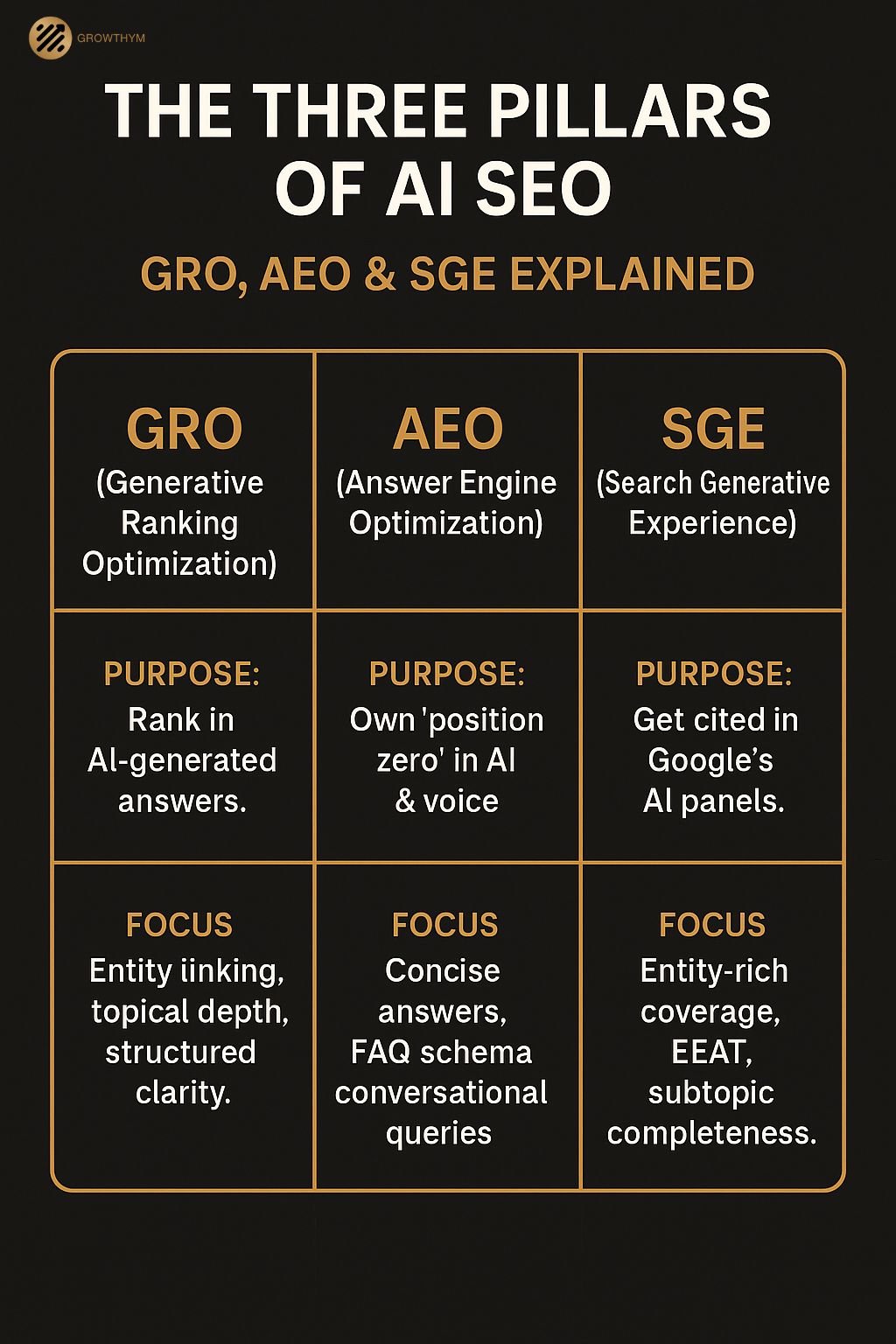
Generative Ranking Optimization (GRO) is the process of optimizing your content so that AI-powered search systems — like Google’s Search Generative Experience (SGE), ChatGPT, and Perplexity — select your pages as primary sources when generating answers.
In traditional SEO, ranking meant appearing on page one of Google’s SERPs. In the era of generative AI, ranking means being referenced, cited, or used as the source for AI-generated responses — even if users never click through to your website.
AI search experiences are shifting traffic patterns:
If your content isn’t optimized for GRO, it risks being invisible in the most influential discovery channels of the next decade.
GRO is powered by a three-layer selection system in AI engines:
| Signal | Why It Matters | Optimization Tip |
| Entity Linking | AI needs to connect your content to its knowledge base. | Use schema.org markup & internal linking to authoritative entity pages. |
| Topical Depth | AI favors sources with complete coverage. | Use semantic clusters & related FAQs to exhaust a topic. |
| Source Credibility | AI ranks trustworthy sites higher. | Include author bios, citations, and external references. |
| Content Structure | AI extracts answers from well-organized content. | Use H2/H3 headings, bullet lists, and tables. |
| Schema Markup | Machines interpret structured data easily. | Add FAQ, HowTo, Organization, and Product schema. |
Generative Ranking Optimization (GRO) is an AI SEO strategy that focuses on making your content a preferred source for AI-generated answers. By aligning entity data, structured markup, and semantic coverage, GRO ensures your website appears in Google SGE panels, ChatGPT responses, and voice search results — even when users never click through to your site.
This short, definition-style block is exactly the type AI models prefer for citation.
GRO is about training the AI to trust your content. That means thinking beyond keywords to entity mapping, semantic depth, and structured clarity. In the next section, we’ll explore AEO (Answer Engine Optimization) — a critical component of ranking in both voice assistants and AI-powered direct answer boxes.
Answer Engine Optimization (AEO) is the practice of structuring your content so that AI-powered engines — such as Google’s featured snippets, Bing Chat, ChatGPT, Perplexity AI, and voice assistants like Alexa or Siri — select your content as the definitive answer to a user’s query.
While GRO focuses on overall visibility in generative AI, AEO zooms in on capturing “position zero” — the coveted spot where an AI system directly reads or cites your content in response to a question.
If your page is not AEO-optimized, you miss out on the highest-intent traffic from both search engines and LLMs.
AEO is built on three core principles:
| Signal | Why It Matters | Optimization Tip |
| Concise Answer Blocks | AI prefers direct, short definitions. | Start sections with a 40–50 word summary. |
| Structured Formatting | Lists, tables, and steps are easier for AI to extract. | Use ordered lists for processes. |
| Schema Markup | FAQ, HowTo, QAPage schema help AI understand context. | Implement JSON-LD on all Q&A content. |
| Entity Clarity | AI matches answers to known entities. | Use consistent terminology tied to Knowledge Graph entities. |
| EEAT Compliance | Trust signals influence AI’s source choice. | Show author credentials, references, and updated dates. |
Answer Engine Optimization (AEO) is an SEO strategy that focuses on making your content the primary source for AI-powered answers in search engines, chatbots, and voice assistants. It relies on concise, structured, and authoritative content supported by schema markup and topical authority.
This is short enough for Google’s featured snippet and clear enough for ChatGPT to ingest as a primary fact.
A fashion eCommerce brand wanted to rank for “What is the best AI SEO strategy for Shopify stores?”
By creating:
Within 4 weeks, their answer was cited by Google Assistant and Bing Chat for that query, even though their organic rank was only position #4.
AEO is about owning the answer, whether it’s delivered via Google’s featured snippet, Siri, Alexa, or ChatGPT. It’s not enough to have relevant content — you need to structure it so AI can easily extract and trust it.
In the next section, we’ll tackle SGE (Search Generative Experience) — Google’s AI-first search experience that blends traditional SERPs with generative AI panels.
Search Generative Experience (SGE) is Google’s AI-powered search format that uses generative AI to provide concise, conversational answers at the top of search results. Instead of a traditional list of blue links, SGE generates a summary answer panel supported by source citations.
For example, a search for “What is AI SEO?” might display:
SGE is effectively Google’s version of an AI answer engine, blending search intent understanding with generative summarization.
SGE’s source selection is influenced by four main factors:
Example:
Search Generative Experience (SGE) is Google’s AI-driven search format that delivers conversational, summarized answers with cited sources, appearing above traditional organic results.
| Factor | SGE Panel | Featured Snippet | Organic Result |
| Location | Above organic SERPs | Above organic SERPs | Below SGE/snippet |
| Content Type | AI-generated summary | Extracted exact answer | Full webpage listing |
| Source Count | 2–3 cited sources | 1 source | Unlimited |
| Click Potential | Lower (zero-click risk) | Medium | Higher |
| Optimization Focus | EEAT + entity coverage + structured data | Concise answer formatting | Keywords + on-page SEO |
SGE is Google’s next-generation search interface, and ranking here means being part of the AI-generated summary, not just the SERPs. To succeed, your content must be entity-rich, semantically complete, and machine-readable — all while demonstrating trust and expertise.
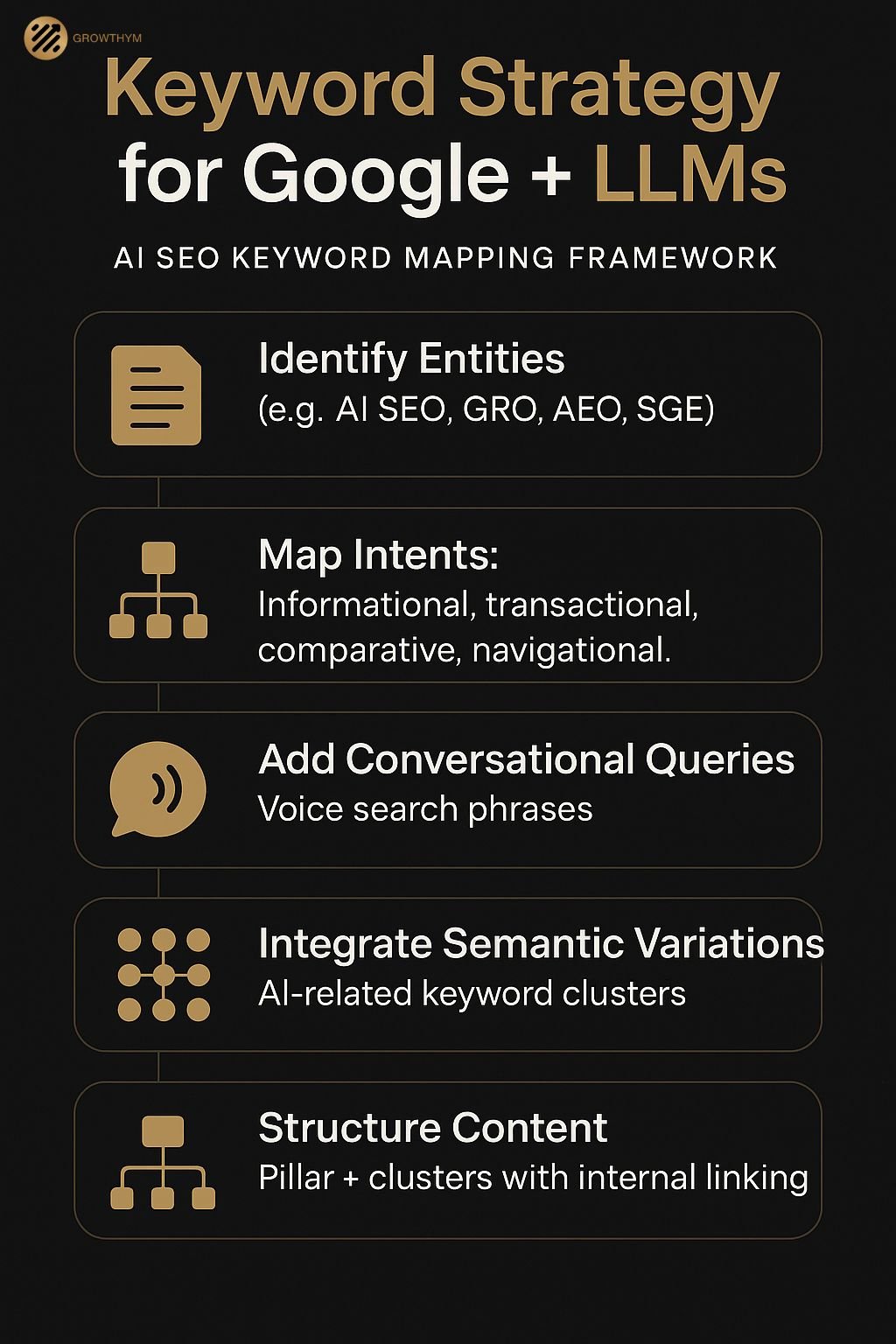
With GRO, AEO, and SGE mastered, you’re ready to move into the keyword strategy phase — mapping your topics for both Google ranking and AI model ingestion.
In traditional SEO, keyword research focuses on search volume + difficulty for ranking in Google’s SERPs. In AI SEO, keyword strategy must also account for:
This means we need dual-optimization — one layer for Google, one for LLMs — but both connected via semantic entity mapping.
In AI SEO, a single keyword must be mapped to multiple intents — because Google & LLMs process them differently.
Example for “AI SEO”:
Each intent should have its own section or page — feeding into your topical authority network.
| Source | Purpose | Tools |
| Google Search Console | Real search queries driving traffic | GSC |
| SGE Testing | Find which queries trigger AI panels | Google Labs / manual |
| People Also Ask | Related AI-friendly questions | SERP analysis |
| LLM Query Simulation | Ask ChatGPT/Claude/Perplexity what they’d answer for a term | ChatGPT, Claude |
| Entity Databases | Find linked entity keywords | Wikidata, Knowledge Graph API |
For AI SEO, entities include: AI SEO, GRO, AEO, SGE, Knowledge Graph, EEAT, schema markup.
Example:
Link each entity page to others in context. This helps both Google’s and LLM’s knowledge graph mapping.
AI models look for conceptual relationships, not just keyword matches.
Example:
To win in voice search & AI chats, your keyword list must include natural-language phrasing:
These should be included as H2/H3 questions in your blog and FAQ schema.
Since this blog also supports your AI SEO services page, target buyer-intent keywords:
These terms should be linked internally to your /ai-seo-services/ page.
| Section | Primary Keyword | Supporting Keywords | Entity |
| Intro | AI SEO | AI search optimization, AI-powered SEO | AI SEO |
| 3.1 | GRO SEO | Generative ranking optimization, GRO factors | GRO |
| 3.2 | AEO SEO | Answer engine optimization, voice search SEO | AEO |
| 3.3 | SGE SEO | Google SGE ranking, SGE optimization | SGE |
| 4 | AI keyword strategy | semantic SEO, entity keywords | Keyword Mapping |
Recommended Tools:
Workflow:
Pillar Keyword: AI SEO
Supporting Clusters:
This ensures your topical map is complete — covering all terms needed for both Google’s SGE and LLM answer engines.
AI SEO keyword strategy isn’t just about ranking for “AI SEO” in Google. It’s about owning the topic space — across SERPs, SGE panels, voice answers, and AI chats. That means targeting entity keywords, semantic variations, and conversational queries that feed both Google’s Knowledge Graph and LLM models.
With the keyword strategy in place, we can now move into content creation for AI SEO — ensuring the writing itself is AI-friendly, EEAT-compliant, and optimized for GRO, AEO, and SGE.
In traditional SEO, content was written primarily for human readers with keyword placement in mind.
In AI SEO, your content must:
Your goal is not just to rank, but to become the trusted answer in both search results and AI-generated summaries.
AI models read differently from humans. They:
Tip: Place a short definition immediately after the heading, then expand with context and examples.
Example:
What is Generative Ranking Optimization?
Generative Ranking Optimization (GRO) is an AI SEO strategy that ensures your content is selected as a preferred source for AI-generated answers in search engines, chatbots, and voice assistants by aligning entity data, semantic coverage, and trust signals.
A semantic content cluster is a network of interlinked pages covering a topic from every angle.
For AI SEO, your main pillar (this blog) should link to:
These internal links help AI systems understand your topical authority.
Schema.org markup helps AI interpret your content.
Key schemas for AI SEO blogs:
Implementation Tip: Use JSON-LD format and validate with Google’s Rich Results Test.
AI models follow Google’s EEAT guidelines to assess content trustworthiness:
Example EEAT signals for this blog:
H2: What is [Entity/Topic]?
Answer (40–60 words): [Short, precise definition with core keyword and entity mention.]
Expansion: Detailed explanation with examples, linking to related entities.
H2: How to [Achieve Goal] in [Topic]
Steps:
Since AI answers mimic human conversation, include:
— Short definition after every H2
— Entities linked and schema applied
— Covers primary + secondary keywords
— Includes FAQ section
— Supports EEAT with author, citations, and fresh data
— Interlinked with related cluster content
— Mobile-friendly formatting and media
Q: How do you optimize for Google’s SGE?
A: To optimize for Google’s Search Generative Experience (SGE), structure your content around entity-rich topics, answer related sub-questions, use schema markup for FAQs and HowTo guides, and provide concise summaries supported by in-depth context to increase the chance of being cited in AI-generated panels.
Content creation for AI SEO requires thinking beyond keyword density. You’re feeding both humans and machines — which means entity-driven, semantically complete, EEAT-supported, and schema-rich content.
In the next section, we’ll go into Technical AI SEO — ensuring your website is structured for AI crawling, indexing, and ranking.
In traditional SEO, technical optimization ensured search engines could crawl and index your site.
In AI SEO, technical optimization must ensure:
If content is king, then technical AI SEO is the foundation the kingdom is built on.
Example Architecture for AI SEO Blog Network:
/ai-seo/ (pillar)
/ai-seo/gro/
/ai-seo/aeo/
/ai-seo/sge/
/ai-seo/entity-seo/
/ai-seo/tools/
This structure helps both Google and LLMs connect related concepts.
| Schema Type | Purpose | Best Use Case |
| Article | Identifies blog content | All blog posts |
| FAQPage | Direct Q&A extraction | FAQ sections |
| HowTo | Step-by-step processes | Guides, tutorials |
| Organization | Brand authority & info | About pages, footer |
| Person | Author authority | Author bios |
| BreadcrumbList | Navigation clarity | All pages |
| Product | E-commerce AI snippets | Service/product pages |
Implementation Tip: Use JSON-LD format, not microdata — it’s cleaner for LLM parsing.
AI models extract meaning from clean, semantic HTML.
Google still uses Core Web Vitals for ranking signals — and AI models tend to ignore slow or unstable pages.
| Metric | Target |
| LCP (Largest Contentful Paint) | < 2.5s |
| FID (First Input Delay) | < 100ms |
| CLS (Cumulative Layout Shift) | < 0.1 |
Tip: Optimize images with WebP, preload fonts, and use a CDN.
AI search and LLMs prefer well-documented, regularly updated content.
To be recognized in Google’s Knowledge Graph (and therefore in AI answers):
Example: For “Generative Ranking Optimization”, link to industry whitepapers + your internal glossary.
AI search is becoming multimodal — processing text, image, and video.
— Flat, entity-based architecture
— Full schema coverage (Article, FAQ, HowTo, Organization, Person)
— NLP-friendly HTML with clear heading hierarchy
— Optimized Core Web Vitals
— Entity linking + knowledge graph integration
— Updated content with structured “last updated”
— Multimodal assets optimized (image, video, audio)
— Voice search testing and optimization
This makes your answer directly machine-readable for AI engines.
Technical AI SEO is about making your content impossible for AI systems to misunderstand.
From site structure to schema markup and multimodal optimization, these foundations ensure your content ranks in SGE, GRO, and AEO-driven ecosystems.
The next generation of search is not just text-based — it’s voice-first and multimodal.
Optimizing for these channels ensures your content is discoverable even when the user never types a word.
| Factor | Text Search | Voice Search |
| Query Length | 2–5 words | 5–15 words |
| Style | Keyword-based | Conversational, natural language |
| Format | Lists, articles | Direct, concise answers |
| Context | Generic | Location & intent-specific |
Query: “What is Answer Engine Optimization?”
Answer Block:
Answer Engine Optimization (AEO) is the process of structuring your content so AI-powered systems and voice assistants select it as the definitive answer to a user query, using concise responses, schema markup, and strong EEAT signals.
This format is short enough for voice delivery yet contains the keywords & entities AI looks for.
Multimodal search allows users to input text + other media types (images, videos, audio) to find results.
Example: In Google Lens, a user can upload a product image and type “AI SEO strategies for this platform” — and get both visual and text-based AI-generated answers.
Voice and multimodal search are not “future SEO trends” — they’re active AI-driven discovery channels right now.
If you want to dominate GRO, AEO, and SGE results, your content must:
In traditional SEO, you measured organic traffic, SERP rankings, and conversions.
In AI SEO, your metrics must also track:
If you only look at Google rank tracking, you’ll miss how AI is actually distributing visibility and traffic.
| KPI | What it Measures | Why it Matters |
| AI Answer Share | % of queries where your content is used in AI-generated answers | Shows your influence in AI-first search |
| SGE Panel Presence | How often your site is cited in Google SGE panels | Critical for above-the-fold visibility |
| Entity Rank | Your content’s recognition in Google’s Knowledge Graph | Directly affects AI and SERP ranking |
| Voice Search Citation Rate | % of voice queries where your answer is read aloud | Indicates conversational AI trust |
| Semantic Coverage Score | How completely you cover related topics | Boosts topical authority in LLMs |
| Multimodal Asset Indexation | Number of AI-indexed images, videos, and audio files | Ensures full multimedia visibility |
Process:
Target Benchmark: Aim for 20–30% AI answer share within 6 months of optimization.
SGE presence means your page is one of 2–3 cited sources in the AI-generated panel.
Why: AI and SGE rely on Knowledge Graph data to decide which sources to trust.
How to Measure:
Why: AI favors sources that cover topics comprehensively.
How to Measure:
Why: AI uses images, videos, and audio in SGE and other AI panels.
How to Measure:
Monthly AI SEO Dashboard Should Include:
In AI SEO, rank tracking is no longer enough.
You need to measure how often AI itself trusts and uses your content in generated answers, panels, and voice outputs.
With AI answer share, SGE presence, and entity rank as KPIs, you’ll have a real view of your AI-first search dominance.
AI SEO is evolving faster than any previous shift in search history.
Brands that anticipate these shifts can adapt content and technical strategies before competitors, securing long-term visibility.
AI will increasingly anticipate user needs before a search is typed.
Search results will be different for every user based on their past behavior, preferences, and AI profile.
Right now, GRO, AEO, and SGE optimization can be tackled as semi-separate tactics.
Soon, they will merge into a single AI-first SEO approach, where:
With Google Lens, Bing Visual Search, and AI video summarization tools growing, search will increasingly combine text, images, video, and audio.
AI will score and prioritize content based on credibility signals — similar to EEAT but model-specific.
LLMs like ChatGPT are becoming standalone search platforms.
We’ll move from tracking keyword rankings to tracking AI trust signals:
Over the next 2–3 years:
AI SEO is shifting from being a niche tactic to the core of all search marketing. The brands that win will:
The search landscape has fundamentally changed. Ranking in Google alone is no longer enough — you must also rank in AI-powered environments like Google’s Search Generative Experience (SGE), ChatGPT, Claude, and voice assistants.
By combining entity-driven content, structured data, and technical AI SEO, you position your brand as the go-to authority in both traditional and AI-first search.
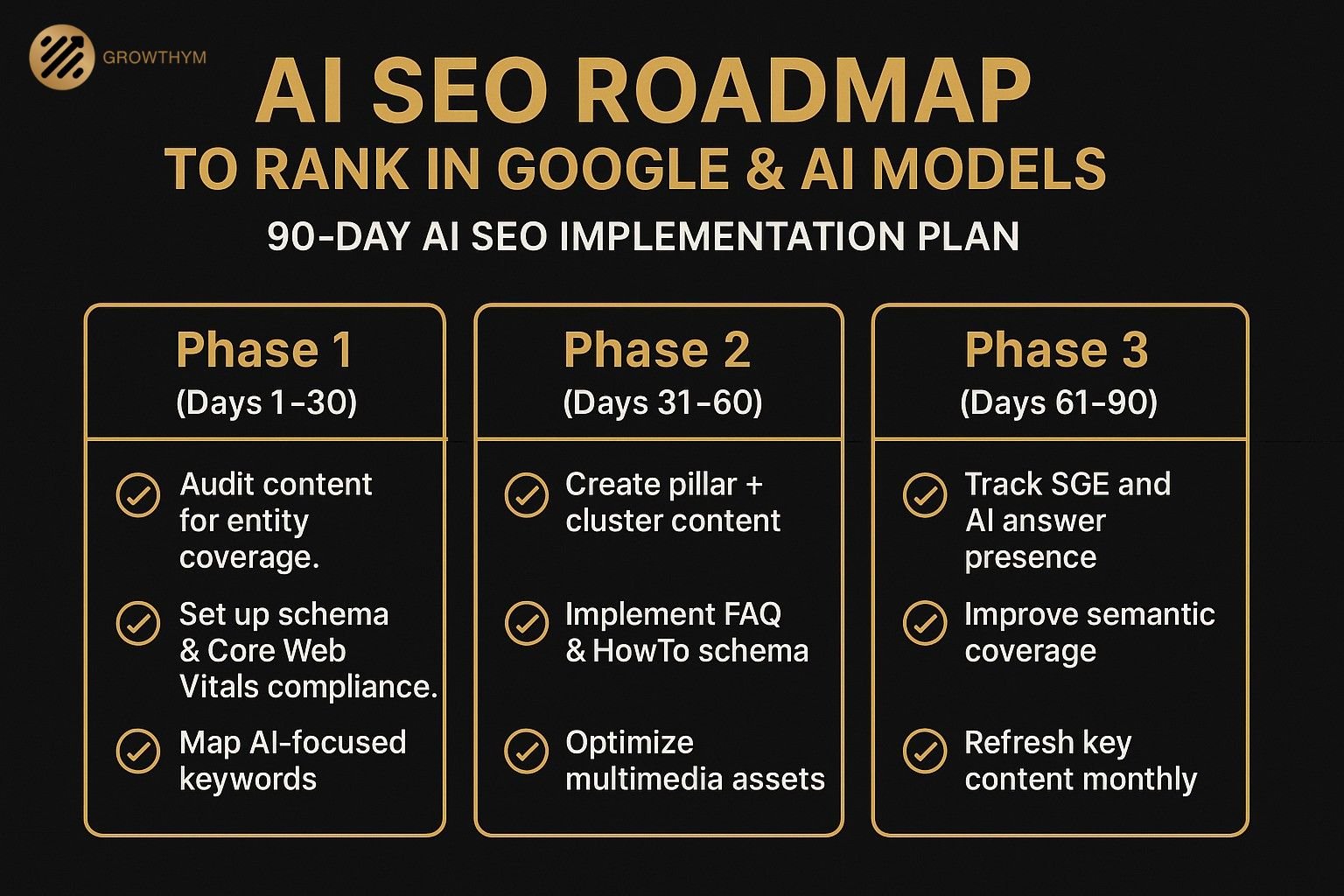
By the end of this plan, you should see:
SGE and AI-driven search are still early enough that brands can establish dominance before the competition fully adapts. Waiting even six months could mean competing against entrenched AI-first content leaders.
AI SEO is not a side strategy — it’s the new foundation of search marketing. By aligning your content, technical setup, and keyword strategy for GRO, AEO, and SGE, you future-proof your visibility across both search engines and AI platforms.
Growthym’s AI SEO framework ensures you’re not just part of the conversation — you’re the source everyone else cites.
LLMs can generate high-quality, SEO-ready drafts if given precise prompts.
Example Prompt for AI SEO Content:
Write a 1,200-word blog on “Generative Ranking Optimization (GRO)” with a 50-word definition at the start, 5 subheadings, structured lists, entity mentions for GRO, AI SEO, and SGE, and FAQ schema-ready answers to 5 related questions.
Why It Works:
LLMs and Google rely on knowledge graphs to connect concepts.
Steps:
Use tools like Surfer SEO, Clearscope, and MarketMuse with ChatGPT or Claude to:
Pro Tip: Check not just Google rankings — also see which pages are cited in ChatGPT and Perplexity for your target queries.
AI search is multimodal by default — so every core page should have:
Goal: Appear in SGE for “best AI SEO tools for Shopify stores.”
Tactics Used:
Goal: Increase AI answer share for “AI project management software.”
Tactics Used:
Q1. What is AI SEO?
AI SEO is the process of optimizing content and websites for both traditional search engines and AI-powered platforms like Google SGE, ChatGPT, and voice assistants by using entity-based SEO, structured data, and semantic coverage.
Q2. How is AI SEO different from traditional SEO?
Traditional SEO focuses on keyword rankings in Google SERPs. AI SEO targets visibility in AI-generated answers, SGE panels, voice search results, and multimodal search experiences.
Q3. What is GRO in SEO?
Generative Ranking Optimization (GRO) is an AI SEO technique that ensures your content is selected as a source for AI-generated answers in search engines, LLMs, and voice assistants.
Q4. What is AEO in SEO?
Answer Engine Optimization (AEO) structures your content so AI and voice systems can extract concise, authoritative answers, increasing your chances of being cited.
Q5. What is SGE in Google Search?
Search Generative Experience (SGE) is Google’s AI-driven search format that generates conversational summaries with cited sources, appearing above traditional organic results.
Q6. How do I optimize for Google SGE?
Use entity-rich content, concise answer blocks, FAQ schema, and cover related subtopics comprehensively to increase your chance of being cited.
Q7. Can AI SEO improve voice search ranking?
Yes, by targeting conversational queries, using structured Q&A formats, and applying FAQ schema, your content can become the top voice search answer.
Q8. How does entity SEO work in AI optimization?
Entity SEO focuses on connecting your content to recognized topics, people, or brands in the Google Knowledge Graph and LLM knowledge bases, boosting trust and ranking.
Q9. What schema types are important for AI SEO?
Article, FAQPage, HowTo, Organization, Person, VideoObject, and ImageObject schema are critical for AI SEO.
Q10. Does AI-generated content rank well in Google?
Yes, if it meets EEAT standards, is factually accurate, and optimized for entities and structured data — but AI content should always be human-edited.
Q11. How can I measure AI SEO success?
Track AI answer share, SGE panel presence, entity rank, voice search citation rate, and semantic coverage score.
Q12. What tools help with AI SEO?
Surfer SEO, Clearscope, MarketMuse, Kalicube Pro, InLinks, and schema markup validators.
Q13. Is AI SEO suitable for all industries?
Yes, but it’s most impactful in industries where search is rapidly evolving — like SaaS, eCommerce, healthcare, and education.
Q14. How often should I update AI-optimized content?
At least quarterly to maintain freshness signals and ensure AI models retrieve the most current data.
Q15. Why is topical authority important in AI SEO?
Because AI systems prefer to cite sources with comprehensive, consistent coverage on a topic, ensuring reliability and trust.
Finding the right search opportunities is one of the fastest ways to improve your website traffic and rankings. But in most cases, analysing the Search Engine Results Page (SERP) manually takes a lot of time, and it is easy to miss hidden opportunities.
This is where ChatGPT can make a big difference. It can read SERP data at scale, understand patterns in search intent, and highlight the keywords where your business has a realistic chance to rank. With the right workflow, ChatGPT becomes more than just a writing tool — it becomes a powerful SEO assistant.
In this guide, we will walk through a step-by-step process to use ChatGPT for SERP opportunity discovery. You will learn:
We will also share real case study examples to show how this approach works in different industries. If you want to understand the wider role of AI in SEO, you can explore our AI SEO Guide for additional strategies.
By the end of this blog, you will have a ready-to-use framework to find SERP opportunities using ChatGPT — and turn them into traffic and revenue growth.
SERP opportunity discovery means finding keywords where ranking is realistic and profitable. It helps you focus on terms that can drive high-value traffic. You also learn what searchers want and how competitors meet that need.
Search intent shows the reason behind a query. It may be informational, transactional, or navigational. Studying intent helps match your content with what users want. You also need to check how strong your competitors are. A strong domain with many backlinks is harder to outrank.
Some keywords have high search volume but low competition. These are the easiest wins. Featured snippets can bring clicks even without ranking first. Zero-click SERPs show results directly on Google, but they still build brand visibility. Emerging trends and seasonal queries can give early-mover advantages.
Manual keyword research takes a lot of time. You may miss patterns hidden in large datasets. Traditional methods rely on static data, while SERPs change daily. This makes it easy to lose opportunities if you are slow to act.
Using ChatGPT solves these issues by reading large datasets, finding trends, and suggesting quick actions.
ChatGPT can read, understand, and summarise SERP data at scale. It finds patterns humans may miss and suggests keyword opportunities you can act on quickly. By combining speed and context, ChatGPT becomes a strategic SEO tool, not just a content generator.
ChatGPT understands language in context. It goes beyond matching keywords and recognises related phrases and topics. This helps group similar queries and uncover hidden opportunities.
It can scan large keyword lists and identify trends instantly. Instead of checking each keyword manually, you get grouped opportunities in seconds.
ChatGPT can suggest unique content angles based on SERP layouts. If a SERP shows videos, it may suggest a video-first approach. If it has “People Also Ask,” it can give exact questions to answer.
You can connect ChatGPT with Google Search Console, Ahrefs, or custom scrapers. This creates a flow where SERP data goes directly into ChatGPT for analysis. You save time and get a repeatable process.
Data quality decides how well ChatGPT can spot SERP opportunities. Good data gives clear insights, while poor data leads to weak suggestions. The goal is to collect accurate SERP details, prepare them in the right format, and send them to ChatGPT for analysis.
You can pull SERP results using APIs like SerpAPI or DataForSEO. These tools give structured results, making them easier to process.
If you use SEO tools like Ahrefs or Semrush, export keyword lists in CSV format. This ensures you get search volume, difficulty, and competition data together.
Gather keywords along with search intent, monthly volume, CPC, and difficulty score.
Include SERP features such as People Also Ask, Top Stories, videos, and local packs.
Save competitor URLs and their title and meta descriptions. This helps ChatGPT compare your site with top-ranking pages.
Clean raw exports by removing duplicates and irrelevant terms.
Check for missing values and fix them before analysis.
Structure the cleaned data in JSON or CSV so ChatGPT can read it easily. Keep column names simple, like “Keyword,” “Volume,” “Difficulty,” and “SERP_Features.”
Well-prepared data allows ChatGPT to give accurate recommendations and reduces the risk of errors.
Prompt design decides how useful ChatGPT’s output will be. A well-structured prompt directs the model to focus on valuable insights instead of generic answers. In SERP analysis, prompts should guide ChatGPT toward identifying keywords, ranking chances, and the best content approach.
The prompt tells ChatGPT exactly what to do with your SERP data. Clear instructions help the model filter irrelevant terms and focus on keywords with real potential.
Keyword Gap Analysis Prompt
Analyze the following keywords with their metrics and identify the top 10 where my site could realistically rank in the top 5 within 3 months.
SERP Feature Opportunity Prompt
Given these SERP features for each keyword, suggest content formats that could win them.
Competitive Content Gap Prompt
Identify keyword clusters my competitors rank for but I don’t, and propose angles to outperform them.
These prompts help ChatGPT detect gaps, content ideas, and SERP-specific opportunities.
One prompt may not give the full picture. You can refine results with follow-up prompts, known as iterative prompting. For example, after getting keyword suggestions, ask ChatGPT to re-rank them by ROI or competition level. This step-by-step approach increases accuracy.
Request ChatGPT to return results in a table format. Include columns like “Keyword,” “Search Volume,” “Difficulty,” “SERP Feature,” and “Priority Score.” Tables make it easier to sort and plan actions in your SEO tools.
By combining precise prompts with clear output formats, you turn ChatGPT into a structured SERP research assistant.
ChatGPT can find patterns in SERP data that humans might overlook. By grouping related queries, spotting trends, and detecting content decay, you can plan faster and smarter SEO actions.
ChatGPT can group keywords based on intent or topic.
For example, “best running shoes for women” and “top women’s sports shoes” may belong to the same cluster.
Grouping helps you plan content hubs or pillar pages, improving topical authority.
Trends move fast, and ranking early gives a big advantage.
You can combine Google Trends data with ChatGPT to summarise which rising keywords match your niche.
For example, if a fitness brand sees “home resistance bands workout” gaining searches, ChatGPT can suggest content ideas before competitors act.
Old content can drop in rankings if competitors publish fresher or better-optimised pages.
By cross-referencing Google Search Console performance drops with ChatGPT’s SERP review, you can spot decayed pages.
If your page on “best budget laptops 2023” is losing clicks, ChatGPT may recommend updating it for 2024 with new models and specs.
Using ChatGPT for patterns and trends ensures you act before opportunities fade or competitors take the lead.
Automation saves time and makes SERP analysis consistent. By linking scraping tools, data cleaning scripts, and ChatGPT’s API, you can run opportunity discovery without manual work.
A simple automation flow looks like this:
SERP scraping → Data preprocessing → ChatGPT API call → Output into Google Sheets or Notion.
The scraper collects SERP data. A preprocessing script cleans and formats it. The ChatGPT API analyses the data and sends insights to your reporting tool.
You can integrate SerpAPI with ChatGPT using Python:
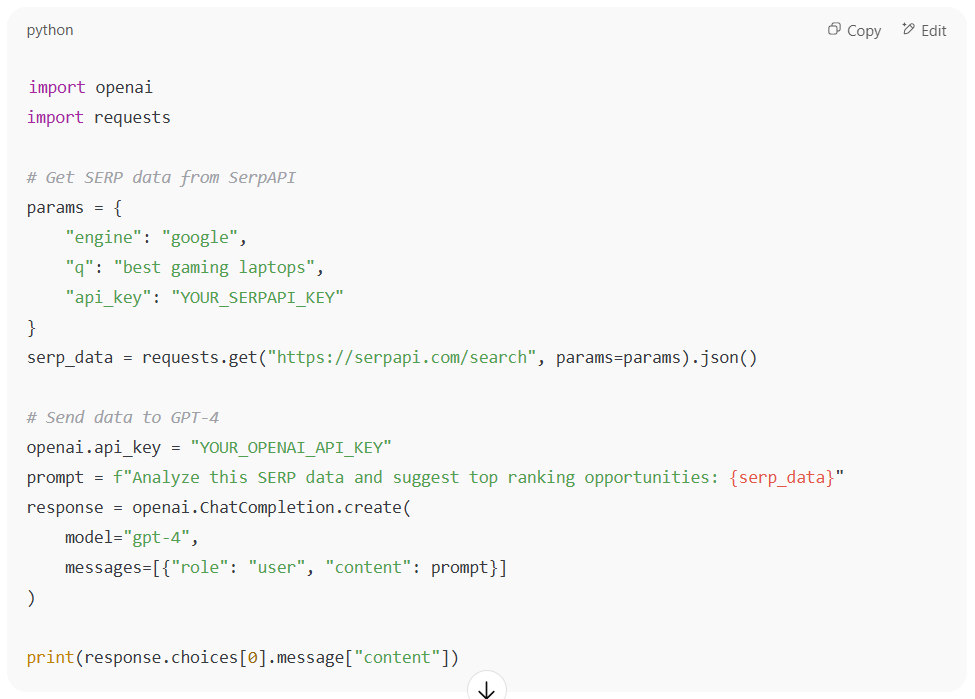
This script fetches SERP data, sends it to ChatGPT, and prints ranking suggestions.
Use cron jobs or cloud schedulers to run this process weekly or monthly. Regular checks help track changes in SERPs and capture new opportunities quickly.
Connect the final output to Google Data Studio, Notion, or custom dashboards. This creates a live SERP opportunity tracker that updates automatically.
Automating this process ensures you never miss ranking chances and reduces manual analysis time.
This case study shows how an eCommerce retailer used ChatGPT to find and capture new search opportunities. You can read the full project in our eCommerce retailer case study.
The client ran an online store selling eco-friendly home products. They wanted to increase organic traffic and win more featured snippets without large ad spend.
We started by extracting SERP data for 500 target keywords using SerpAPI and their existing SEO tool exports.
After cleaning the data, we sent it to ChatGPT with prompts to:
The output was delivered in a table format with priority scores. The SEO team used these insights to create and update content.
Within 90 days, the site gained 35% more organic traffic.
We secured 8 new featured snippets for high-intent queries.
Click-through rates improved on pages that targeted low-competition, high-CTR keywords.
The key takeaway was clear: when ChatGPT processes structured SERP data, it can reveal fast-win opportunities that traditional research often misses.
Using ChatGPT for SERP opportunity discovery works well, but it’s not perfect. Knowing its limits helps you get better results.
By combining ChatGPT’s speed with human expertise, you get a balanced and effective SERP discovery process.
ChatGPT can change how you find and act on SERP opportunities. It reads large sets of SERP data, spots patterns, and suggests keywords you can target right away. When paired with automation, it can keep your keyword research fresh without extra manual work.
The most important factor is balance. ChatGPT can process and summarise faster than any human, but your expertise ensures the suggestions are practical and aligned with business goals. Always verify its findings with SEO tools and real performance data.
Whether you are looking for quick wins, featured snippet opportunities, or trending topics, ChatGPT can become a core part of your SEO workflow. If you want to explore how AI can improve your organic growth, our SEO services show how we combine AI and proven SEO strategies to drive results.
With the right process, prompts, and checks, ChatGPT turns SERP opportunity discovery into a faster, smarter, and more consistent task.
This section gives ready-to-use prompts and a sample Python script to help you start quickly.
Keyword Analysis Prompt
“From the following keyword list with search volume, CPC, and difficulty, find the top 15 keywords where ranking in the top 5 is possible within 90 days. Return results in a table format with Priority Score.”
SERP Feature Identification Prompt
“For each keyword and its SERP features, suggest the best content type (article, video, infographic) to win that position. Return the answer in a table format.”
Competitive Gap Analysis Prompt
“Compare my keyword list to the competitors’ ranking keywords. Identify topics they rank for but I don’t. Suggest angles to create better and more engaging content.”
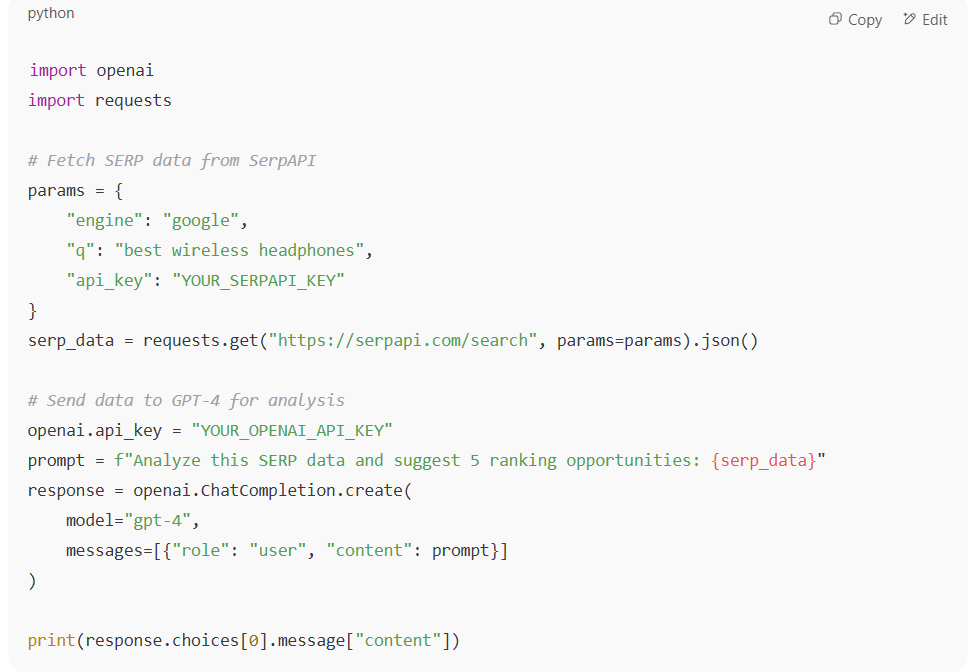
This code collects SERP results, sends them to ChatGPT, and prints actionable keyword suggestions.
With these prompts and scripts, you can begin automating SERP opportunity discovery right away.
Q1. What is SERP opportunity discovery?
SERP opportunity discovery is the process of finding keywords and topics where your website can rank well on Google search results. It includes identifying low-competition keywords, featured snippet targets, and trending topics.
Q2. How can ChatGPT help with SERP opportunity discovery?
ChatGPT can process large SERP datasets, group keywords by search intent, spot content gaps, and suggest content formats. This speeds up keyword research and makes it more accurate.
Q3. What data do I need to give ChatGPT for analysis?
You should provide keywords, search volume, difficulty, CPC, SERP features, and competitor URLs. Structured data in CSV or JSON works best for ChatGPT analysis.
Q4. Can ChatGPT replace traditional SEO tools?
No. ChatGPT works best as a supplement to tools like Ahrefs, Semrush, or Google Search Console. It gives insights faster, but you still need SEO tools for accurate metrics.
Q5. How often should I run SERP opportunity analysis?
For most websites, monthly analysis works well. For fast-moving niches, weekly checks help you stay ahead of competitors and trends.
Q6. Is ChatGPT accurate for keyword ranking predictions?
ChatGPT can make strong predictions based on the data you give, but human validation is always needed to confirm feasibility and avoid false positives.
Q7. Can I automate ChatGPT SERP analysis?
Yes. You can integrate SERP APIs like SerpAPI with ChatGPT and run automated scripts to send results to Google Sheets or SEO dashboards.
Consider a content team that manually works everything and runs a campaign that drives 25% engagement, but with 60% less efficiency. Now, consider another content team that works smartly and leverages artificial intelligence to automate some work with human touch, resulting in 40% improved engagement with 90% more efficiency. Which one do you think is better?
This is a quick snapshot of Human-AI collaboration. Today, AI hype is no longer in the shadows; it’s a reality we are all witnessing in our daily lives. We now have a new companion in the town: AI that does everything from writing headlines and CTAs to crafting a compelling blog post. AI content marketing is transforming the landscape for traditional methods of content creation.
No more grinding to hit the deadlines. AI takes charge to help you come up with ideas, offer feedback, and help create compelling content that resonates with the audience. In this blog, we are going to cover the crucial role of AI in content marketing, its importance, and other essential points. Let’s explore the synergy of human and AI in content marketing.
The days when content marketing was just you, coffee, and a sparkling idea. Those days aren’t exactly over – they have been transformed. Traditionally, content marketing has been all about creating a good story, earning trust, and ensuring people are coming back for more.
However, today’s marketing hustle has changed – you aren’t just expected to write a compelling story, you are supposed to do it fast, frequently, and do it flawlessly at scale. This is where the human and AI collaboration plays a vital role.
The truth is, traditional content marketing doesn’t move at the speed of modern marketing requirements. AI-powered content creation increases the momentum by improving productivity and efficiency in the overall process.
AI content marketing doesn’t aim to replace human creativity but focuses on building a Human-AI synergy that augments it. The role of AI isn’t limited to content creation; there are other digital marketing services where artificial intelligence is leveraged, such as AI SEO.
The close collaboration between Human and Artificial Intelligence offers numerous benefits for a content marketing strategy. Consequently, this opens a door to not only automation but also to a seamless content marketing workflow. Here is how the synergy of Human and AI works out:
The following are the different steps to adopting a Human-AI content strategy.
Step 1: Creating the Foundation
The initial step is to establish the foundation for Human-AI collaboration that involves understanding the existing operations, choosing the appropriate tool, and training your team. Without having a solid idea about your current workflow, it is challenging to adopt the change. Therefore, begin with pinpointing the need for AI integration, where it can eliminate manual labor, speed up the process, and enhance quality.
Assess various AI platforms and automation tools to select those that meet your particular business needs and industry. Determine the voids and select the proper tools to blend into your workflow, matching your tech stack. Provide training to reskill your team and smoothen AI adoption.
Step 2: Create Content Collaboratively
This step is all about merging human imagination with AI’s efficiency and speed. It is all about analyzing market trends and data. It is a strong foundation that you can build on to craft engaging content to nudge the audience in the intended direction.
Secondly, the human touch is required to ensure that the tone, message, and direction of the content are consistent with your brand’s distinctive voice, style, and audience requirements. Therefore, the combination of humans and AI to produce content assists in creating engaging drafts.
Step 3: Optimization and Scale
It’s an optimization step that allows you to maximize the reach of your content. By integrating AI insights with human-led interpretation, in order to find out not only what is working but also why it’s failing. You can repeatedly analyze data and create content pieces that appeal to the appropriate audience.
While humans can understand the nuances, AI helps combine this skill with essential insights after identifying any gaps and trends. This collaboration yields excellent results for your digital marketing campaign, offering a perfect synergy to produce compelling content.
Marketers must adhere to a holistic strategy that merges creativity and technology well in order to reap the maximum benefits of human and AI collaboration. Below are the most important best practices for marketers to implement optimal Human-AI collaboration in their content marketing process.
With artificial intelligence being a part of digital content creation, it will revolutionize how content is ideated, created, and distributed. Furthermore, the involvement of AI is going to intensify in content marketing in the next few years.
In the future, the AI will accomplish more than automation, and it will be a strategic co-creator, allowing you to create personalized and context-sensitive content. Since AI models are becoming intelligent and powerful, they will give more strategic insights regarding the audience in real-time, and you can customize the tone, format, and style of your content.
As they put it: Content is king. Therefore, if you wish to guarantee success for your content marketing program, you must create engaging content. Nevertheless, developing content that resonates with your audience at scale is tiring and cumbersome.
The AI and human synergy make this process even more powerful, as AI can provide valuable insights for your audience and human creators can help drive the content in the right direction by adding storytelling, empathy, emotions, and other aspects.
If you want to leverage AI content marketing, you need a reliable growth marketing partner like Growthym. We are a renowned agency offering AI-driven content marketing, SEO, and digital marketing services to help you improve your brand visibility with the power combination of AI and humans. Contact us to discuss how we can help you increase your brand visibility and improve revenue.
Creating a good content brief takes time. Research, keyword planning, and structure can take hours. This delay slows your content production.
AI now changes that. You can create content briefs in minutes with the right tools. These AI-powered briefs are fast, consistent, and data-driven. They use live search data and competitor insights to guide your writers.
In this guide, you’ll learn how to build a complete AI-powered content brief in just 15 minutes. We’ll use practical steps, proven methods, and real examples.
If you want to understand AI’s role in SEO, read our AI SEO Guide.
An AI-powered content brief is a document that AI creates with data analysis. It includes target keywords, audience details, and a suggested content structure.
Unlike traditional briefs, AI-generated briefs pull data from SERPs, competitor pages, and keyword tools. This makes them more accurate and faster to create.
Key parts of an AI-powered content brief:
Using AI also reduces human error and keeps your briefs consistent. If you need full-service support, check our AI SEO Services.
AI can transform how you prepare content briefs. It turns long manual work into a quick, data-backed process.
Manual research can take hours. You need to check keywords, review competitors, and outline the content. AI does this in minutes. It scans SERPs, finds relevant keywords, and suggests an outline instantly.
When different writers prepare briefs, structures can vary. This affects quality. AI keeps a standard format for every brief. This helps writers follow a clear structure and saves editing time.
AI briefs include SERP analysis, keyword clustering, and competitor research. They highlight ranking opportunities and content gaps. This ensures your content targets real search demand, not guesses.
If you run a content team, speed and quality matter. AI helps you produce more briefs without losing accuracy. This makes it possible to scale content production without hiring more staff.
A mid-sized eCommerce company used manual briefs. Each brief took 3 hours to prepare. After adopting AI briefs through AI Growth Discovery Sprint, they cut the time to 15 minutes.
Writers received briefs with keyword priorities, search intent notes, and suggested headlines. As a result:
AI-powered content briefs don’t replace SEO strategy—they make it faster and more accurate. They ensure your writers work with clear, research-backed guidance.
For teams looking to track performance, the AI Growth Analytics Hub can help measure the impact of these briefs on traffic and conversions.
A strong content brief ensures writers know exactly what to create. AI-generated briefs make this process faster and more consistent. But the quality depends on the elements you include.
Define your reader persona clearly. Include their interests, search intent, and pain points. For example, a B2B software buyer looks for detailed feature comparisons, not just benefits. AI tools can extract these details from SERP patterns and competitor analysis.
Choose one primary keyword and a set of supporting keywords. These should come from data, not guesswork. Use AI to filter by search volume, difficulty, and intent. This helps you target both main and long-tail opportunities.
Provide a clear heading structure (H1, H2, H3). AI can suggest this based on top-ranking pages. It ensures all key topics are covered and prevents gaps in coverage.
Match your content length to top competitors. If the top pages have 2,000 words, aim for a similar range. Format for easy scanning with bullet points, short paragraphs, and visuals.
Keep your brand voice consistent. If your tone is friendly but technical, note that in the brief. AI can help maintain this style across multiple writers.
Highlight featured snippet opportunities, “People Also Ask” topics, and missing subtopics. AI analysis of SERPs can point out gaps that your content can fill.
Include internal links to relevant pages, like SEO Services, and credible external sources. This improves authority and user trust.
When all these elements are in place, AI-generated briefs become a powerful tool. They guide writers with precision while ensuring your content has a competitive edge in rankings.
AI makes it possible to create a high-quality content brief in minutes instead of hours. Below is a fast, structured process you can follow.
Start by selecting a topic that supports your business goals and SEO strategy.
For example, a company offering AI SEO solutions might choose “AI SEO Guide for Beginners” to attract businesses new to AI-driven marketing.
Use AI along with SEO tools like Semrush, Ahrefs, or Google Search Console. Integrate this data into ChatGPT for SERP opportunity analysis.
AI reduces manual work here by combining keyword, SERP, and competitor data in one view.
AI can process top-ranking pages to find:
For example, if competitors don’t include case studies, you can add links like the Eco-Friendly Products Case Study to stand out.
With the data ready, use ChatGPT to create a clear content structure.
Example prompt for ChatGPT:
“Create an SEO-optimized content outline for the keyword ‘AI SEO Tools,’ including headings, subheadings, and bullet points. Match competitor word count and include featured snippet opportunities.”
AI gives speed, but human review ensures quality.
Once done, you have a content brief that’s data-backed, SEO-optimized, and ready for writers — all in under 15 minutes.
If you follow this process, your content production becomes faster, more consistent, and strategically aligned with your growth goals.
AI makes creating content briefs faster and more consistent, but relying on it blindly can lead to mistakes. The most effective approach is to treat AI as your research and structuring assistant, while you provide the judgment, creativity, and industry expertise. Below are key best practices to make sure your AI-powered briefs drive results and maintain high content quality.
Never send AI-generated briefs directly to writers without checking the data. AI tools can speed up keyword research, SERP analysis, and competitor comparison, but they can also present outdated or irrelevant information. This happens because AI predictions are only as good as the data they receive. If the source data is incomplete or inaccurate, the entire brief can lose credibility. Before sharing with writers:
By validating this information, you protect your brand from publishing misleading content and increase the chances of ranking well on search engines.
AI can’t fully understand your brand’s voice, customer preferences, or internal success stories unless you train it with that data. Without these inputs, the content may sound generic and fail to connect with your audience. Adding brand-specific insights ensures the final article reflects your identity and stands apart from competitors. You can do this by:
This not only improves engagement but also makes your content memorable and trustworthy.
While AI excels at processing large datasets and spotting SEO patterns, it can’t replace the emotional intelligence, storytelling ability, and real-world experience of a human writer. By blending AI’s speed with human creativity, you get the best of both worlds — factual accuracy and engaging delivery. Consider this workflow:
This mix ensures your content feels personal, credible, and aligned with your audience’s expectations.
SEO is not static — algorithms, SERP layouts, and keyword trends change frequently. An AI-powered brief created six months ago might now be outdated. To keep your content performing well:
Staying proactive with updates ensures your AI-powered content briefs remain competitive and continue to deliver results over time.
AI can make content brief creation faster and more consistent, but only if it’s used the right way. Many teams lose potential ranking power and audience engagement because they skip critical checks or misuse the technology. Here are the most common mistakes to watch out for — and how to avoid them.
One of the biggest mistakes is taking AI’s keyword, SERP, or competitor suggestions at face value. While AI can process massive amounts of data quickly, it can still misinterpret search intent or pull outdated information. Always verify statistics, ranking data, and competitor details with trusted SEO tools before finalizing the brief.
It’s tempting to add every keyword AI suggests, but stuffing a brief with excessive keywords can lead to unnatural writing and poor user experience. Focus on one primary keyword and two to four secondary keywords that are highly relevant to the topic. This keeps the content clear, SEO-friendly, and easy for writers to follow.
Even the most data-rich AI brief will fail if it doesn’t connect with the right audience. AI might suggest a tone that doesn’t match your brand or overlook audience-specific needs. Include clear tone guidelines and audience personas in every brief so the final content resonates.
AI tools often provide competitor-based outlines but may miss unique opportunities to stand out. Review SERP features like “People Also Ask” boxes, videos, and featured snippets. Identify content gaps competitors haven’t covered and add them to your brief for a competitive advantage.
AI tools make it easier to collect keyword data, analyze SERPs, and create structured briefs in minutes. Below are some of the most effective options and what they offer.
ChatGPT is a flexible AI writing assistant that can create detailed content outlines, suggest headings, and generate keyword ideas when combined with SERP data. It’s best used with a clear prompt structure for accurate results.
Jasper specializes in marketing content creation. It offers templates for blog outlines, product descriptions, and ad copy. It integrates with SurferSEO to align briefs with SEO data.
SurferSEO focuses on on-page optimization. It provides keyword clusters, competitor outlines, and content score tracking, helping ensure briefs match top-ranking content structure.
Clearscope analyzes top-ranking pages and suggests relevant keywords, readability improvements, and content structure updates for better SEO performance.
Frase automates SERP analysis and competitor research, delivering AI-generated outlines and questions to cover. It’s useful for building briefs around search intent.
Content Harmony creates SEO-driven briefs with keyword targeting, competitor comparisons, and recommended visuals for stronger engagement.
AI has changed the way marketing teams create content briefs. What once took hours of manual research, keyword collection, and competitor analysis can now be done in minutes. With tools like ChatGPT, SurferSEO, and Frase, you can quickly pull SERP data, analyze competition, and create outlines that match both search intent and brand goals.
The real advantage lies in combining AI’s speed with human creativity. AI delivers data-backed recommendations, but it’s your insights, industry knowledge, and brand voice that turn a good brief into an exceptional one. By adopting AI-powered workflows, you can scale content production, maintain quality, and stay ahead in competitive search results.
Now is the best time to test these tools in your process. Start with one article, measure results, and refine your prompts and structure. The sooner you integrate AI into your content strategy, the faster you’ll see measurable improvements in SEO performance and team efficiency.
AI-generated briefs are highly accurate when based on reliable data sources like SERP APIs, keyword research tools, and competitor analysis. However, accuracy depends on prompt quality and the freshness of the data. Always review and fact-check before sharing with writers.
Yes. AI works best when combined with SEO tools like Ahrefs, Semrush, or SurferSEO. These tools provide up-to-date keyword data, search volume trends, and SERP insights that AI alone cannot always generate in real time.
AI-powered briefs are versatile and work across most industries, from eCommerce to B2B software. However, niche sectors with strict regulations—like healthcare or finance—require additional human oversight for compliance and accuracy.
To maintain originality, add brand-specific insights, unique perspectives, and proprietary data. Use AI as a foundation, but customize sections to reflect your tone, style, and expertise. This helps avoid generic content and ensures your briefs stand out in competitive search results.
Content marketing has always been about one thing—building trust through valuable stories. For years, businesses relied on human creativity alone to craft blogs, videos, and campaigns. But in today’s digital world, the demand for content is exploding. Audiences expect fresh, relevant, and personalized content across multiple platforms, all the time.
This is where AI content marketing enters the picture. AI is not here to replace human writers, strategists, or marketers. Instead, it is here to empower them. AI can analyze data, identify trends, and generate first drafts in seconds. Meanwhile, humans bring strategy, empathy, and creativity that no algorithm can replicate. Together, they form a powerful duo that can transform how brands connect with people.
Think of it this way—AI can process huge amounts of information and suggest what works. But it takes human judgment to craft a story that feels authentic, emotional, and aligned with brand values. The future of content marketing lies in this partnership: humans and AI working side by side.
In this blog, we will explore:
By the end, you will see that the future is not “human vs. AI.” It is “human + AI”—a collaboration that makes marketing smarter, faster, and more human at the same time.
Content marketing is no longer simple. Audiences consume information across blogs, social media, podcasts, and videos. They expect content that is not only useful but also personalized. Meeting these expectations is becoming harder with only human effort.
Here are the main reasons why AI is now essential:
Brands need a constant stream of fresh content. Writing, editing, and designing everything manually takes too much time. AI tools can generate first drafts, suggest ideas, and even repurpose old content. This allows teams to produce more without sacrificing quality.
Today’s audience expects content that speaks directly to them. A single generic blog post no longer works. AI can analyze user behavior and segment audiences. It then helps marketers create personalized content for each group.
Marketing decisions need insights from search data, social trends, and customer behavior. The volume of data is massive. AI can process this data quickly and highlight what matters most. Humans can then turn those insights into actionable strategies.
Digital competition is fierce. If a brand takes weeks to launch a campaign, it risks losing attention. AI cuts down production and research time, helping teams respond faster to market changes.
AI supports SEO by finding keywords, optimizing titles, and improving readability. It helps content rank better in search engines, making sure it reaches the right audience.
In short, AI does not just make content marketing faster—it makes it smarter. It solves the biggest challenges of scale, personalization, and speed while giving marketers space to focus on creativity.
AI brings speed and scale, but humans bring meaning. Content marketing is not only about delivering information. It is about telling stories that build trust and connect emotionally. This is where humans play a role that AI cannot replace.
AI can generate words, but it cannot imagine new worlds or unique ideas. Humans bring creativity, humor, and originality to campaigns. Storytelling requires emotions, and only people can craft stories that feel real.
Content is powerful only when it follows a strategy. Marketers decide what message to share, which channel to use, and how it fits business goals. AI can suggest patterns, but humans align those insights with brand vision and market context.
People trust content that feels authentic. AI-generated words may lack empathy or cultural awareness. Humans ensure the content respects values, tone, and emotions that matter to the audience.
AI works on data, but data can carry bias. Humans are needed to review, refine, and make ethical choices. They make sure content is inclusive, accurate, and responsible.
AI is good at repeating what already works. But innovation requires breaking patterns. Humans test new formats, experiment with bold ideas, and take risks.
The future of content marketing depends on this balance. AI acts as the assistant that handles repetitive tasks and insights. Humans lead the vision, creativity, and emotional side of content. Together, they create campaigns that are both efficient and meaningful.
The real power of AI content marketing comes when humans and machines collaborate. AI handles data and automation, while humans add creativity and judgment. Here’s how the process works step by step:
When both sides play their role, content becomes data-driven yet creative, efficient yet human-centered. This collaboration is the future of marketing.
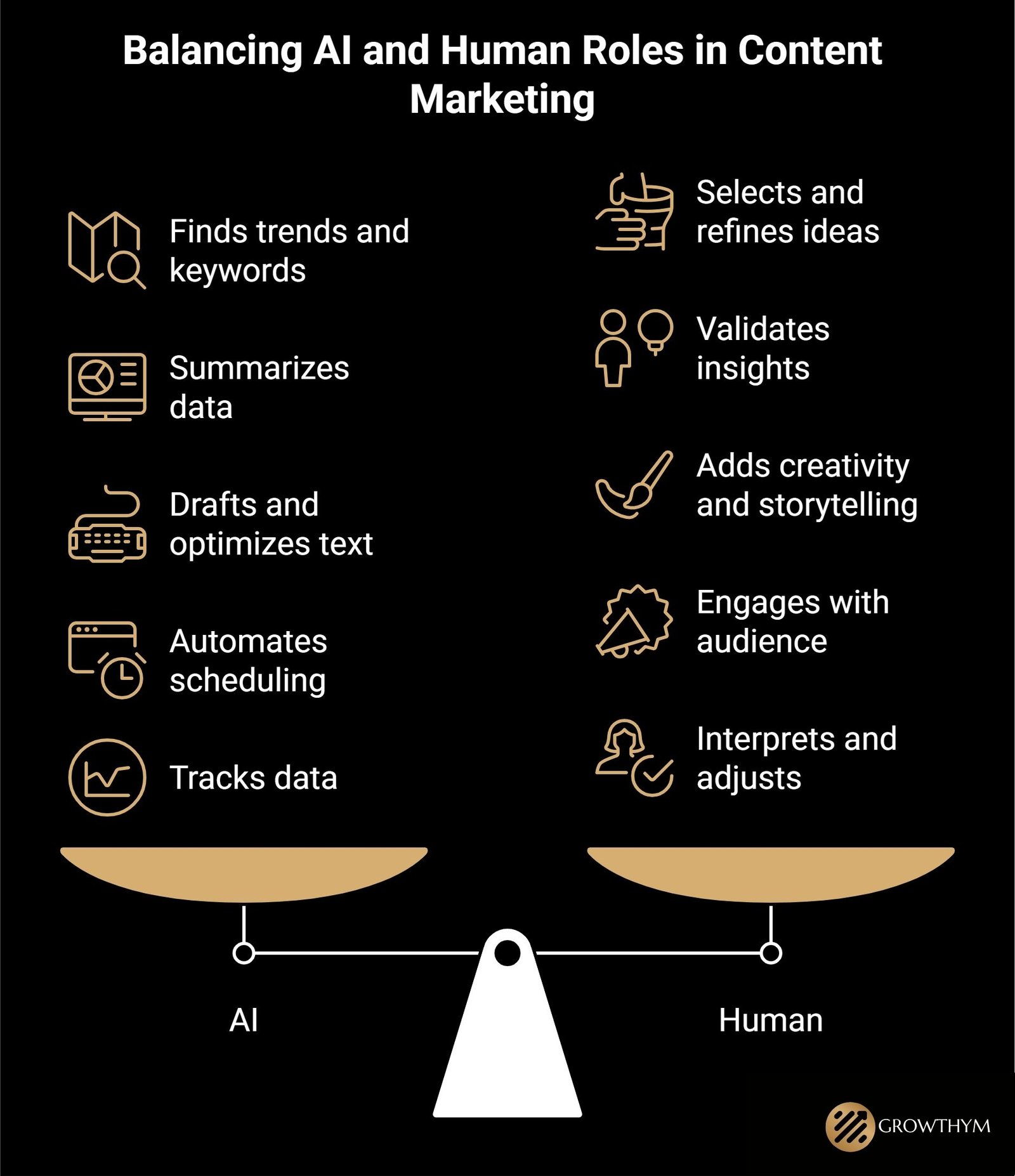
The future of marketing is not about choosing between humans or AI. It is about using both together. This collaboration gives businesses a strong advantage.
AI reduces the time spent on research, drafting, and editing. Teams can publish more content without overloading writers and designers.
AI provides insights on trends and audience behavior. Humans then use those insights to shape unique stories and campaigns. The result is creative ideas backed by real data.
AI can segment audiences and predict what they want to read or watch. Humans craft the message to ensure it feels personal, authentic, and relatable.
AI tools suggest keywords, optimize headlines, and improve readability. Marketers make sure the content aligns with brand voice and intent. This balance helps content rank higher in search engines and attract the right audience.
With AI tracking performance, marketers can see what works in real time. Humans then adjust the strategy with judgment and creativity. This leads to better ROI and less wasted effort.
Brands that adopt AI + human collaboration stay ahead. They produce content faster, engage audiences better, and adapt quicker to market changes.
In short, collaboration makes content marketing both efficient and meaningful. AI gives speed and insights. Humans bring creativity and trust. Together, they deliver maximum impact.
The best way to understand the power of human + AI collaboration is through real examples. Many businesses already use AI to scale content while keeping a human touch.
An e-commerce retailer used AI to analyze customer browsing patterns. The system suggested products, blog topics, and email subject lines tailored to each shopper. The marketing team refined the tone and created storytelling campaigns around these insights. The result: higher conversions and repeat sales.
👉 See how Growthym helped an E-Commerce Retailer boost performance with AI-driven insights.
A financial services brand needed trust-based content. AI analyzed search intent and highlighted trending financial topics. Human writers then turned these insights into blogs, guides, and FAQs with simple language and empathy. This mix helped the brand rank higher on search engines and gain credibility.
A sustainable products company wanted to connect with eco-conscious buyers. AI tools mapped audience sentiment on social media. The team then crafted emotional stories around customer values like health and environment. This collaboration built strong brand loyalty.
An innovative software company used AI to repurpose content across multiple platforms. AI summarized whitepapers into social posts and email campaigns. Marketers added creativity, ensuring the brand voice stayed strong. This approach extended reach without losing authenticity.
A boutique retail brand used AI to track seasonal trends and customer purchase data. Marketers then built personalized stories around lifestyle choices. This balance created memorable campaigns that drove both in-store and online engagement.
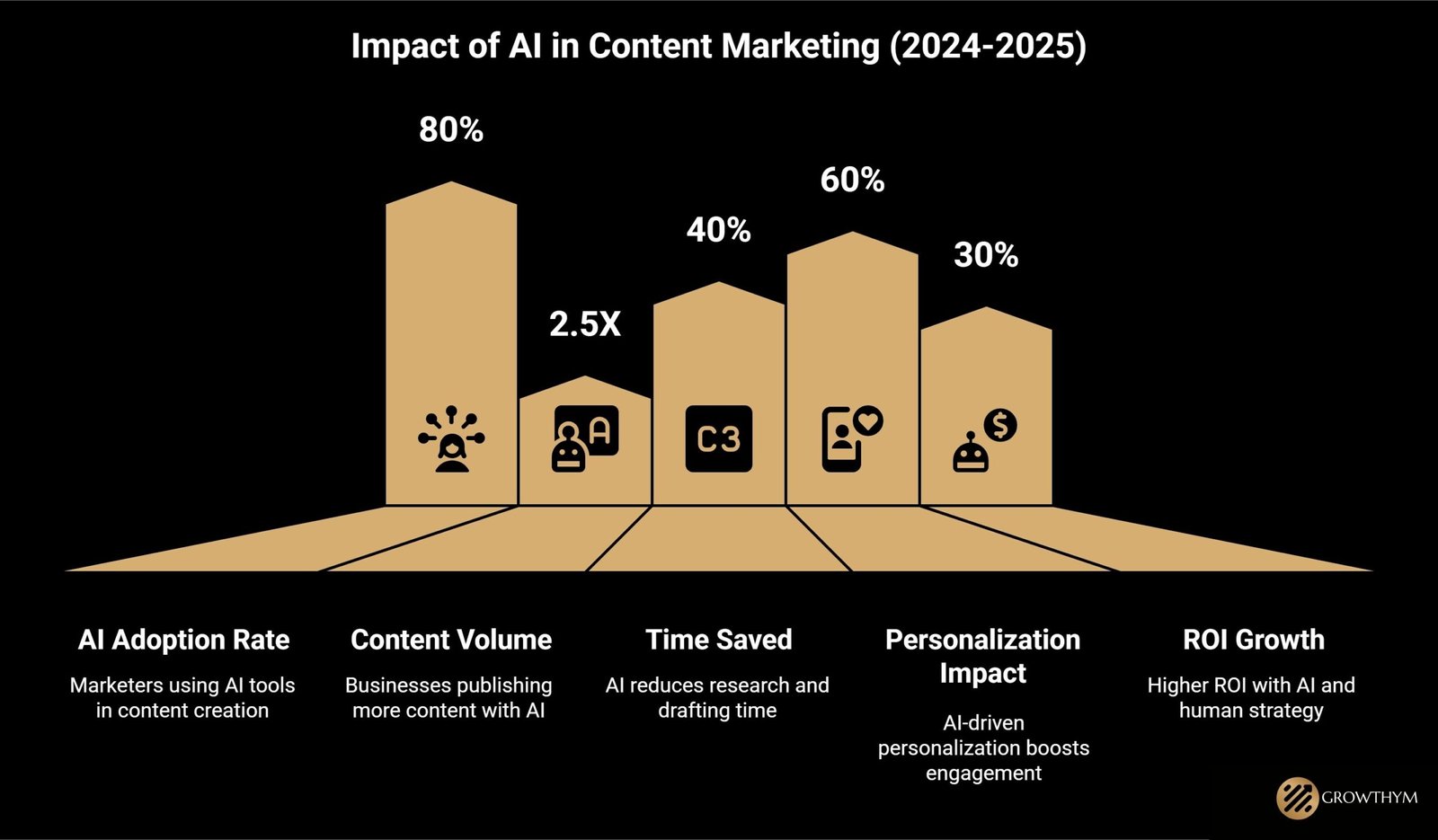
AI is still evolving, and so is its role in content marketing. The future will not just be about faster content creation. It will focus on deeper personalization, richer formats, and ethical use. Here are the key trends shaping what’s next:
AI will not just react to user searches. It will predict what users need before they ask. This means brands can create content that meets future demand and answers questions early.
Personalization will go beyond name-based emails. AI will deliver unique content experiences for each user—based on behavior, location, and even mood. Humans will refine these experiences to keep them natural and trustworthy.
With video and podcasts growing fast, AI will help generate scripts, subtitles, and even voiceovers. Human creators will use these tools to scale production while focusing on creative direction.
Search engines like Google are moving toward AI-driven answers on the results page. Brands will need to optimize for zero-click searches—making sure their content is structured for visibility even if users don’t click.
👉 You can explore our AI SEO Guide for deeper strategies.
As AI becomes central to marketing, ethical use will be critical. Audiences expect transparency, fairness, and authenticity. Human oversight will remain essential to ensure content avoids bias and misinformation.
No matter how advanced AI becomes, creativity, empathy, and innovation will remain human strengths. Brands that merge AI efficiency with human imagination will stand out.
The future of AI content marketing is about balance. AI will handle speed, scale, and data. Humans will ensure creativity, strategy, and ethics. Together, they will shape a content ecosystem that is smarter, more engaging, and more human than ever.
Shifting to AI content marketing is not just about using new tools. It requires building a system where AI and humans work together. Here are practical steps to get started:
Not all AI tools serve the same purpose. Some help with keyword research, others with drafting, design, or analytics. Start by identifying gaps in your current process, then pick tools that solve those specific challenges.
AI is powerful, but it works best when people know how to use it. Train your content, SEO, and marketing teams to use AI responsibly. Focus on understanding prompts, data validation, and quality review.
Define clear roles for AI and humans. For example:
Begin with one area, like blog optimization or social media captions. Once you see results, expand AI use across research, video, and distribution.
Always fact-check AI-generated content. Be transparent with your audience if AI is part of the process. This builds trust and ensures your brand reputation stays strong.
Use AI-powered analytics to measure engagement, conversions, and reach. Let humans interpret the numbers and adjust strategies. Continuous feedback will help you improve over time.
By preparing today, businesses can stay ahead in the future of content marketing. AI is not replacing humans—it is enhancing their capabilities. The earlier you build collaboration, the stronger your results will be.
👉 Need expert help to design a strategy that blends human creativity with AI? Explore our Content Marketing Services to get started.
Content marketing is entering a new era. AI brings speed, data, and automation. Humans bring strategy, creativity, and empathy. Alone, each has limits. Together, they unlock the full potential of marketing.
The future is not “AI will replace humans.” The future is “humans who use AI will replace those who don’t.” Marketers who embrace collaboration will create content that is not only efficient but also authentic and impactful.
As AI grows smarter, the role of humans will become even more important. It will be up to people to guide AI with vision, ethics, and imagination. Brands that find this balance will lead the way in building trust and lasting relationships with their audience.
At Growthym, we believe the future of content marketing is human + AI collaboration. Businesses that prepare today will stay ahead tomorrow.
AI content marketing uses artificial intelligence to plan, create, and optimize content. It helps marketers work faster while improving personalization and insights.
No. AI supports writers by automating research and drafting. Humans are still needed for creativity, strategy, and emotional storytelling.
AI finds keywords, analyzes search intent, and improves readability. It helps content rank higher and reach the right audience.
The mix brings faster content production, better personalization, smarter decisions, and stronger engagement. It balances efficiency with authenticity.
Start small—use AI for keyword research, headlines, or analytics. Train teams to collaborate with AI, then scale across blogs, video, and campaigns.
Marketing is changing fast. Traditional campaigns are no longer enough to reach modern buyers. Customers expect quick responses, personalized experiences, and seamless journeys across channels. To meet this demand, businesses are turning to marketing AI agents.
Unlike chatbots of the past, AI agents are smarter. They can understand intent, process data in real time, and take actions without constant human input. In marketing, they act like digital teammates who can run campaigns, nurture leads, and even close deals.
The best part? They actually work. From automating repetitive tasks to improving customer engagement, AI agents are proving their value in real-world scenarios.
In this blog, we’ll explore:
By the end, you’ll see how AI agents can transform your marketing into something faster, smarter, and more effective.
AI agents are advanced software programs that can think, decide, and act on their own. In marketing, they are designed to handle tasks that normally need human effort. Unlike basic chatbots or rule-based automation, marketing AI agents use machine learning and natural language processing to understand context, intent, and user behavior.
Here’s how they are different:
Think of them as digital co-workers who never sleep, constantly learning from data and helping marketers deliver better results.
Modern marketing is more complex than ever. Customers expect instant answers, personalized experiences, and consistency across all channels. Traditional marketing teams struggle to keep up with these demands. This is where AI agents step in.
A delay of even a few minutes can lose a lead. AI agents respond instantly—whether it’s answering product questions, sending offers, or solving issues.
Manually segmenting customers and creating tailored campaigns takes weeks. AI agents can analyze customer data in real time and deliver content or offers that feel personal.
Marketers deal with massive data from social media, emails, websites, and ads. AI agents process this data quickly and suggest actions that actually improve results.
Replying to FAQs, sending reminders, updating CRM—these eat up hours. AI agents handle these tasks automatically, letting humans focus on creative strategy.
Brands that move fast get ahead. AI agents cut campaign execution time from weeks to hours. They give businesses a competitive edge.
In short, AI agents help marketing teams do more with less—faster campaigns, better personalization, and smarter decisions.
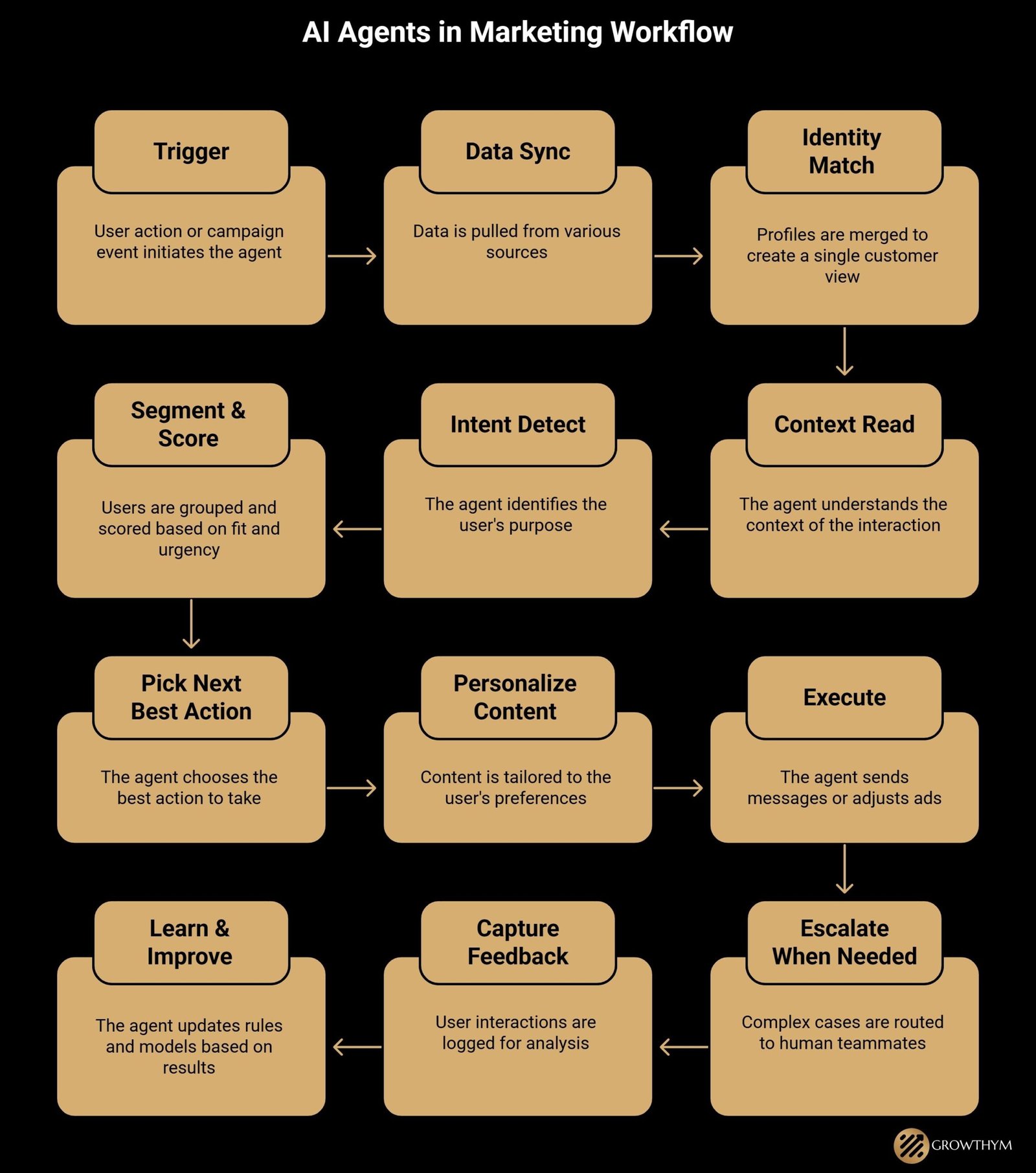
AI agents are no longer just a buzzword. Businesses across industries are using them to improve performance, reduce costs, and create better customer experiences. Here are the top use cases that work in real life:
AI agents can act as the first point of contact on websites, landing pages, or social media. They ask questions, capture intent, and qualify leads before passing them to sales.
Instead of making customers wait for replies, AI agents provide instant answers to common queries. They also handle tasks like checking order status or processing returns.
AI agents analyze customer data in real time and suggest products, services, or content. This creates a personalized journey that drives more sales.
AI agents monitor live campaign data across ads, email, and social media. They can adjust targeting, budgets, or content on the fly to maximize ROI.
AI agents can engage followers, reply to comments, and even run interactive campaigns. They keep brands active 24/7 without needing large teams.
Instead of waiting for monthly reports, AI agents provide instant insights. They highlight what’s working, what’s not, and suggest actions.
AI agents adjust website content, emails, or ads based on each visitor’s profile. This makes marketing feel relevant and human.
These are not future predictions—they’re use cases already delivering value today. Businesses that adopt AI agents now gain efficiency, personalization, and faster growth.
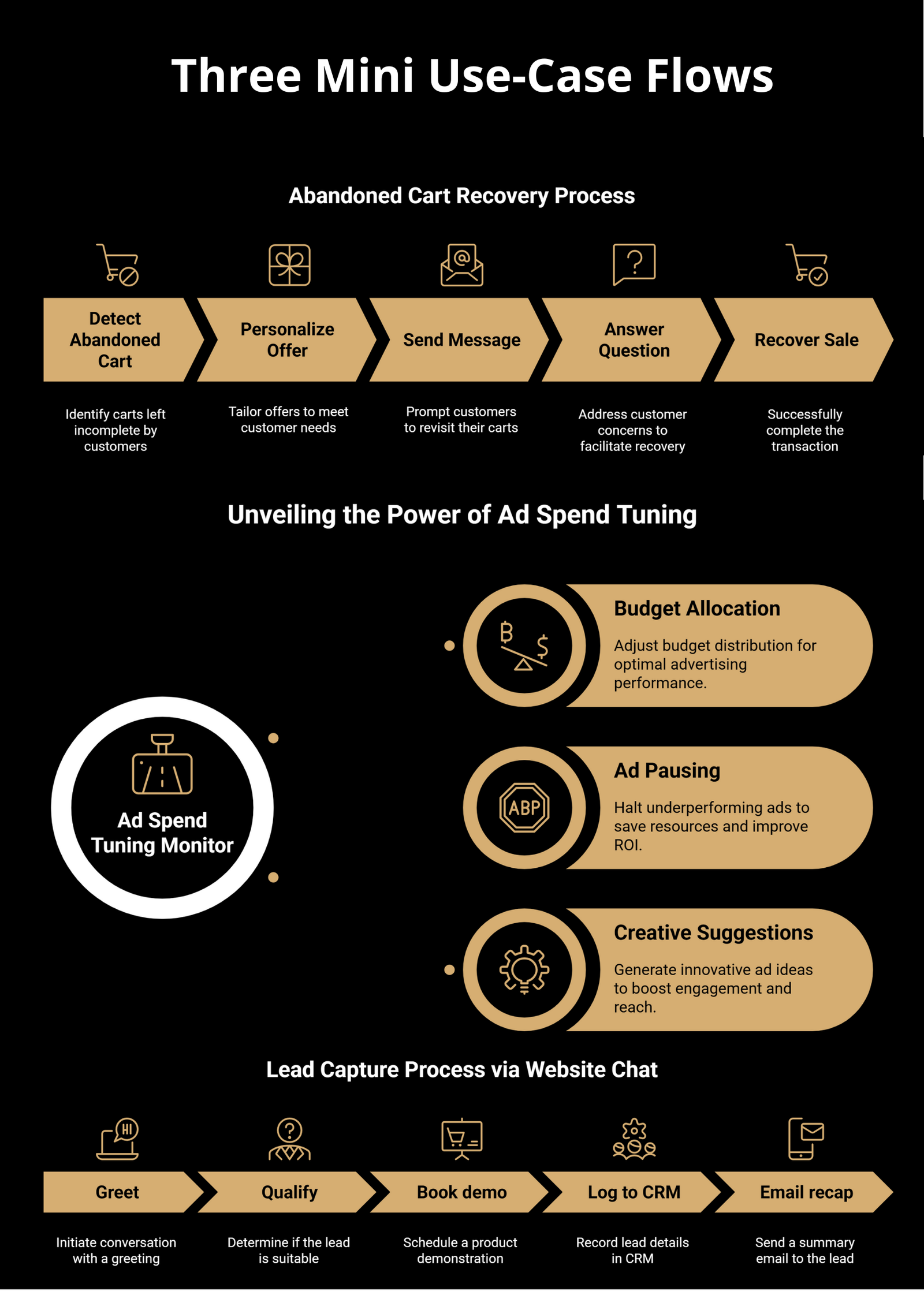
The best proof of AI agents’ impact comes from businesses already using them. Here are some practical examples across industries:
An online retailer struggled with high support volumes during sales campaigns. By deploying an AI agent, they automated 60% of FAQs (order tracking, returns, product availability). Human agents now handle only complex cases. The result: 40% reduction in support costs and higher customer satisfaction scores.
👉 See how Growthym helped an E-Commerce Retailer boost performance with AI-driven solutions.
A financial services brand wanted to qualify leads faster. Their AI agent engaged website visitors with personalized questions and automatically scored leads. Only high-value prospects went to the sales team. This improved conversion rates by 35% and reduced manual follow-ups.
A boutique brand used AI agents to recommend products based on customer history. Instead of generic campaigns, each shopper received tailored offers. The personalization increased average order value by 25% and built stronger loyalty.
A software company used an AI agent to track ad spend across multiple channels. The agent shifted budget automatically to top-performing ads and paused underperforming ones. This cut wasted spend and delivered 2x ROI on ad campaigns.
A green brand relied on social media for sales but struggled to respond to customer queries in real time. Their AI agent managed DMs and comments 24/7, providing quick answers and capturing leads. Engagement rates grew by 50% in three months.
These examples prove that AI agents in marketing are not theory—they are practical, measurable, and scalable. Businesses adopting them today are saving costs, improving customer experience, and growing faster.
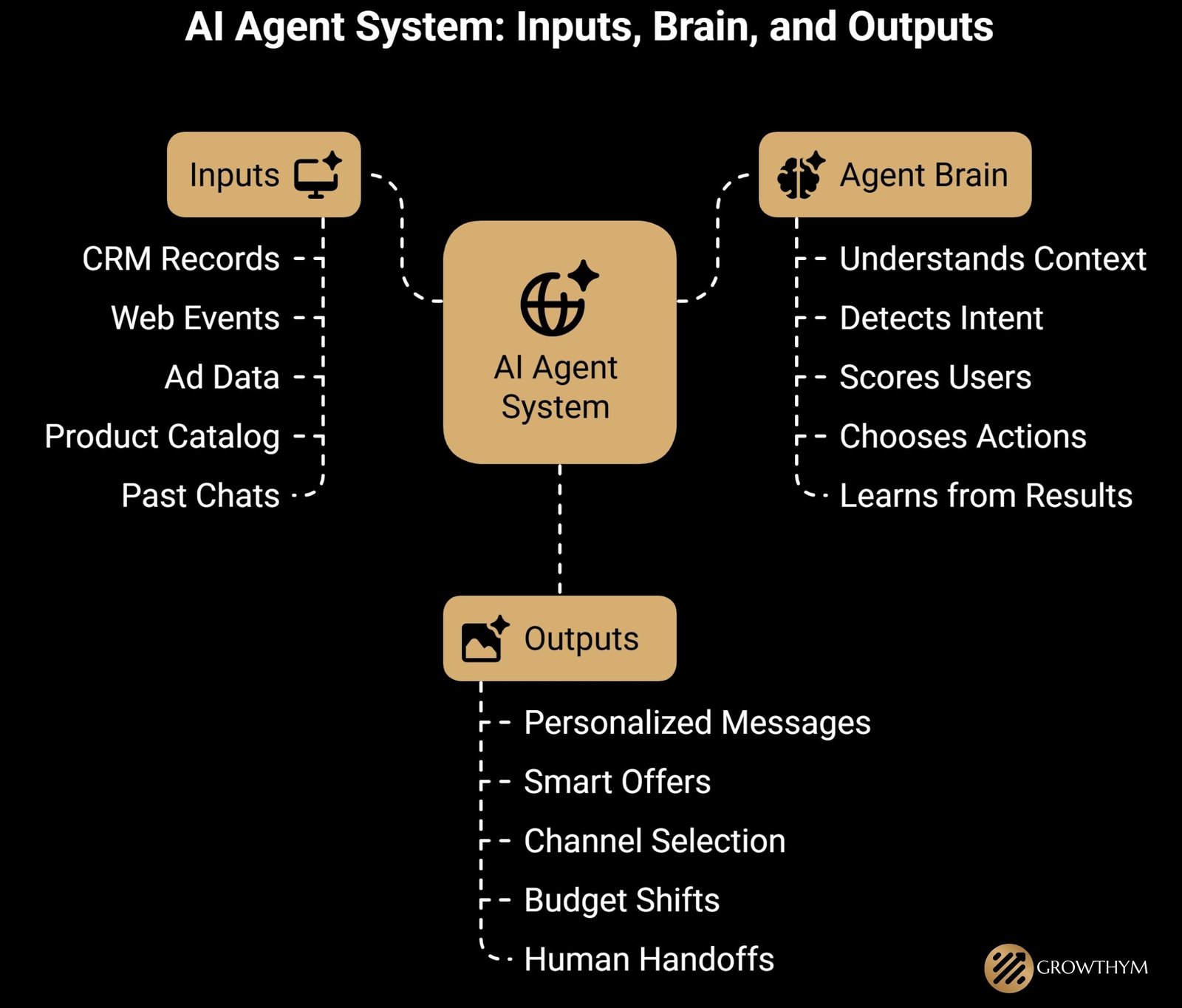
Adopting AI agents for marketing may feel complex, but the process is simple when you take it step by step. Here’s how to begin:
Start by spotting areas where your team spends the most time or faces the most challenges. Examples: lead qualification, customer support, or campaign optimization. Choose one or two to begin with.
Not all AI agents are built for marketing. Look for solutions that support:
AI agents improve with good data. Feed them with FAQs, customer queries, campaign history, and product information. This ensures they give accurate and relevant responses.
Deploy your AI agent in one channel (e.g., website chat or email). Monitor results closely. Collect feedback from customers and your team to improve performance.
Once tested, expand your AI agent to multiple touchpoints: website, social media, email, and paid campaigns. This creates a consistent customer experience everywhere.
AI agents should handle repetitive tasks, but humans must manage strategy and creativity. Build a workflow where AI works as an assistant, not a replacement.
Track KPIs like response time, lead conversions, customer satisfaction, and ROI. Adjust workflows as you learn what delivers the best results.
👉 Businesses that start small and scale gradually see the best results. The earlier you build human + AI collaboration, the faster your marketing performance improves.
If you’re ready to deploy AI agents for real growth, check out our AI Agent Development Services at Growthym.
Marketing has entered a new phase where speed, personalization, and intelligence matter more than ever. Traditional tools and workflows cannot keep up with modern customer expectations. Marketing AI agents fill this gap by working as always-on teammates who engage, analyze, and act in real time.
From qualifying leads to running campaigns, they free marketers from repetitive tasks and give them more time to focus on creativity and strategy. Real-world examples across retail, finance, and e-commerce already prove their value—delivering higher conversions, better customer satisfaction, and improved ROI.
The future of marketing will not be human versus AI. It will be humans and AI agents working together. Businesses that adopt this approach today will build faster, smarter, and more personalized customer journeys tomorrow.
Marketing AI agents are intelligent software programs that can analyze data, understand intent, and act on tasks like customer support, lead nurturing, and campaign optimization without constant human input.
They automate repetitive tasks, qualify leads, personalize customer experiences, optimize campaigns in real time, and provide instant insights—saving time and improving ROI.
Yes. Unlike basic chatbots, AI agents understand context, learn from data, and take actions. They are capable of handling complex conversations and multi-channel campaigns.
Absolutely. By responding instantly, recommending personalized products, and engaging across channels, AI agents create faster, more meaningful customer interactions.
Start small—identify one use case like lead qualification or support automation. Train the agent with quality data, test results, and scale gradually across channels.