Search is not disappearing. But it is changing shape. For years, digital visibility was mostly about rankings. Brands worked to win positions, capture clicks, and move visitors to landing pages. Now, AI search is changing that path. Users are getting direct answers, summarized recommendations, and fewer reasons to visit multiple websites. That shift is moving the focus from ranking to referencing.
This is where AI search visibility starts to matter. A brand no longer needs to be only present in search results. It needs to be present inside the answer. That is a different kind of visibility, and it changes how discovery works. In many cases, AI brand mentions now influence awareness before a click even happens. Content still needs strong SEO foundations, but AI SEO adds another layer. It asks whether your content is clear enough to extract, useful enough to trust, and strong enough to cite in AI-driven search experiences.
From Search Engines to Answer Engines
Search has been transforming ever since Google launched. Initially, what used to be a list of blue links is now a landscape of AI-generated answers that often don’t require any clicks. And end users instantly trust these summaries. As a result, the full discovery journey is happening even before the user lands on a website.
Today, AI is the first thing people go to understand any complex topic or to evaluate any brand. AI brand mentions across ChatGPT, Gemini, Perplexity, Copilot, and Google AI Overviews now transform how users think and what they pick. AI SEO has completely transformed consumer behavior. Also, AI referral traffic accounts for around 1.08% of all website traffic and is growing about 1% month over month, with ChatGPT driving 87.4% of that traffic.
This shift warns traditional SEO. Brands may lose about 20% to 50% of traffic, as most decisions are taken even before a click. AI search visibility surpasses all the steps that were required for multiple searches into one conversion. While traditional search still matters, it no longer guarantees that your content is selected by AI engines. These search engines often dive deeper than keywords and backlinks. AI search engines give priority to clarity, structure, and authority. These pull answers from trusted third-party ecosystems such as Wikipedia, Reddit, G2, industry review sites, etc.
This clearly shows brands need to think more about websites; everything—narrative, data, messaging, and credibility—must be aligned so AI learns about their brand. AEO (Answer Engine Optimization) and GEO (Generative Engine Optimization), which call for four core practices:
- Answer users’ questions directly
- Information should be structured so that AI can interpret it without confusion
- Keep brand details consistent across all platforms
- Build brand authority
What AI Search Visibility Means
In simple terms, AI search visibility measures how frequently and favorably a brand is mentioned, cited, or recommended within AI-generated responses (e.g., ChatGPT, Gemini, Perplexity, Google AI Overviews). These engines don’t provide a menu of blue links. Instead, they give an answer sourced from a credible source they trust most. And this changes the rules of organic visibility.
This is also where AI SEO starts to look different from standard optimization. The goal is not only to help a page rank. The goal is to help the brand become useful in an answer environment. That means the content needs to be easy for AI systems to read, interpret, and trust. It should answer real questions clearly, stay close to the topic, and offer enough substance to be worth citing.
When a brand appears in AI-generated responses, it gains exposure at the exact moment a user is looking for direction, comparison, or clarity. This ultimately influences awareness, consideration, and even buying decisions long before a visitor lands on the website.
So, AI search visibility is not just about being found. Rather, it is about being included. It is about whether your brand shows up when AI tools assemble an answer, compare options, or point users toward trusted sources. And for brands trying to stay discoverable, that difference matters.
How Brands Get Cited in AI
To boost AI brand mentions, marketing must shift from just being search-list visible to being answer-list trusted. Here is how:
Create AI-Readable Content
A lot of brand content still sounds polished but says very little. That is a problem in AI search. If the page is too broad, too padded, or too vague, it becomes harder for AI systems to pull anything useful from it. Content needs to get to the point faster. It should clearly map problems to the solutions, and the language should be simple. Keep the headings clear and the sections short. AI prefers content that is easy to parse and summarize.
Demonstrate Brand Authority
AI references brands that appear credible. It comes through detailed service pages, strong point-of-view content, practical blogs, case studies, and proof that the team understands the problem from the inside.
The more consistent the expertise, the easier it becomes for AI systems to treat the brand as a trusted source.
Structure for Conversational Queries
People now ask questions directly, sometimes very specific. And AI search is built around that behavior. Hence, your content should meet this pattern and reflect how end users actually speak, compare, and decide. Frame subheadings as natural questions. Include FAQs and short and scannable summaries.
Strengthen Reputation Signals
AI systems look at the mentions on relevant websites, backlinks from credible sources, consistent brand references, founder visibility, and signs that the business exists beyond its own blog. AI engines reward clarity and credibility.
SEO vs AI Visibility
SEO and AI search visibility are connected, but they do not work in the same way. Traditional SEO visibility is about rankings. The goal is to help a page appear in search results, earn clicks, and bring visitors to the site. On the other hand, AI search visibility works a little differently. In many cases, the user does not scroll through ten blue links. They get a summarized answer.
Here is a brief differentiation between SEO and AI search visibility :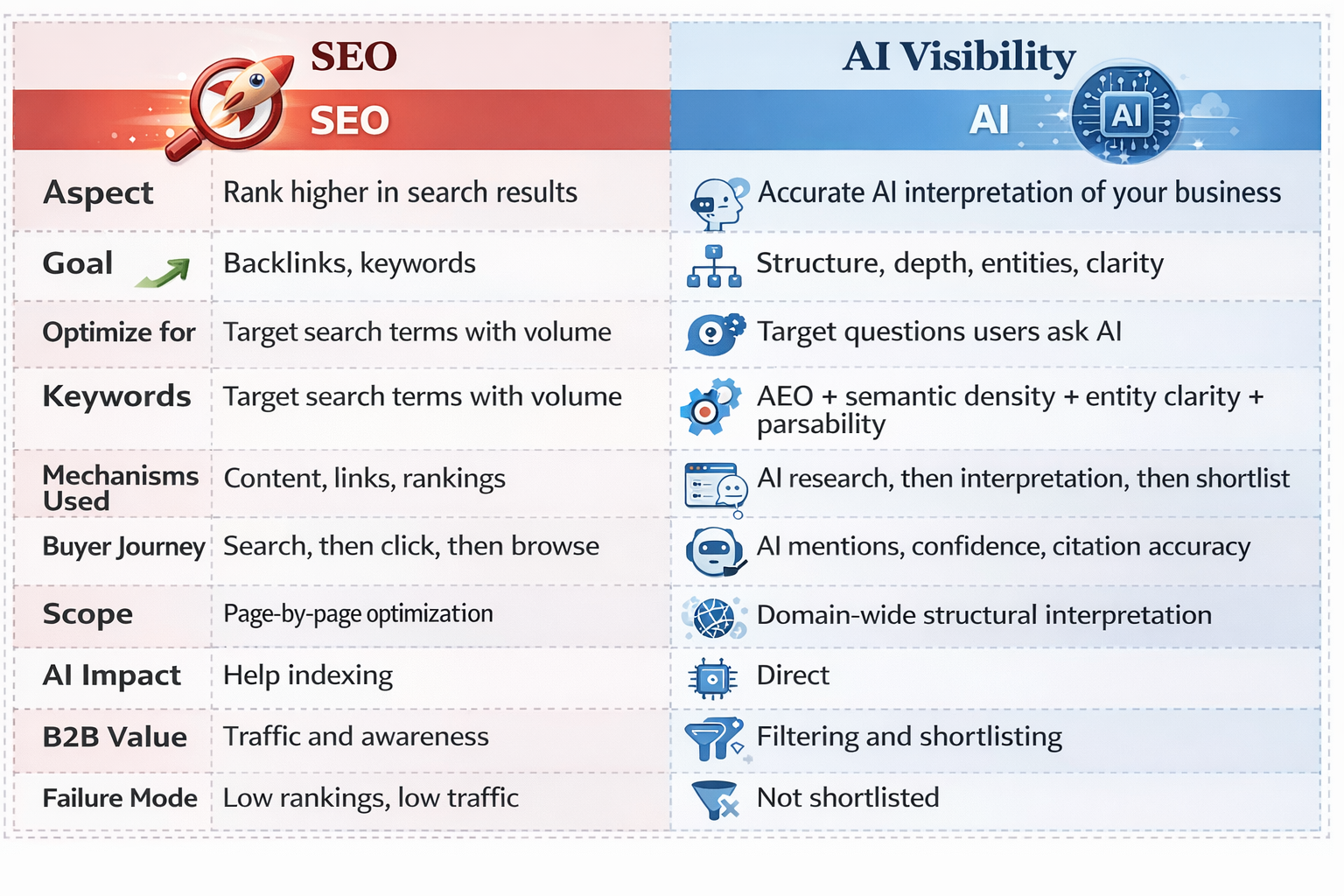 Future of Organic Discovery
We are now entering an era where discoverability is governed by intelligence, not indexation. The brands that win are often those that AI engines can understand deeply and trust completely. To get visibility in AI search results, your answers must be:
- Expert-powered: backed by credible leadership
- Trustworthy: validated by reputation and sentiment
- Structured: designed for context
- Machine-recognized: clearly mapped as an authoritative entity
Ultimately, the future of search is not just about replacing one method with another. Rather, it is about creating integrated approaches that meet users wherever they are in their information discovery journey. And businesses that understand and adapt to this multi-channel reality.
FAQs: AI Search Visibility
How is the role of search changing in the AI era?
Search is moving from link discovery to answer delivery. Users now expect direct, contextual responses from tools like ChatGPT and Perplexity, so AI search visibility matters alongside rankings. That means brands need content that can be understood, trusted, and cited inside the answer, not just listed on a results page.
Why is structured content important for AI SEO?
Structured content makes it easier for AI systems to identify what a page is about and pull the right information from it. Clear headings, direct answers, clean page hierarchy, and well-marked entities improve AI SEO because the content becomes easier to interpret, summarize, and reference. Google also uses structured data to better understand page content and the relationships within it.
What is the difference between SEO and AI SEO?
SEO is mainly about helping pages rank and earn clicks from search engines. AI SEO goes a step further. It focuses on making content clear, credible, and answer-ready so it can influence AI-generated responses and earn AI brand mentions. In simple terms, SEO helps you get found, while AI SEO helps you get referenced.
Does schema markup help with ChatGPT and AI LLMs?
Schema markup helps by giving machines cleaner signals about page meaning, entities, and context, so it supports stronger AI readability. It is not a guarantee that ChatGPT or other AI LLMs will cite a page, but it can improve how content is understood across search and AI systems. At the very least, it strengthens the technical foundation behind AI search visibility.